It's an industry truism that professional tour guides love to tout their own destinations, sometimes coming up with prideful superlatives that can be a bit hard for visitors to swallow. It was, therefore, no surprise to hear our guide in Montpellier, in the southern French region of Languedoc-Roussillon, claim that the area is the largest wine-producing area in France.
"Of course, the quality isn't very good," she said cheerfully, to everyone's surprise, adding, "It is getting better, though."
This exchange was just our first taste of the nonconformist spirit that characterizes Languedoc-Roussillon, where vintners aren't afraid to experiment with new varieties of wine, chefs are adept at creating dishes from the abundance of local produce and locals speak their minds.
A repeat visitor's delight
We began our exploration of the region in Montpellier, which is a bit of a schlep from Paris. You can fly from a Paris airport, drive or do as I did and hop aboard the high-speed train from Charles de Gaulle Airport for the 3.5-hour, nonstop scenic ride.
 This is not the land of American franchise stores. English is not as widely spoken as in some other parts of France, and fast food has not caught on.
Instead, Montpellier offers a booming and diverse student population, thanks in part to several universities and medical schools; a highly regarded violin-making industry; and a beautiful central square, Place de la Comedie, that buzzes with sound and light shows on summer nights.
This is a region probably best suited to repeat visitors to France looking for a new territory to explore, said Cynthia Albright of International Travel Specialists in Geneva, Ill. Her clients who have traveled to Paris once or twice typically either want to branch out to Provence or the Riviera or are open to other ideas.
"Clients often learn about Languedoc-Roussillon through my suggestions," Albright said, adding, "I have mainly sent mature travelers who travel the region by rental car, but there is plenty for young travelers to enjoy, as well."
Because the region is known, in part, for its outdoor activities, we made a beeline for the countryside, stopping for the night at the two-star La Lozerette hotel in Cocures, a tiny town in the Lozere, a department in southern France. The cozy country property offers simple accommodations with beautiful views, excellent food and free, if spotty, WiFi.
In authors' footsteps
The next day we made our way to Le Pont-de-Montvert in the National Park of Cevennes. "Treasure Island" author Robert Louis Stevenson loved hiking in the area so much that he wrote about it in "Travels With a Donkey in the Cevennes," and a network of trails is now known at the Robert Louis Stevenson Trail.
Here, you can pick up the hiking trail for a half-day or extended hike among the steep gorges. Visitors can rent a donkey to carry their things -- or their young children -- for about $60 a day from here, or they can go fishing in the clean, mountain-fed water. In the winter, they can ski on 5,577-foot-high Mont Lozere, where easy family runs, cross-country trails and sledding areas are a good fit for families.
The town is known for its abundance of local artisans, some 30 of whom are represented in a miniscule gallery in the center of town that sells one-of-a-kind pottery, clothing and handcrafts at reasonable prices. Visitors can learn more about the ecology and history of the area at the Musee du Mont Lozere, located a short walk from the center of town.
After lunch at the Restaurant Adonis in the Tarn Gorges Hotel in nearby Floriac, we wandered through its streets, stopping to admire the works of local artisans.
An afternoon visit to the Gaballi vineyard in nearby Ispagnac followed, where visitors can take in views of the terraced vineyards, as well as taste and purchase wine at the wine cellar.
Travelers who like their country accommodations on the more lavish side will likely enjoy the Chateau de la Caze near the scenic town of Sainte-Enimie. The four-star chateau is regal without being oppressively opulent, and accommodations range from classical to modern, but all offered views of either the countryside or the rushing river. A highlight was the multicourse dinner at the property served in a banquet room with accompanying wines.
Natural wonders
Among the notable attractions in the Tarn Gorge area is the Aven Armand, a cave filled with enormous, eerily lit stalagmites. Once called the Devil's Mouth (because animals that fell in were never seen again), the cave is accessible via a funicular that descends about 160 feet into the ground, after which visitors follow a guide carefully on foot down steps and along pathways with banisters. The going is steep and a little slippery, but the descent is worth it to find oneself at the bottom dwarfed by a forest of immense, eerily shaped formations, some of which bear a resemblance to roosters, madonnas and -- my favorite -- Cinderella's castle.
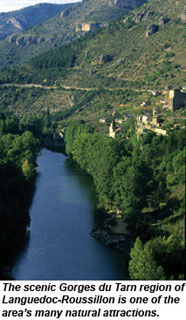 One thing to keep in mind when contemplating a visit to Aven Armand is that the ride to the site from the base of the gorge is along a switchback zigzag road that is either breathtakingly scenic or terrifying, depending upon your point of view and your comfort level with your rental car.
Also at the top of the gorge, foodies can happily spend an hour or two at Le Fedou cheese farm, where they can taste varieties of sheep's milk cheese accompanied by other local produce at picnic tables overlooking the sweeping valley below. Three of the best-known varieties of local sheep's milk cheese are peraldou, brique and especially tomme, often found on cheese trays in fine restaurants in Paris.
Back at the base of the gorge, the adventurous can try a down-river rowboat excursion via Bateliers de la Malene, where they can enjoy views of the gorge not visible from any other vantage point, followed by a multicourse meal at the 15th century Manoir de Montesquieu.
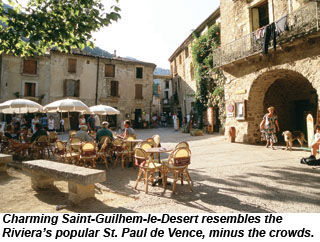
The last stop on our itinerary was Saint-Guilhem-le-Desert in the Herault department, which resembles the popular St. Paul de Vence in the Riviera minus the hordes of tourists. A historical abbey on a pilgrimage trail, an inviting swimming beach and a much-photographed Devil's Bridge are among the attractions, and visitors can also taste local wines and buy olive oil nearby.
The wines, by the way, were delicious.
For more on travel to Languedoc-Roussillon, check out www.sunfrance.com and www.franceguide.com.