Press reports of Rio de Janeiro's preparations for the 2016 Summer Olympics were already unflattering, ranging from unfinished venues to pollution problems.
Now, Brazil has the Zika virus to add to its list of Olympic woes.
"I haven't had any cancellations, but our interest level has completely plummeted in the past seven to 10 days, and we are attributing this to the Zika outbreak and the media coverage increasing," said Anbritt Stengele, president of Chicago-based Sports Traveler, which specializes in global sporting events, including the Olympics.
As Rio completes final preparations for hosting the Olympics from Aug. 5 to 21, concerns are mounting about the rapidly spreading Zika virus. Last week the Brazilian president's chief of staff, Jaques Wagner, advised pregnant women not to attend the Games following news that the World Health Organization (WHO) had declared the Zika virus and the clusters of microcephaly and other neurologic disorders that have been associated with it an international public health emergency.
Public health officials have been working to establish the connection between pregnant women who contracted the mosquito-borne Zika virus and babies born with cases of microcephaly, or unusually small heads, as well as between Zika and Guillain-Barre syndrome, a rare disorder in which the body's immune system attacks its nervous system. And last week, health officials in Texas, where the first known case of Zika virus transmission in the U.S. was reported, said it likely was contracted through sexual contact, adding another element of concern.
There are now some 30 countries and territories throughout the Caribbean, Central and South America, the Pacific islands and even Cape Verde in Africa where the Centers for Disease Control and Prevention (CDC) has identified Zika virus transmission. (At press time, the CDC had not listed the U.S., aside from Puerto Rico, among the destinations with Zika transmissions.)
But much of the attention has focused on Brazil because of the high number of microcephaly cases that have been reported there -- 3,500 between October and January, according to the CDC.
And while Brazil has warned pregnant women of the risks of traveling to the August event, Olympics organizers maintain that there is no larger travel warning.
"There is no travel ban being pronounced by the WHO," International Olympic Committee President Thomas Bach said last week.
Bach also said the Games would take place during Brazil's winter, "not the preferred breeding time for mosquitoes."
These factors "make us very confident that at the time of the Olympic Games there will be good conditions for athletes and spectators," Bach said.
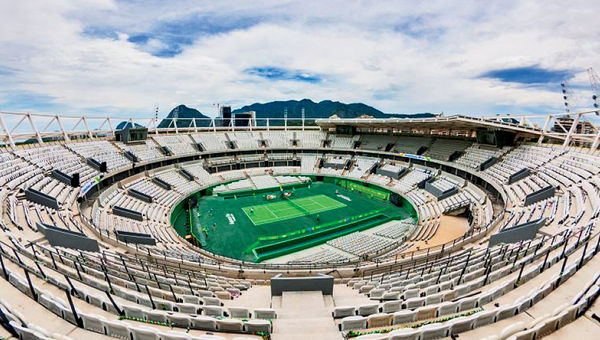
According to a Brazlian website, Olympic stadium construction is 80% to 100% finished. Photo Credit: Alex Ferro/Rio 2016
Olympics travel
The Olympics is often touted as an opportunity to showcase a destination before and during the Games, something Brazil did quite a bit of during the World Cup two years ago. Zika is clearly disrupting the traditional promotional period for Brazil.
While it is still unclear what the overall impact of Zika will be for Brazil as a destination, as far as the Olympics is concerned, operators say enthusiasts and supporters of the athletes will go, no matter what.
"We are definitely continuing to write new orders at a fast pace, and not one previous client has canceled because of the outbreak," said Brian Peters, managing director of Austin, Texas-based BucketList Events. "In fairness, a significant percentage of our clients are families of the athletes, and even a zombie apocalypse wouldn't keep them from making the trip."
Peters called Olympics bookings "very steady" and said the company would host a similar number of people, about 600, for the Olympics that it did for the World Cup.
"For some reason I do not understand, the U.S. media wants to make out Rio as a third-world destination," Peters said. "That is simply not the case."
Mark Cardoza, a travel consultant for Salem, Ore.-based Peak Travel Group, said Zika was "not a big concern" for his clients booked for the Olympics, but he cautioned that Olympics packages tend to be nonrefundable, so having travel insurance is key. (See related story, "Travel insurers: Most policies don't cover Zika.")
Zika aside, Stengele said one of the bigger challenges in booking the Rio Olympics was the sky-high prices for accommodations, limited hotel availability and difficulty in obtaining tickets to various events.
"I've had hotels offer us rates from $500 a night for a Brazilian three-star, all the way up to five-star hotels wanting $3,000," Stengele said. "There's a lot of two- and three-star hotels, so you put a real crush on that four-star demand. Brazil has not built enough hotels to accommodate [that demand]."
She also pointed to confusion regarding visas requirements. Earlier this year the Brazilian government said the U.S. would be part of a waiver program for travel between June 1 and Sept. 18, during which U.S. citizens wouldn't need Brazil visas.
"However, when I contacted my visa-services expert to find out more information, she said the details of how a traveler will register for this waiver program has not been released," Stengele said. "It's a very confusing situation right now."
All told, she said, bookings are a bit lower than what was anticipated for the Rio Olympics, but that in the last week, despite Zika coverage, she has still been getting new bookings, even if still fewer than expected.
According to Embratur, the Brazilian Tourist Board's marketing organization, Brazil is still expecting between 350,000 to 500,000 visitors to visit the country during the Olympics.
And in an effort to counter concerns about how far along Rio is in terms of overall preparedness for the games, an issue that was under the microscope before Zika stole the headlines, Embratur points to a website that is monitoring the progress of the venues, which indicates between an 80% and 100% completion status with seven months left before the opening ceremony in Rio's Maracana Stadium.