
Arnie Weissmann
Toward the end of my cover story this week about the ecological phenomenon "the Boiling River" and its potential for tourism, I wrote, "There is something about the Boiling River, the surrounding jungle and its residents that profoundly changed me and my relationship with the natural world."
While living in the jungle as I did for 12 days would likely bring anyone closer to the rhythms of nature, I was thinking about one incident in particular when I wrote that sentence.
Two days before I was to return home, I joined a few people for a jungle hike led by Ever Impicciatori Mesicomer, the proprietor of the Shanay Timpishka Ecolodge, where we were staying.
At one point in the hike, there was a steep, narrow descent to see an enormous 300-year-old lupuna colorada tree. Ever handled the descent with ease while the rest of us moved slowly and cautiously. When we rejoined him at the base of tree, he was weeping.
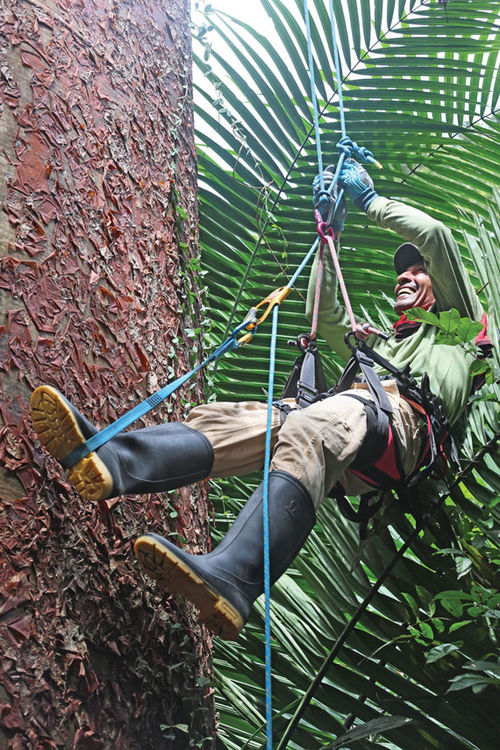
Ever Impicciatori Mesicomer climbing his beloved tree. Photo Credit: Arnie Weissmann
We asked what was wrong. He said he loved the tree and had made a promise to it that he would bring it to the attention of the outside world to help protect it from illegal logging. For a group of foreign visitors, including a journalist, to come visit it overwhelmed him with emotion.
Ever moved to the tree and, eyes closed tight and arms spread wide, hugged it. He stayed there as minutes passed. Some of us joined him in giving it a hug and when I did so, a strange thing happened. I immediately felt a sense of deep calm. It was physical -- my breathing slowed, and I sensed that my pulse did, as well.
I am not New Age-y, but thanks to my horticulturist wife I do have a relatively good understanding of the interconnectedness of the natural world. This, however, took communing with nature to a new level. It fixed me in a meditative state.
When we returned from the hike, I wanted to understand what was going on and sat down with Ever to talk about it.
He grew up not far from where the ecolodge is today. As an adult, he moved to Pucallpa, a large city in Amazonian Peru, and worked in the food service industry.
But when he turned 40, he returned to the jungle and discovered trees were being illegally logged. "I decided to leave everything behind -- my future, my profession -- because I felt the energy of the trees' spirit pulling me back," he said. "I decided to dedicate my life to them."
He went to that tree in particular and began "talking to it like a madman, telling it that I wished people from all over the world could meet you."
His experiences with the tree mirror what I felt. "When you hug a tree like that, you get something valuable in return. It has an energy that transmits tranquility and a sense of friendship. It brings you to a state of peace and calm, clearing your mind."
Later that day, word about Ever's attachment to the tree spread among members of our expedition, and Kathryn Naherny, an entomologist who had been climbing jungle trees to study arboreal stingless bees, offered to show Ever how to climb his tree the next day if he wanted.
He wanted. So most of us went to watch Ever get a new, higher perspective on his beloved tree. Not unexpectedly, the experience once again brought him to tears.
I don't know if there's a scientific explanation for the effect this tree has on Ever and had on me. And frankly, I'm hesitant to come out as a tree-hugger; I know how strange this all sounds. But if Ever believes that spreading the word about this tree will help save it, I'll do my part and go public about my unexpected dive into transformational travel.