
Arnie Weissmann
In 1993, during his graduate studies at the Cornell School of Hotel Administration, Calvin Stovall researched Black-owned hotels, resorts and motels from the 1700s to the present and wrote a 100-page monograph on the Black hospitality experience.

Calvin Stoval
After graduating, he worked his way through the industry to become vice president of marketing for Homewood Suites by Hilton.
He was cleaning out some boxes during the pandemic and came across his bound college monograph. A friend who was visiting asked to look through it, and when she finished, she gave him her verdict: "This is a book," she said.
He liked the idea, and thought, not just a book, but a fully illustrated coffee-table book. He did more research and expanded the monograph. He looked into self-publishing and found a printer who would produce high-quality books for $25 each.
He wants to order 3,000 copies for $75,000. To raise the funds, he brought the concept to the American Hotel & Lodging Association Foundation, which agreed to pick up half the cost if he could raise the other half. He said he's now 93% there, thanks to sponsors including Sheila Johnson, co-founder of BET and CEO of Salamander Hotels and Resorts; Ariel Investments; and the Los Angeles Tourism & Convention Board.
Editor's note: "Hidden Hospitality: Untold Stories of Black Hotel, Motel and Resort Owners from the Pioneer Days to the Civil Rights Era" is available now.
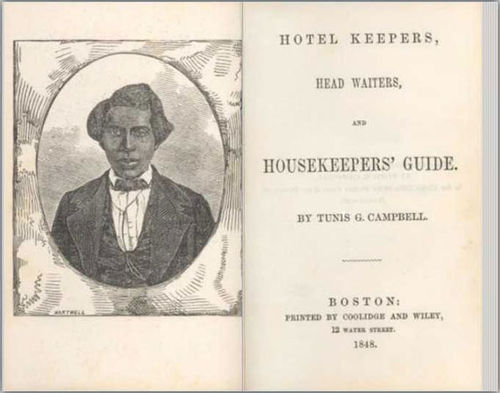
An image of Tunis G Campbell from Calvin Stoval's book, "Hospitality Historiography." Photo Credit: Courtesy of Hospitality Historiography
Stovall shared some of the pages with me, and I found them fascinating. Among the portraits he creates is one of Tunis G. Campbell, an abolitionist preacher who, in 1848, wrote what appears to be the first book published in the U.S. about how to run a hotel. Its title: "Hotel Keepers, Head Waiters and Housekeepers' Guide."
Also included in Stovall's book is John "The Baptist" Stradford, who in the early 1900s built a luxurious 54-room hotel in the Greenwood District of Tulsa, Okla., referred to today as "Black Wall Street." The hotel was burned to the ground in the infamous 1921 torching of the neighborhood by white Tulsans.
And there's James Wormley, who purchased a hotel just a block from the White House in 1871. Soon it was frequented by the rich and politically powerful and was one of the first hotels in the city to install telephones. Wormley had traveled in Europe, where he perfected his culinary skills, and the hotel became famous not only for its well-appointed rooms but for the European-style cooking in its restaurant.
Some of Stovall's profiles put a focus on a hotel itself. The Lord Calvert Hotel in Miami became the preferred property for touring Black artists in the segregated South (its motto was "Resort to the Stars"). Stovall coincidentally had a book of photos by Sammy Davis Jr., and, sure enough, he noticed that some of them were taken at the Lord Calvert.
Stovall calls his book "Hospitality Historiography." He's hoping to have it available by the next festive season.
• • •
I met Petar Krstic when he was resort manager of the Amanjena in Marrakech, Morocco. We saw each other a few years later after he was assigned to help open the Aman New York, and he reached out to me recently on LinkedIn to say he had left Aman and was now living in Geneva, employed as CEO of a hospitality company I had never heard of: Ultima Collection.
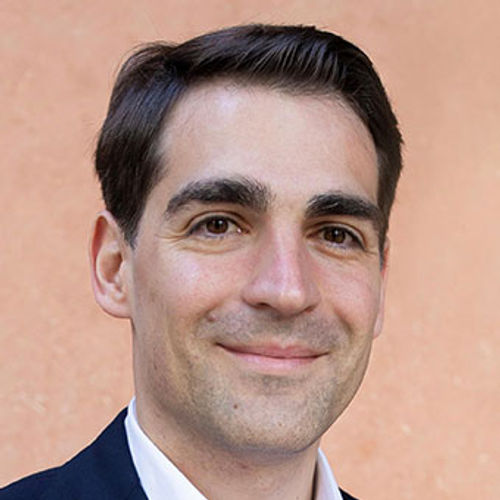
Petar Krstic
We Zoomed last month, joined by Ultima Collection chief commercial officer Sven Flory, and Krstic laid out the history of the company and what appears to be its unusual positioning.
The company owns and rents villas and chalets -- but not just anywhere, and not just any villa. At the top end, think $350,000 a week, 16-bedroom villas with on-property nightclubs or a teppanyaki restaurant, a commercial kitchen and a giant spa, staffed by butlers, chauffeurs, chefs, on-site management, massage therapists and, in the chalets, ski butlers.
"They're sizable," Krstic said. "The only things not included are alcohol and buckets of caviar."
As might be expected, they're found where wealthy people like to go: Gstaad, Crans-Montana and Geneva in Switzerland; Megeve, Courchevel and Cannes in France; Corfu in Greece.
Aside from its product profile, the company is unusual in that most villa owners don't set out to build a consumer brand, as Ultima is doing.
Krstic's ambition is to build up to 30 locations.
"We're looking to add St. Tropez, Capri, Amalfi Coast, Lake Como. Eventually, Zermatt and St. Moritz," he said. "In six or seven years, we'll cross the Atlantic -- Aspen, St. Barts, perhaps a penthouse in Manhattan."
He appeared unworried by the large number of villas popping up everywhere.
"There are dime-a-dozen villa rental companies out there, mostly on online platforms," he said. "Very few offer a cohesive brand."
So, you wouldn't put the villas on general villa booking sites? I asked.
"I hope never to have to," Krstic said. "That's the honest answer. Ideally, we want the position to be, similar to Aman, rare and difficult to attain."
Update: A link to Calvin Stovall Jr.'s "Hidden Hospitality: Untold Stories of Black Hotel, Motel and Resort Owners from the Pioneer Days to the Civil Rights Era" was added Nov. 13.
CORRECTED: This story was updated on May 13 to include the correct title for Petar Krstic while he was at the Amanjena in Marrakech. Krstic was resort manager there.