One of the newest Unesco World Heritage Sites, the Marquesas Islands of French Polynesia, is still relatively untouched by tourism.
I first traveled there back in 2018, and one of the first things I noticed on that trip was that most visitors arrive via cruise ship, such as the combination passenger/cargo ship Aranui 5, which makes frequent circuits from Tahiti (Windstar Cruises and Paul Gauguin Cruises also operate in the region).
I recently returned with Aranui Cruises because I wanted to see what the experience was like and because the ship visits some islands, like Fatu Hiva, that don't have airports and are otherwise inaccessible.
What I discovered was that the experience was completely different: Although the Aranui 5 is a small ship, accommodating just 230 passengers, it still unleashes a small torrent of visitors whenever it calls at the sparsely populated islands (Fatu Hiva, for example, has around 600 residents). And while I enjoyed the "boat day" atmosphere, with the entire community turning out for demonstrations or to sell crafts, I found myself missing the ethereal silence of the islands that I'd enjoyed on previous solo visits.
Here's what to know when planning foreign independent travel to the Marquesas Islands.
Getting to the Marquesas
There are six inhabited islands in the Marquesas group. The administrative centers on Nuku Hiva and Hiva Oa are served by Air Tahiti and Air Moana. Christina Turrini, a certified Tahiti specialist with VWT by Chase Travel recommends booking Air Tahiti's Marquesas Pass for fare savings when clients are traveling to both Nuku Hiva and Hiva Oa. Visitors traveling to the smaller islands of Ua Huka and Ua Pou can also be booked on Air Tahiti via Nuku Hiva, where a smaller aircraft provides onward connections.
Where to stay
There are two resorts in the Marquesas: Le Nuku Hiva by Pearl Resorts, a Relais & Chateaux property in Taiohae on Nuku Hiva, and Hanakee Lodge on Hiva Oa. These islands, and the smaller islands in the group, also have pensions (guesthouses) available, which offer a range of accommodations from private rooms to private bungalows, typically with table d'hote, (family-style meals) included.
Touring Nuku Hiva
Whether booking hotels or pensions, the hosts can make arrangements for tours during the stay. On Nuku Hiva, a popular excursion takes visitors through the lush valley of Taipivai to the picturesque pitons of Hatiheu, where there is also a preserved archaeological site. Visitors can alternately take a boat to the small village of Hakaui, set under towering sea cliffs in a hidden bay.
On my solo trip to Nuku Hiva, as I slowly strolled the two-lane divided avenue fronting the black sand beach of the bay at Taiohae, I happened across a horse that had broken free, still with the rope attached to its bridle, standing resolutely at a bus stop as though waiting for the next one. There was virtually no traffic aside from the odd cyclist or pedestrian en route to one of the snack shops or general stores dotting the waterfront, and nobody seemed at all bothered by the bus-hailing horse.
Le Nuku Hiva arranged a car trip to Hatiheu with another Tahitian couple, and we took in the view of the pitons as we lunched from the sole occupied table in a popular local restaurant. We were similarly the only occupants of the artisanal craft center in Taipivai, where we perused items carved from garnet phonolite or "flower stones," a type of rock with a naturally occurring flower burst pattern, mostly imported from the neighboring island of Ua Pou.
Touring Hiva Oa
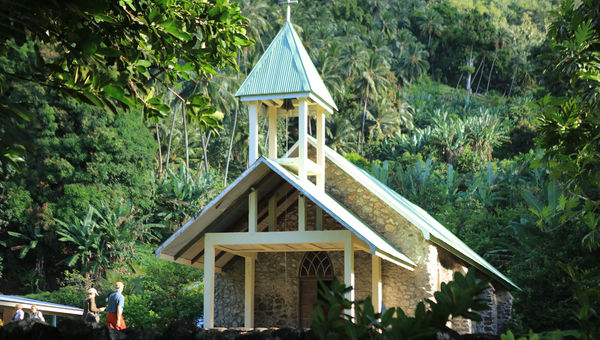
A small community church in the village of Hapatoni on the island of Tahuata. Photo Credit: Tahiti Tourisme
From Hiva Oa, popular excursions include visits to the giant tikis in Puamau (Tahiti specialist Turrini calls visiting them a "humbling experience that stays with you long after returning home"), or a boat excursion to Tahuata, a neighboring island for swimming. Travelers can also visit the villages of Hapatoni (known for bone carving) and Vaitahu, with its open-air stone church, museum and local market.
In the town of Atuona, there's a new craft market (resort or pension hosts can advise on opening hours), and most city sightseeing excursions include a stop at the hilltop cemetery where Paul Gauguin and Jacques Brel are buried a few yards from each other. Both the artist and singer have their own small museums in town.
Ua Huka and Ua Pou islands
The smaller islands of Ua Huka and Ua Pou are even quieter and more tranquil. The owners of the pensions on these islands will often take the lead for arranging activities, such as hikes or horseback riding.

The endangered pihiti bird only exists on the island of Ua Huka. Photo Credit: Tahiti Tourisme/Viki Ura
On Ua Huka, birders can seek out the rare pihiti (also known as the ultramarine lorikeet), which exists only on that island, and meet the specialized rat-hunting dog that monitors all boat arrivals to ensure the island remains free of pests that could threaten this critically endangered bird.
The value of working with a local destination specialist
Destination specialists can add value for advisors working through individual itineraries in the remote Marquesas. Calling a specialist can especially smooth the ways when working with a pension, as some of the smaller operators don't directly take credit cards and prefer payment in local currency or a bank transfer, which can be difficult to arrange for U.S. advisors.
Turrini says she typically works with Tahiti Travel Services, particularly when booking an accommodation she hasn't recently visited.
Raphael Bernard, CEO of Tahiti Legends, notes his agency books accommodations and experiences on Hiva Oa and Nuku Hiva, but also recommends an Aranui Cruises sailing to visitors wanting to see all six of the inhabited islands in the Marquesas.
Specialists can also assist with stopovers on Tahiti, which are generally necessary for visitors coming directly from North America. Flights to the Marquesas typically depart Tahiti's Faa'a Airport in the very early morning, making same-day connections impossible.
Destination specialists also have their thumb on the intricacies of travel in this remote island group. On smaller islands like Ua Huka and Ua Pou, for example, tourist facilities like souvenir shops are normally only open on days when ships are in port, or by appointment, and specialists usually have these details available, along with knowledge of local transport schedules for help with logistical planning.