VANCOUVER -- In the age of sustainability, this is the new
sexy: a fluorescent-lit room deep in the
interior of a cruise ship with several powerful fans and white cases with racks
filled with blue blinking LED lights.
The fans are to keep the room cool, dissipating the heat
from dozens of electrical storage batteries.
The room is found on Hurtigruten's Roald Amundsen, the world's
first hybrid electric cruise ship.
You don't have to be around Hurtigruten CEO Daniel Skjeldam
for very long before he starts waxing poetic about the beauty of batteries.
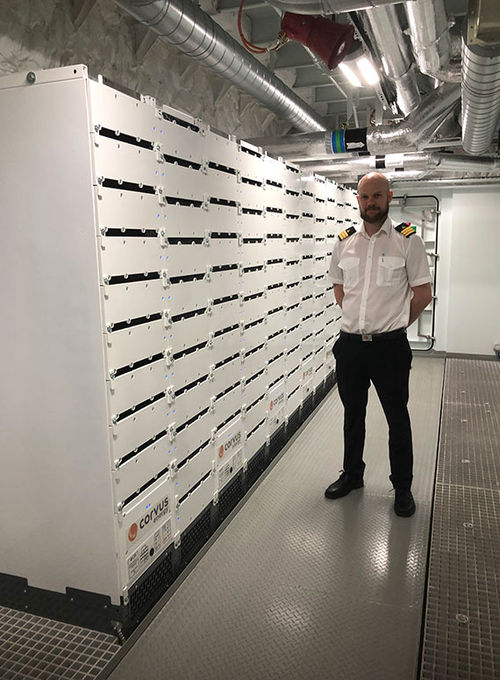
A ship's engineer on the Roald Amundsen in one of the two battery rooms. Photo Credit: Tom Stieghorst
"We like to say she's electrifying," Skjeldam said
at a press conference here aboard the 530-passenger vessel named for polar
explorer Roald Amundsen. "This is a ship that opens a new chapter in
maritime history."
Battery power, still in its infancy, enables the
460-foot-long ship to cut its emission of air pollutants by 20%, Hurtigruten
says. It's still far away from being able to power a ship for an entire cruise,
however.
The Roald Amundsen can cruise on batteries alone for 20 to
30 minutes. In practice, it doesn't happen that often. Engineers on the
Amundsen say that by using the batteries to meet surges in power demand, they
can operate the engines at maximum efficiency. So called "peak-shaving"
employs fewer engines run at a level speed, day and night, storing power for
those moments when it is needed.
Ships have multiple engines. An off-line engine kicking into
action produces a surge of nitrous oxide, soot and other harmful emissions.
Keeping that from happening is another way that battery power reduces
pollution.
Skjeldam said that emitting less pollutants is especially
important for cruise lines that spend a lot of time cruising in pristine Arctic
and Antarctic waters. "We are very, very focused on walking the walk. You
meet a lot of companies that talk the talk. They're about talking about
everything they're going to do in the future, but they're not so interested in
talking about what they are doing now. We are the opposite."
The batteries that partly power the Roald Amundsen were
developed by a Norwegian/Canadian company called Corvus Energy, which also has
an agreement to provide batteries to German line AIDA Cruises.
Skjeldam said the Roald Amundsen and sister ship Fridtjof
Nansen have a lot of extra space built into their battery rooms so that
additional racks can be installed. "The way the ship operates today, we
don't need more batteries, but we're envisioning a lot to happen in shore
power, a lot will happen in the years to come, so that is why we're setting
aside more room," he said.
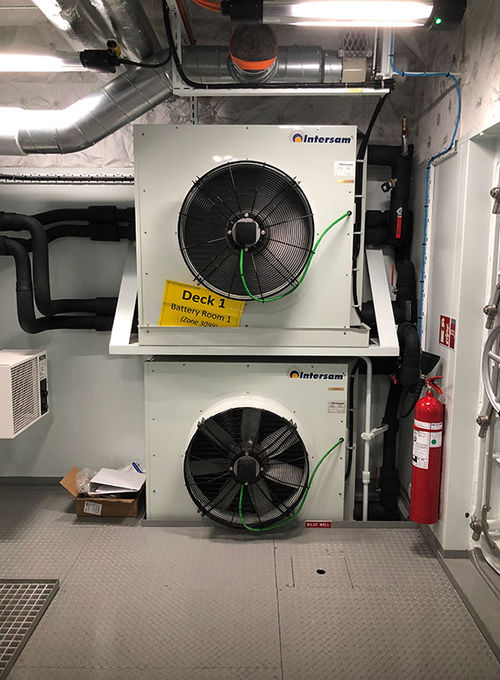
Powerful fans cool the battery rooms on the Roald Amundsen. Photo Credit: Tom Stieghorst
Corvus is reporting that its next generation of batteries
will be an improvement of nearly 400% over those supplied to the Roald Amundsen
when it was designed four years ago.
In Hurtigruten ships used only on the Norwegian coast and
not for international expedition duty, the company will begin experimenting
next year with biofuel made from fish farm waste.
"We think at the moment the future is more likely to go
in that direction than in the direction of ships that operate only on
batteries," Skjeldam said.
When re-reading some of Amundsen's old papers, researchers
for Hurtigruten came across a passage he wrote in 1882 as a 10-year-old,
envisioning electric ships that could break through the Arctic ice to reach the
pole.
"What an inspiration!" Skeldjam marveled. "Our
plan is to sail 100% emission free in the future," he said. "It is
not possible today, or we would do it. But we think this will be possible and
is not too far away from reality."