A resort's success in the unglamorous arena of solid-waste management rarely defines its appeal as a top vacation spot.
In fact, that commendation probably would be the last thing that would make or break a traveler's decision as to where to head for sun, sand and sea.
Jake Kheel, environmental director of the 355-room PuntaCana Resort & Club, a resort and real estate community in the Dominican Republic, thinks otherwise.
"Sustainable tourism in all its aspects, including solid-waste management, is a hot topic as more travelers are introduced to environmental practices that impact their lives and their vacation time," he said.
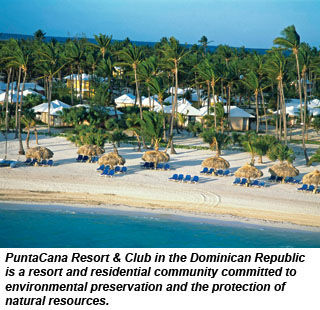 The PuntaCana Resort complex could write the book on sustainable tourism development, according to Kheel.
Its founders recognized that tourism had to be environmentally and socially sustainable to be profitable over the long term.
Kheel said that when the resort built its first beach cottages in 1971, developer and parent company Grupo PuntaCana built an elementary school at the same time for the children of its employees.
The resort's design and construction used only local materials, no building was higher than a coconut tree "and these traditions of social and environmental concern have been guiding principles ever since," according to Kheel.
In 1994, the PuntaCana Resort & Club helped set up the PuntaCana Ecological Foundation and donated 1,500 acres to be set aside in perpetuity for conservation, research and recreation. That was followed in 2001 by the launch of the PuntaCana Center for Sustainability and Biodiversity, which now runs research and educational programs to support the sustainable development of the entire Punta Cana region, including reef conservation and the protection of coastal resources.
In fact, the PuntaCana Resort & Club now encompasses 15,000 acres and includes the 15-villa Tortuga Bay complex, the 240-room PuntaCana Hotel, the Six Senses Spa, the PuntaCana Ecological Foundation, three residential communities, a marina, seven restaurants, an 18-hole designer golf course and the Punta Cana International Airport.
The entire Punta Cana region is a big one, to be sure. Total room inventory will top 27,000 units in the next several years in properties that range from boutique inns to complexes that include hotels, residences, villas and condominiums.
The airport in Punta Cana presents additional environmental challenges. "The impact of more than 2 million passengers a year passing through the airport is huge," Kheel said.
A recycling program spearheaded by the PuntaCana Resort & Club is now in place at the airport and is being adopted elsewhere.
"There's been huge growth and lots of big development in Punta Cana, which brings new challenges," Kheel said.
One challenge, according to Kheel, was to encourage other developers, owners and investors to sign on "and get environmentally involved for the betterment of the entire region."
PuntaCana Resort & Club continues to set the bar very high. For example, its resort villas employ design elements, such as solar heaters for hot water, and high ceilings and tall windows to delay the need for artificial lighting during the day and early evening.
The Six Senses Spa was honored by the Green Globe Benchmarking program for commitment in energy and water consumption, community involvement and environmental policy.
"This resort built the first water-treatment facility in the region in 1992; our golf course was the first in the Dominican Republic to use hybrid grass, which means we can use seawater and recycled fresh water to water the greens," Kheel said.
And then there are the worms. The resort runs a composting operation using more than 500,000 worms, which can process 500 pounds of organic waste a month.
Its beekeeping project includes 30 bee boxes that produce 15 gallons of honey a month, which is sold to homeowners and used in resort restaurants.
The 1,500-acre Ecological Reserve offers trails, hiking paths, birdwatching, experimental gardens, a petting zoo, natural swimming lagoons and protected sea turtle nests. Kids who attend the Carrousel Club learn about indigenous plants and animals and how to protect the environment.