In 2004, while onboard a Princess ship, Norma McClellan, an outside agent with Sunrise Travel in California, paid $212 for a print signed by a Polish artist, Magdalena Greene.
It was the second time she had purchased art in an auction onboard a cruise ship.
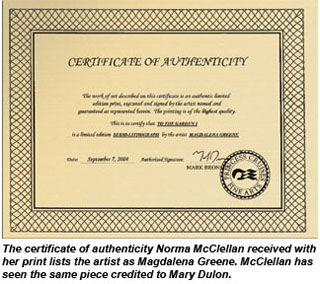 The paperwork she was given authenticating the piece, titled "To the Garden I," identified the artist as Magdalena Greene. But sometime later, while looking around on art websites back home, McClellan was shocked to see the same exact piece being sold as the work of an artist named Mary Dulon.
McClellan said she contacted Princess, where a spokesman referred her to Global Fine Arts, the company that operates auctions aboard Princess' cruises.
Thus began a two-year quest to authenticate the print. McClellan said she was contacted once, but never given the information she requested, before she finally gave up.
"According to all information I have collected, the picture was done by Mary Dulon," McClellan said. "I cannot find anything that says that these two names are one person. All I was asking for is some documentation that says they are one and the same. I do not understand why they were so reluctant to provide that."
Princess last week provided Travel Weekly with a letter from Larry Winn, the CEO of Grand Image, the Seattle-based publisher of the print in question, dated December 2006, stating that "the artist Marysia Zielinska ... also worked under the name Marysia Burr (married name -- since divorced), Magdalena Greene and Mary Dulon (studio name). ... In 2003 Grand Image contracted Marysia to create six images. ... This is standard practice and I can attest to the certainty of the size of the edition that Marysia did indeed sign these under Magdalena Greene."
McClellan said she was never given that letter; Princess said that it had verbally informed McClellan of this information.
"We had a phone conversation with her to tell her our findings," said Princess spokeswoman Julie Benson. "We are unaware that she continued to have questions about the artwork or its authenticity after our conversation, and she did not recontact us after November 2006. We are surprised to learn that now, two years later, she believes her question has not been answered. At the time, we would have been happy to provide her with the documentation regarding her artwork, had she asked us to provide it."
McClellan said she did ask for it and was repeatedly ignored. And she is not a typical Princess customer. She is a Commodore-level graduate of Princess' online educational program and a self-described fan of the line who still sells their cruises.
"I support them," she said. "I didn't want my money back; I just wanted clarification. If I sell [the print] to somebody, I just want to be able to sell it under the proper pretense or proper name."
McClellan's story is one of many that have made cruise ship art auctions increasingly controversial, especially following a critical New York Times report this summer.
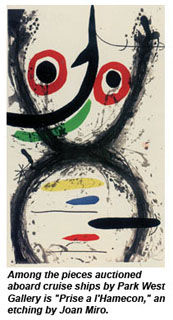 The Times article took aim at Park West Gallery, an art auction company that operates on 85 cruise ships, citing customers' allegations that the art they had purchased from Park West while on cruise ships was not worth anywhere near the value claimed by Park West auctioneers.
The passengers also claimed that some work attributed to famous artists, including Salvador Dali, was not genuine. Those are among the complaints in three current class actions against Park West in Florida, California and Washington state.
Park West Gallery operates on sailings of Carnival Cruise Lines, Disney Cruise Line, Holland America Line, Norwegian Cruise Line, Oceania Cruises, Regent Seven Seas, Celebrity Cruises and Royal Caribbean International.
Global Fine Arts has also been sued by customers alleging that their art valuations are fraudulent.
Many travel agents have long had reservations about art auctions and have steered clients away from them. Some state outright that cruise lines should get rid of them.
"It's something that really should go out," said Peter Dallo, president of Tourservice Custom Travel Experts in Hendersonville, N.C. "It doesn't belong there. ... We can understand that some lines can use the money, but when you start getting to [higher-end lines], it's disgusting."
Dallo said that the Times article had confirmed what he already suspected: that the art couldn't possibly have the value the auctioneers say it does.
"I had some clients [on a high-end ship], and they went to an art auction and said, 'What kind of junk is this and what kind of fraud is this?'" Dallo said. "Who in their right mind would believe there are Rembrandts and Picassos and Dalis on a ship, of all places?"
Park West defends both its business practices and its products. The company, which has been in business for 40 years, sells 300,000 works of art per year, mostly on cruise ships, and claims 1.2 million "satisfied customers."
In a letter responding to the Times story, Albert Scaglione, Park West's CEO, wrote, "In Park West's 40-year history, we have never sold a nonauthentic work of art.
"Park West guarantees the authenticity of every work of art it sells. The artwork we sell comes primarily from the artist's studio, and we use the world's finest experts to authenticate all others."
Scaglione also said that the Times article had failed to note "what is widely known in the art world: Market values cannot be based on what happens in a single auction sale on one specific day."
Two weeks ago, Park West made a sweeping change to its "all sales final" policy, though it insisted that the change had nothing to do with bad press. The company now gives customers 40 days to return their art purchases and 40 months to exchange them.
 Albert Molina, head of the Park West Gallery cruise line division, said the policy had been piloted on four cruise ships a year ago and was deemed successful.
"No auction house offers anything like this," Molina said. "We don't think it's only the best in class; we think it's phenomenal in retail in general. Where can you go and buy a watch or furniture and have this sort of policy?"
The program will be implemented this month for both sea and land auctions.
The 40-months provision enables the original buyer to exchange any artwork for any other artwork of an equal or greater price in the Park West collection, the company said, up to 40 months from the date of the invoice, with the buyer paying only the difference if the new piece is more expensive. The 40-days policy enables the buyer to obtain a refund for the full price of the art, less the buyer's premium, which is 15% of the purchase and which will not exceed $1,000 per piece, within 40 days.
For the cruise lines, art auctions represent onboard revenue, which has become an increasingly larger part of their top line, especially since ticket prices are actually lower now in real dollars than they were 20 years ago.
The lines earn revenue on each piece sold onboard, and like other onboard concessionaires, such as gift shops and spas, the galleries also guarantee a minimum in return for the onboard real estate they are given.
Dallo said he understood that ships needed the revenue from the art auctions, but said there was too much emphasis on the auctions. He contends that they are given prime time slots when passengers would benefit more from lectures about the ports they are visiting.
Those informative sessions, Dallo said, "get relegated to offbeat times because these art things get the main time."
The art auction has come to take a central role among onboard activities. The ship's corridors are festooned with displays of art offerings, and almost daily, a flier is distributed, touting free champagne at the next auction.
But beyond revenue, the cruise lines say that passengers enjoy the events.
 "It is one of the highest-rated entertainment services that are on ships," said Rick Sasso, president of MSC Cruises USA and former president of Celebrity Cruises. "It has artistic value, commercial value. It also creates camaraderie, people getting together in the lounge to participate in an event onboard. People don't get the chance to go to art auctions at home. Ninety-nine percent of people say, 'I love it.' "
Regent said in a statement that the auctions are "considered by many to be a positive addition to the cruise experience. ... To date, guest satisfaction ... has been positive."
Some travel agents, especially those who send their clients on high-end cruise ships, said the art auction problems have not become an issue because their clients are too savvy to buy art at them.
"Most of my clients don't even attend," said Kris Krenz of Pak-N-Go Cruises and Tours in Brick, N.J. "If they go, it is for the free champagne and to people-watch."
Krenz said he had not had to caution his clients against attending the events, but he added that he might now have to.
"It may be a good idea," he said. "I do this for dolphin encounters. If you love dolphins and know the facts, you would never go to an encounter."
A top producer for Crystal Cruises and Regent Seven Seas said people on those brands should know better.
"It's buyer beware," she said. "None of my clients buys art on cruises. If someone spends $30,000 on a painting, they should know what they are doing, or know not to buy it on a cruise ship."
But among cruisers who did purchase art on a ship, then regretted it, some were surprised to learn that the cruise line itself would initially play no role in attempting to resolve their issues.
Using outside vendors is a common business practice in hotels and airports, as well as on cruise ships. But because the ship is such a contained world, a problem with onboard vendors reflects on a cruise company in a more personal way than a bad experience at an airline terminal Starbucks would reflect on the airport.
As comments from cruisers on Web forums and in newspaper and magazine articles show, when passengers experience a problem with any onboard product or service, they expect to be able to turn to the cruise line for a resolution. Many are surprised and disappointed to be referred directly to the vendor.
Every cruise line interviewed for this report said that if a passenger has a problem with an onboard vendor, he or she is referred to the vendor to resolve it. But on rare occasions, the lines said, they will step in to try to facilitate a resolution.
"We hold vendors to the same high standards and code of conduct to which we hold our own crew members," said Tim Gallagher, spokesman at Carnival Cruise Lines, an assertion echoed by most cruise lines. "If a guest has an issue with a vendor that they are unable to resolve with that vendor onboard and they contact us, we will get involved and attempt to get the complaint resolved to the guest's satisfaction."
T he cruise lines all insist that they work with the vendors in such respect.
Michael Sheehan, a spokesman for Royal Caribbean Cruises Ltd., the parent company of Celebrity and Royal Caribbean International, said, "Both our company and Park West want happy and satisfied customers. Should a case arise where a customer is not satisfied, we work with Park West to resolve the matter in a manner that is mutually agreeable to all parties involved. This is also the case in situations involving other vendors."
The New York Times article told the story of a Regent passenger who said that he had spent $73,000 with Park West on prints by Picasso and Dali that he said had later been appraised for about $10,000 when he returned home. He was also told the Dali signatures could be fake.
Regent said that it would "monitor the activities surrounding the display and sale of art aboard our ships to ensure that we continue to deliver the acclaimed cruise experience expected by our guests."
When asked if Regent took responsibility for issues its passengers have with its concessionaires, spokesman Andrew Poulton responded in an email: "While RSSC does not 'take responsibility' for any issues or concerns of our guests regarding our onboard concessionaires, it is obviously in our best interests to do whatever we can to ensure a high level of guest satisfaction in all areas, and if appropriate, we will assist guests in the resolution of such issues."
Mary Jean Tully, a top producer for high-end cruise lines, said that cruise ship auctions had never been an issue among her clientele because they don't buy art on ships.
But if there were an issue with the art, she said, she would expect the cruise line to help the passenger resolve it.
"A company like Crystal or Regent, I think the cruise lines would stand up and protect the client," said Tully, while onboard the Crystal Cruises top producers event. "You should get what you pay for."