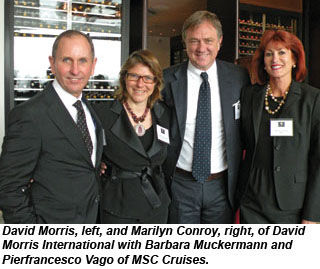
NEW YORK — It was an unlikely convergence: MSC Cruises, still relatively unknown and not considered a luxury brand, and David Morris International, a travel marketing firm that focuses on upscale cruise products.
Yet there they were, entertaining members of the press in a private dining room overlooking Central Park.
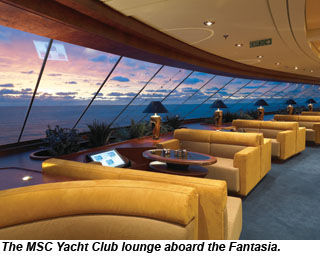
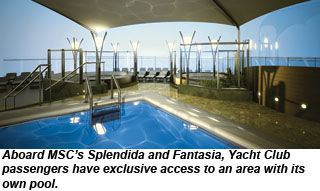
The gathering was part of a major brand campaign MSC Cruises launched to tout the MSC Yacht Club, the line’s ship-within-a-ship concept that gives passengers in 77 suites a private area with its own pool, sun deck, private restaurant and butler service.
 If it sounds familiar, that’s because it’s similar to the luxury accommodations on Norwegian Cruise Line’s private, ship-within-a-ship complex. The biggest difference may be that in the Yacht Club, alcoholic beverages and specialty coffees are included at the Yacht Club bars, restaurants and in the suite minibars.
The MSC Yacht Club, launched in early 2009, was built on the line’s two newest and largest ships, the Splendida and Fantasia. The suites and other facilities take up two of the ships’ forward decks.
The Yacht Club cabins are larger and more luxuriously appointed than those on the rest of the ship, MSC said.
To launch this very small part of its overall product in North America, MSC decided to outsource the sales and marketing of the Yacht Club to upscale specialists David Morris International.
David Morris, along with Marilyn Conroy, both formerly of Silversea, launched DMI after leaving the luxury cruise line last year.
DMI’s clients include several small, upscale cruise products such as Tahitian operator Paul Gauguin Cruises, Australia’s Orion Expedition Cruises and Windstar Cruises.
With the MSC Yacht Club, the group is in the rare position of handling only one part of a line’s sales. Within this platform, agents who call to book the Yacht Club will have a separate reservation line with separately trained res agents.
 For DMI to take on the MSC Yacht Club took some persuading from MSC.
Morris and Conroy, who also worked together at Cunard and Crystal, were initially wary of the luxury billing for a product whose parent brand, MSC, didn’t have a reputation for luxury in the North American market.
"We weren’t sure we’d do it at all," Morris said."We liked the concept. We had to try the product."
Morris and Conroy embarked on a Mediterranean cruise aboard an MSC ship last fall, staying in Yacht Club accommodations. They came away convinced.
"We know luxury and what it is," Conroy said. "This is a luxury experience that happens to be on a big ship."
Now they are tasked with conveying this to the luxury travel specialists they have worked alongside for so many years.
"The challenge is explaining what the Yacht Club is and how it’s different," Morris said.
This is especially true because despite several years of marketing to North Americans, MSC has not gotten the awareness it wanted here. Its executives admit that knowledge of the product continues to be low, and that where there is awareness, it is not necessarily good.
"The original positioning of the MSC product in the U.S. was not optimal," said Barbara Muckermann, head of MSC’s corporate marketing office, and also formerly of Silversea.
Muckermann explained that MSC is considered a premium cruise product in the Med, but that in the U.S., where it competed with price in the Caribbean, the trade and customer base here considered it mass market.
"We need to grow in the U.S. and to position ourselves as a premium product," she said. “Awareness is really low here. We need to make the investment and spread the word."
Muckermann said that by investing so heavily in the launch of the North American marketing campaign for the Yacht Club, MSC is hoping to re-create the brand’s overall image here. Its sales strategy, she said, is based almost entirely on travel agents, who book more than 90% of MSC’s worldwide sales.
 According to Morris, the lack of awareness here can be a good thing when dealing with the trade.
"Travel agents don’t know MSC, and they don’t understand it," he said. "That is good and bad. It’s good because we can define what the Yacht Club is."
The downside is the challenge of asking consumers to pay upscale product prices for a product not considered upscale.
MSC said the pricing is about 10% less than an Oceania Cruises trip.
Conroy said the product needs a lot of explaining.
"[Agents] say, 'I don’t get it,'" she said. "Once they do get it, they understand the need for it. They are hearing so much from their clients that they are getting bored on the small ships and that they want to have something for the kids to do."
Conroy said for the Yacht Club, they are going after "the upcoming baby boomer, not the aging baby boomer."
Morris said the product is still evolving, and that he and Conroy will cruise again this month. They said MSC’s management made changes after their first visit, such making the restaurant exclusive to Yacht Club guests and revamping the menus.
"We are committed to getting it right," Morris said.