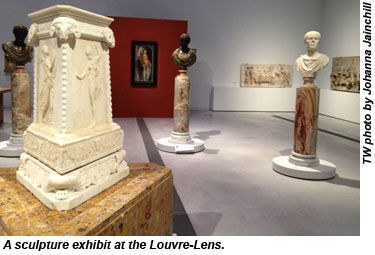
 LENS, France — The Louvre, arguably the word’s most famous art museum, tomorrow will open its first sister museum, the Louvre-Lens.
Henri Loyrette, president of the Louvre, told press attending a sneak preview of the museum, that the new Louvre gives the museum an opportunity to "rethink its vocation, to consider its collections and to step outside of its walls and look at itself from a little distance."
The Louvre, known for being the home to Leonardo da Vinci's Mona Lisa painting and the I.M. Pei-designed glass-and-steel pyramid at the entrance, has been around since its establishment during the French Revolution in the late 1700s.
The nation decided almost ten years ago to build a sister museum in another region of France. Lens was an unlikely choice to become the site of the next "museum of museums," as the Louvre is sometimes called.
Noting that Lens is in the heart of “a coal region, a city that has been through all manner of crises and wars”, Loyrette said Lens was chosen in part for how much it has suffered — through both World Wars, the demise of the mining industry and now as one of the poorest towns in France.
“It was important for us to bring the Louvre to a place that needed educational and cultural input,” he said.
He also noted that the region, the Nord-Pas de Calais, is reputed for its cultural vitality and the density of its museum networks, and is ideally situated “at the crossroads of Europe, near Belgium, Great Britain and Germany.”
“It’s very important for Lens and also for the future of Louvre,” he said of Louvre-Lens.
Built on the site of a former coal mine, the building was designed by Japanese architects from Sanaa, Kazuyo Sejima and Ryue Nishizawa. They created a low structure with five brushed steel wings shooting off a glass central entry point.
Noting that the two museums will display much of the same art but in a different manner, Loyrette said the Louvre in Paris is like an “encyclopedia of art history.”
“Here there is a different presentation of art,” he said. “Lens will be a laboratory for the Louvre.”
Both museums will have “some of the greatest works of art” in the world, he said.
Daniel Percheron, president of the Nord-Pas de Calais region, said he hopes the museum will have the same effect on the region that the Guggenheim did for Bilbao, Spain.
In its first year, tourism officials expect 700,000 to visit the museum, tapering off to about 500,000 during the following years.
“This will revive the local economy,” he said. “It presents regional opportunities. ... The mines were closed for many years, and now this museum opens. The Louvre will be the soul of the region.”
Follow Johanna Jainchill on Twitter @jjainchilltw.