It is no wonder that a mention of the German state of Mecklenburg-Vorpommern, undoubtedly a mouthful in any language except the recondite native tongue, rings no bells with typical American travelers.
After all, M-V was effectively verboten to the West from World War II's end, when the Communist regime held sway over this largely agricultural region and its Baltic Sea port cities, until the Berlin Wall came tumbling down in 1989 and reunification became a fact of geopolitical life.
Although the allure of the region’s many attractions has again made it one of Germany's most popular in-country tourist draws, M-V has hardly extended its reach across the ocean to North America, where its existence is largely unknown.
 What a loss for us, given that the region is an unspoiled domain of nature reserves, white-sand beaches, lakes, medieval cities, quaint villages, thatch-roofed farmhouses, forests and stately manor homes and castles, some of whose origins date to the 13th century.
Of course, reminders of the GDR years, such as utilitarian sprawls of Soviet-style flats and dilapidated estate houses just now being reclaimed from years of neglect and ill use, still exist, but they are mere blips on an otherwise picture-perfect landscape.
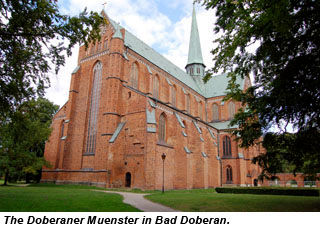
The province’s most salient influence remains the Baltic Sea, which forms its northern border and whose navigational openings to Northern Europe gave rise to Hanseatic trading cities such as Lubeck, Rostock, Stralsund and Wismar, where thriving marketplaces, 13th century squares, brick gothic churches and Scandinavian-influenced architecture have survived time, wars, occupation and ideology.
As for geography, Schleswig-Holstein forms M-V's western boundary, while Poland is to the east. To the south lie Brandenburg and Lower Saxony. High-speed motorways and rail effectively link the region to Berlin and Hamburg.
These days, a transient’s primary focus when visiting M-V must be its inventory of splendid castles and manor houses. Most are surrounded by lush gardens and parks that are, in themselves, worth visiting just for the delights of their plantings, landscaping and thickly treed tracts of pine, linden, beech and live oak.
Starting in 1945, the remaining aristocrats who owned these properties were dispossessed from their lands. Their sprawling estates -- those that weren’t burned to the ground by the occupying Russians -- were commandeered by the Soviets and their client government.
Estates were used as hospitals, town halls, schools, old-age homes and collective domiciles for German refugees from bomb-flattened Berlin and Hamburg and from surrendered German-held territory in the East.
Others were abandoned and left derelict.
This appeared to be the unfortunate destiny of these grand structures, some of which were designed by Karl Freidrich Schinkel, the chief architect of the House of Hohenzollern, and his talented pupils.
 Fortunately, the German federal government, the provincial governments and individual entrepreneurs, some tracing their roots to the families that built and owned the estates centuries ago, have recognized the commercial and historical value of these properties and have committed the funding necessary to their survival and revival.
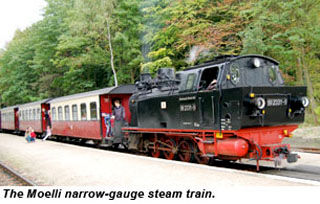
Other attractions worth seeing in M-V are the Moelli narrow-gauge railroad; the Doberaner Muenster, a magnificent, brick, Gothic-style church; the Deutsches Bernsteinmuseum, a former monastery that houses the largest collection of amber in Europe; the Nature & Environment Park Guestrow; and Mueritzeum, a natural history museum with Germany's largest aquarium for native, freshwater fish.