Orlando, my tour guide in Acapulco during the Tianguis Turistico in March, proved a good source of information and background intel on a destination whose reputation has been tarnished by drug violence over the years.
Although tourists have not been injured nor main tourist areas impacted, the violence did gut tourism numbers, halt development and knock the destination off the radar for a while.
I had last been in Acapulco in 2011, and what I saw of Acapulco this time impressed me.
Orlando confirmed some of my observations.
"There are a lot of condominiums now, more than 50 complexes, in Diamante, the newer section of town," he said. "That's where all the development is."
I passed one tall, nondescript building after another, bordering the Bay of Acapulco.
The architecture wasn't particularly impressive, but the views must have been worth the price.
The city invested close to $20 million in tourism infrastructure in preparation for this year's Tianguis, seizing the opportunity to showcase the destination in a new light.
New roads, airport upgrades and a cleaned-up downtown area struck me immediately.
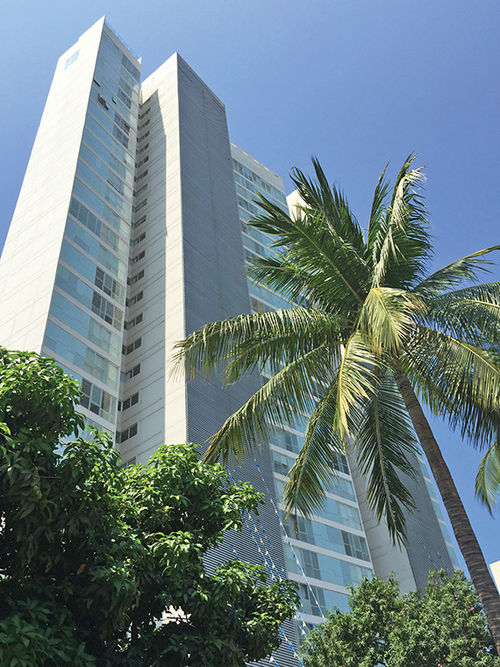
Acapulco has sprouted a number of modern condominiums and office buildings in recent years. Photo Credit: Gay Nagle Myers
Acapulco welcomed more than 9 million visitors in 2014, with 80% domestic tourists and 20% from the U.S. and Canada.
The 814-room Mundo Imperial, a luxury hotel adjacent to the cavernous new Mundo Imperial Expo convention center, opened last year.
Tianguis delegates who stayed at the Mundo gave it high marks for room amenities, including super-fast WiFi, spacious rooms and attentive service.
Coming up in 2016 is the newbuild, 350-room Fiesta Americana Grand.
Los Flamingos, the first hotel built in Acapulco, in 1930, is still standing. Renovations to the iconic Boca Chica Hotel left the 1950s exterior intact but upgraded the interiors in a contemporary style.
Acapulco, in the state of Guerrero, is a spread-out city with a population of 2 million. All of Guerrero has 5 million people.
"We've got three parts to this town. The western part is my favorite part. It's Old Acapulco, where the cathedral and [markets] are," Orlando said.
"It's where I live. It's the real part, the heart of the city."
I liked it, too, for the colorful dresses hanging in vendors' stalls, the old men sitting on park benches, the kids playing and the aromas of grilled foods and strong coffee.
Acapulco Dorado heads east along the bay, and then there's Acapulco Diamante, southeast of Acapulco proper.
"I love to show off my city," Orlando said.
He peppered his tour narration with a host of interesting tidbits as we drove down Miguel Aleman, Acapulco's main street, also known as the Coast Highway.
It's seven miles long and hugs the shoreline all the way around the bay.
He explained that Acapulco is an Aztec word, meaning bamboo or reeds. "It's the place where reeds were destroyed or broken by hurricanes in the 1500s."
The city is no stranger to hurricanes nowadays. It was battered by Hurricane Manuel and the floods that resulted in September 2013.
However, it was spared damage from last September's Hurricane Odile, which ravaged Los Cabos farther north.
Orlando's tour took us past several beaches, set with lounge chairs and umbrellas for rent.
It was midday and hot, but I spied several golfers teeing off on a nearby course.
"Acapulco has five golf courses. It costs $100 to play 18 holes plus cart fees. You need a cart. It's too hot to walk," he said.
We were approaching La Quebrada, where Acapulco's famous cliff divers perform their dives twice a day and four times at night.
The last night dive is done with lighted torches held by the divers as they streak toward the narrow opening between the cliffs.
"La Quebrada means Broken Cliff. Or it could mean broken bones, broken head, but no one has ever died doing a dive, and they've been at it since 1934," Orlando said.
The divers climb the cliffs barefoot with no safety nets, step by step and rock by rock.
"Each one prays at the top of the cliff at the Shrine of Our Lady of Guadeloupe and then dives 115 feet into the waters below."
The cliff divers remain the top attraction in town, both for first-time tourists and repeat visitors.
"If you haven't seen the divers, you cannot say you have been to Acapulco," said Orlando.