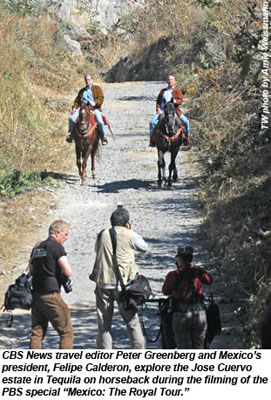
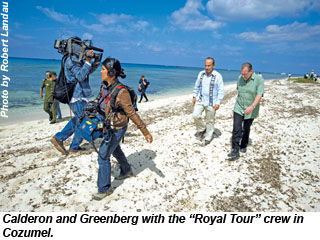
 "Mexico: The Royal Tour," hosted by CBS News travel editor Peter Greenberg and featuring Mexico's president, Felipe Calderon, will premiere on PBS affiliates on Sept. 22 (times vary; check local listings). Travel Weekly Editor in Chief Arnie Weissmann joined Greenberg, Calderon and the production crew in Mexico for a week in late January and early February, and the following is a behind-the-scenes look at how they swiftly crisscrossed the country in the hopes of giving Mexico tourism a much-needed boost. (View a slideshow of photos from the tour here or by clicking on the photos.)
Peter Greenberg lives about a half-mile from me in New York. We're friends. He called one day and said he was going to tape a "Royal Tour" with Mexico's president and asked if I wanted to come along. "It'll be a whirlwind week," he said. "You have never experienced anything like it."
I knew Greenberg had taped Royal Tours with the king of Jordan, the prime minister of Jamaica and the presidents of New Zealand and Peru, in which the head of state acted as a tour guide, showing Greenberg (and home viewers) the most exciting sights of the host's country.
I'll pause here to say that I love Mexico -- its people, its culture, its history, its sights, its food. I lived in Texas for 21 years and made frequent trips over the border, but the Royal Tour itinerary included several places I hadn't visited but wanted very much to see: the Mayan ruins of Palenque and the Lacandona Maya region in the rebellious state of Chiapas; the Monarch Butterfly Biosphere Reserve; the city of Tequila; and the Cave of Swallows in San Luis Potosi, among others.
If I did go, I asked, would I have a chance to interview Calderon? Mexico is, of course, in the midst of a battle against drug gangs, and although most major tourist areas are far from the violence, the violence itself is dramatic and unsettling. It presents a stark contrast to the images of peaceful colonial cities; fantastic ruins in the jungle; or sand, sun and surf that have traditionally characterized Mexico. If I were going to be near Calderon for a week, I wanted to ask him about the prospects of a return to normalcy.
Greenberg said an interview could be arranged.
"How much of the time will the president actually be with us?" I asked.
"He's on vacation that week," Greenberg said. "He'll be with us every day."
I felt certain there was no way the leader of a nation with the 10th-largest economy in the world was going to devote an entire week to this project. I supposed most of our time would be spent getting background footage and waiting for Calderon to show up. When he did drop in, I expected he would say his lines, and a helicopter would whisk him away until the next day's shots were ready.
I would discover, however, that I had seriously underestimated his commitment to tourism and this project. Encouraged by his energetic secretary of tourism, Gloria Guevara, Calderon has devoted significant time to promoting tourism, cognizant of its importance as a source of both jobs and foreign currency.
In January, he had declared 2011 to be "The Year of Tourism," and in May, he traveled to Las Vegas to meet with members of the World Travel and Tourism Council at its annual summit. All of this attention to tourism promotion is unprecedented by a sitting Mexican president.
When I arrived at the Presidente InterContinental Hotel in Mexico City on Jan. 29, Greenberg was at Los Pinos, the president's residence, shooting an interview with Calderon. In the meantime, I met several members of the 30-person-plus crew: camera operators and sound engineers, still photographers, interns, production and logistics personnel. It was going to be quite an operation with a lot of moving parts, a very tight schedule and plenty of ground to cover. (View the trailer for "Mexico: The Royal Tour" below.)
Sponsors of the project were represented, as well, among them InterContinental Hotels and Resorts and AARP. That night, 10 of us joined Greenberg; Jim Abrahamson, then president of InterContinental Hotels in the Americas; and the Royal Tour's director, John Feist, for dinner in the hotel's wine cellar.
I liked Feist immediately. A born storyteller, he had directed some of Greenberg's other Royal Tours and had worked on a few "Survivor" episodes, including the first. I sat next to Brad Bonnell, director of global security for InterContinental Hotels Group. The uprising in Egypt had just begun, and Bonnell would eventually excuse himself early for a call with security chiefs from other companies with hotels in Cairo to coordinate plans for their guests' safety.
• • •
The next morning, we flew to Cancun to shoot footage of the president scuba diving in one of the cenotes, underground lakes that riddle the area. At the airport, I got in a van with interns, production assistants, coordinators and a still photographer, while those involved in the actual shooting took a helicopter to the site.
As large underwater lights and cameras were assembled on location, a security detail of divers, large knives strapped to their thighs, examined every inch of the underwater route.
Soon after, Calderon and his two young sons, outfitted in scuba gear, walked down to the cave. But when I raised my camera, a communications officer stopped me. Everyone who worked for Greenberg had signed a contract authorizing the president's staff to preapprove photos. I had not, and therefore wasn't allowed to shoot pictures of the president.
This was a major impediment. I explained it was not my intention to publish photos that would embarrass the president, but I did need to illustrate any story I might write. The media officer said he would ask for permission for me to shoot, but in the meantime, I could not take photos that included the president or his family.
I watched Calderon enter the water, my camera back in its bag. Greenberg, who does not dive, sat on the rocks of the cenote and waited to greet him upon his return.
• • •
The following morning, the crew went to Chichen Itza to film Calderon and Greenberg scaling the ancient El Castillo Mayan pyramid and entering it to see the emerald-encrusted, jaguar-shaped throne that lies deep within. Later, Greenberg called me over to meet the president. We shook hands and made small talk, and I said I was looking forward to interviewing him later in the trip. Afterward, Greenberg cautioned me not to say "interview." "That means something very specific, and it will involve a lot of formalities," he said. "Just say you look forward to speaking with him."
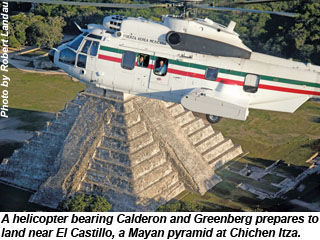 The group was one helicopter short for the journey to our next stop, Palenque, which was 350 miles away. So my van mates and I returned to Merida, where we had spent the previous night, and began what was in many ways a highlight of the trip.
In our unglamorous van, outside the electric presence of the president and his detail, with no cameras rolling or helicopter blades whirring, we went overland through unsung parts of Yucatan, Campeche, Tabasco and Chiapas states, enjoying the country in all its glory. We stopped in the coastal village of Champoton to eat tacos, watch the sunset and look on as fishermen cleaned their nets. None of us thought twice about drug cartels nor saw evidence of anything but citizens going through the paces of daily life.
• • •
The next day, we gathered in the predawn to caravan to the archaeological site of Palenque. Security was tight, and I still had not been authorized to shoot photos of Calderon. But my disappointment was quickly dispelled by the beauty of the site, cast in the glow of the early morning sun. In Chichen Itza, tourist areas had been manicured, and El Castillo appeared to rise out of a mowed field. But Palenque is hemmed in by jungle, and howler monkeys provide a fitting soundtrack.
I followed Greenberg and Calderon, just out of camera range, down a steep stairway within the imposing Temple of Inscriptions to the depths of the tomb, which was uncovered only in 1952. "It's Indiana Jones time," Greenberg said to the president as they descended.
A viewing door that normally restricts tourists had been unlocked, so when the taping was finished, I had the rare opportunity to closely examine the carvings on the lid of the tomb.
A Vietnam-era Huey helicopter had been procured so I and some of my van mates could join the production crew for the rest of the journey. We flew over hilly jungles punctuated by deep blue lakes, en route to our next stop, the most remote and least-known of the attractions we were to see.
We landed in the Lacandona village of Metzobok, where the last remaining pure descendents of the Maya live, having managed to remain isolated and avoid contact with outsiders well into the 20th century. The men and boys have long hair and dress all in white. They take their responsibility as guardians of the area seriously. In their territory is a chain of lakes and canals that holds caves containing old skulls and other artifacts of their history.
They paddled Greenberg, Calderon and crew out to see the caves, and later the entire village gathered outdoors for a simple, traditional lunch of chicken and beans.
As people gathered for group photos with the president, it seemed that every one of the Lacandona themselves were shooting photos of the president. I approached the press liaison and asked if I were the only person present who could not take photos. He said to go ahead and shoot, after which he did not put restrictions on my photography.
 It was clear even then that a lot of good footage was going to have to be discarded to edit everything down to one hour. Our next stop, the market of the Chiapas capital, San Cristobal de las Casas, and a visit to its Cathedral, did not survive the final cut. That stop was remarkable in part because the president walked right through a crowded area in the heart of a state so rebellious that it was, for a time, off-limits to tourists. Though security around the president was tight, I marveled several times during the trip at how he would wade into a crowd or walk over to greet Mexicans who happened to be in the vicinity of the shoot. He has declared war on some of the most violent, powerful and destructive people in the world, yet he appeared to be more accessible than leaders of far less troubled countries.
We returned by chopper to Mexico City that evening.
• • •
We were to take off early the next morning for the stunning Cave of the Swallows in central Mexico. Although the skies were clear in the capital, it was apparently raining hard at the site. We waited for things to clear, but the skies over the cave never did. It was decided that we would instead visit the Monarch Butterfly Biosphere Reserve, though Feist had concerns we would arrive after the day's butterfly activity had all but ended.
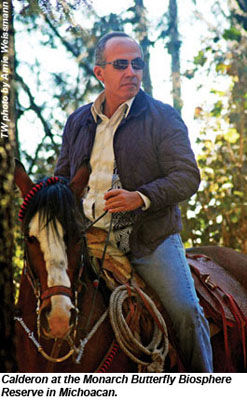
It turned out he was right. On horseback, we descended to where millions of butterflies migrate each winter. Some were awake and fluttering, but comparatively few were in the sky. Most had settled for the night in enormous clumps on trees.
The site would be revisited the next week when the butterflies were more active, but while we were there I did make my one small contribution to the final film. As we were looking around, I noticed a butterfly had landed on the president's leg, and pointed it out. The cameras swung around, and the image is, fleetingly, in the final version.
• • •
Morelia, the president's hometown in Michoacan state, was the next stop. Most of the footage shot in this well-preserved colonial city did not make it into the Royal Tour, but what was preserved was of a very personal nature: the president's visits to his high school and parents' home. (There is also a colorful scene where he and Greenberg watch traditional mask dancing.)
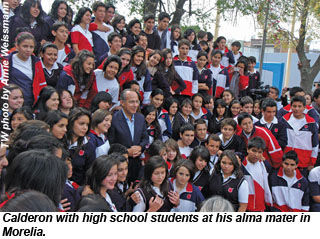 Although only Greenberg joined him in the visit to his parents' modest home, the visit to the high school (and a similar visit to his grade school) were some of the warmer moments of the tour and film. When I eventually did interview the president, I asked what lesser-known areas he would recommend to travelers. A proud son of Michoacan, he mentioned Morelia first.
• • •
The next day, my last, was also my favorite. We boarded the presidential jet to fly to Guadalajara. We were greeted by pink-uniformed attendants and entered the rear of the plane, which was laid out in a three/three configuration. There were no preflight safety instructions, and no one asked us to turn off our electronic devices.
Greenberg, the president and his family occupied the front half of the plane, and the rest of us sat in the back.
Toward the end of the flight, one of the president's staff came back and said Calderon had asked that I join him in the forward part of the plane. When I got there, I saw that Guevara, the tourism secretary, had joined the group.
The president and I spoke at length for the first time, primarily about climate change and environmental issues, which concern him deeply. Before we deplaned, the press liaison told me that, barring unforeseen circumstances, I could conduct my formal interview with the president on the return flight.
From Guadalajara, we overflew a beautiful canyon and landed in a sports field in the city of Tequila.
In most cities, we were greeted by uniformed military personnel, governors or other officials, but in Tequila an older man dressed in a guayabera and his wife greeted Calderon and his wife, Margarita, warmly. We all walked into what I thought was a beautifully landscaped park.
The president called me over and introduced the older man as Don Juan Beckman, a descendant of Jose Cuervo and current CEO of the famed tequila company. Rather than a park, we were on the grounds of his hacienda.
Beckman told me about his dream of starting a "tequila trail" in the state of Jalisco, in which tourists could visit tequilarias, similar to how oenophiles tour Sonoma and Napa counties in California.
 The president and Greenberg mounted horses and were filmed in various parts of the estate, first along a wooded stream and eventually in Cuervo's agave fields, where they dug up and trimmed an agave "pineapple," whose pulpy flesh provides the basis for tequila.
They moved to a series of buildings showing everything from the fermentation pits to a bottling table and ended up in a tasting cellar.
Though the president did not drink tequila during the shoot because it would not be considered proper, his wife, the Beckmans and Greenberg did sample Reserva de la Familia, the finest-quality tequila Cuervo makes, drawn with a dipper from oak barrels.
When the shooting was done and the cameras put away, the crew was invited to join in and sample the tequila. No one had to be asked twice. Tequila is my drink of choice, and I've sampled many fine varieties. I have to say I have never in my life tasted a smoother, more flavorful tequila. As the crew relaxed after a hectic week, a mariachi band we had seen earlier reappeared and the president, a strong tenor who frequently sang songs on the campaign trail, serenaded the group with traditional songs.
• • •
During my interview with the president on the flight back, I asked several security-related questions. (The full interview with Calderon appeared in the Feb. 14 issue.) What impressed me most was that when I asked him directly when the violence would end, he said he had no idea. The issue, he said, was not simply a "war on drugs"; the cartels were an expression of organized crime, which exists everywhere. The desire for drugs was not going to go away. What he hoped to do was "restore the authority and to re-establish in Mexico strong institutional frameworks in order to enforce the laws. Our main goal is to make Mexico a rule-of-law state, where the law is enforced and anyone, visitors or citizens, will live in order, following the law, with a strong government supporting and defending the rights for everyone."
The change he is seeking is much broader and more meaningful than simply an authoritarian crackdown on crime. Having spent a week with the president hardly makes me an expert in Mexican politics, or even necessarily a reasonable judge of his character.
He is clearly in a very difficult situation, but I came away feeling his blend of pragmatism and hope for a better Mexico motivates his decision to fight the cartels even though it damages him politically in the short term and results in headlines that do nothing to encourage tourism.
And I found he was willing to be candid about his challenges. Despite all the beautiful footage and wonderful sights shown of Mexico (including some that were added after I left the shoot), the final cut of the Royal Tour opens with a long segment in which the president discusses the violence.
When Greenberg showed me the final cut, I was delighted with the results. This is a show you can wholeheartedly recommend to clients interested in Mexico. As we in the industry all know, a tour guide, more than anyone else, determines whether or not a trip is a success.
In President Calderon, Mexico has an outstanding guide.