
Andrea Zelinski
It had been too long since I'd stood under a sky full of stars shimmering like diamonds.
But here I was, on Isla Espiritu Santo, about a 40-minute boat ride from the mainland city of La Paz, on Mexico's Baja peninsula. I had no cellphone service, no Instagram demanding my attention. Just the sky, my thoughts and the company of travelers ruminating about the universe.
I was on a press trip hosted by Go La Paz, the tourism bureau for this capital city of Baja California Sur state, a three-hour, curvy drive from Los Cabos Airport. I arrived just two weeks after the cartel blocked roads and burned cars in Puerto Vallarta and Guadalajara as a statement after the killing of its leader, "El Mencho" in Jalisco.
Several travel advisors said the violence chilled interest in Mexico, although they were optimistic demand would bounce back. I had inquired about the scene on the ground in La Paz myself, eventually deciding to go ahead with my travel plans.
What La Paz is … and what it isn't
The city is nestled on the eastern shore of the peninsula on the Sea of Cortes, where the beaches were quiet during my five-day, midweek visit. The city felt like a calm and quiet place where people live, not where college students escape for spring break.
La Paz doesn't want to be the next Cabo. All-inclusive resorts and nonstop energy aren't part of its DNA. It wants to be known for casual, barefoot luxury, where people visit to connect with nature in this desert landscape that meets the sea.
Luz Maria Zepeda, general director of the La Paz Tourism Trust, put it this way: Celebrities who want to be seen go to Cabo, those who don't come to La Paz.
One of the newest additions to the city was the airy 155-room Hotel Indigo, where I stayed on this early March visit. The IHG property was the type of boutique hotel you can expect to find in La Paz. (Hilton plans to open a Tapestry Collection property here in June, albeit a year later than planned.)
Direct air lift to La Paz from the U.S. is limited but has improved in recent years. Alaska Airlines began direct from Los Angeles in 2024, and local tourism officials hope to build on that with seasonal flights from Dallas and Chicago in the next few years.
A developing food scene
While it's overall a quiet destination, I found a cheeky, creative energy here. Art was sprinkled through the city, like the dog portrait mural awash in rainbow colors and boardwalk sculptures of La Paz's most notable wildlife, like the oyster with a silver pearl inside.
The food was also expressive. We ate at Biznaga Baja Bistro, which had an actual "hole in the wall" in one of its dining rooms, enabling diners to see inside the kitchen. I sampled several dishes at the bistro, but what stood out was the oyster under a blanket of chopped tuna with sesame oil, chives and a special salsa. The dish was fresh, as if it had been pulled from the cold sea just minutes ago.

At Biznaga Baja Bistro, an oyster and chopped tuna dish tasted as fresh as if it had been pulled from the sea just minutes before. Photo Credit: Andrea Zelinski
The cocktails were complex, such as the smoky mezcal with hints of cucumber, pineapple and cardamom, which was refreshing and sinful at once. A few members of my group later wandered over to a bar where they said some drinks were served flaming.
La Paz is becoming more foodie-friendly, tourism officials said, and they hope to position the city as a culinary destination. As we sat for a multicourse meal at Nemi (a high-end restaurant that seats only 20), we couldn't help but notice locals lining up across the street to buy tamales on the corner. We joked about joining them after dinner.
Reconnecting with nature
Beyond the city, nature and wildlife are the main features. Common activities run the gamut: hiking, mountain biking, sport fishing, bird-watching, kayaking, paddle boarding, kite-surfing, swimming, snorkeling and the like. One traveler I met was taking his twin sons sand boarding (think snowboarding on sand), which is a new one for me, and another was bikepacking through the peninsula.
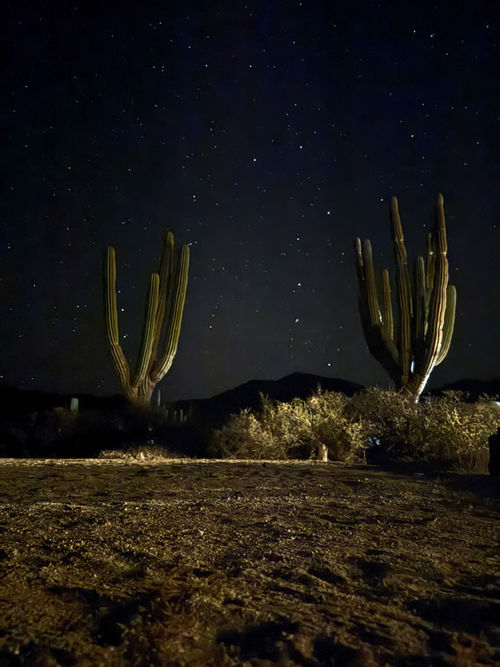
A star-studded night sky over Camp Cecil on Isla Espiritu Santo. Photo Credit: Andrea Zelinski
On my visit, our group was taken to Rancho Cacachilas to learn how goat cheese is produced and about sustainable desert farming and vaqueros (Mexican cowboys). But a major feature of a visit to La Paz is meeting the migrating wildlife in the area, like the humpback whale I saw breach in the distance or the sea lions and whale sharks I swam close up to.
On an excursion with Pita's Tours, I swam with five whale sharks around me. I learned to dance with them in circles as they fed on plankton. Their wide, dotted heads breached the surface as their bus-length bodies took their time going anywhere. I felt so small.
Several tour companies offer glamping on Isla Espiritu Santo, either on the beach or the nearby desert. I did so at Camp Cecil with Todos Santos Eco Adventures, curling up in my tent and snoozing on a mattress with pillows, sheets and comforters.
During my stay I met
several travelers who were here from the U.S. and Canada, looking for adventure.
Tourism officials hope the fact that it takes a boat ride to reach the
island makes it a special experience and fosters connection by being
just out of cellphone-reception range.