There are lots of luxurious kitchens. But Tomas Piroska
does his cooking in the 65-square-foot galley of an Etihad Airbus A380, and he
wouldn’t have it any other way.
“I like absolutely everything about working with Etihad
and our In-Flight Chef program,” said the native of Slovakia, who has been with
the United Arab Emirates-based airline for five years.
Piroska’s charge isn’t easy. Over the course of long-haul
routes, such as the 8,400 miles from Abu Dhabi to Los Angeles, he is tasked
with tailoring a lavish three-course dinner, an upscale breakfast and plenty of
snacks in between for high-paying first-class customers. When Piroska finds
himself on routes featuring the Residence, Etihad’s luxurious three-room suite,
dinner for those customers is sometimes six or seven courses, he said, and
expectations for quality run high.
Piroska, though, said he loves the challenge.
“The connection you create with the guests in a 16-hour
flight, it’s amazing,” he said.
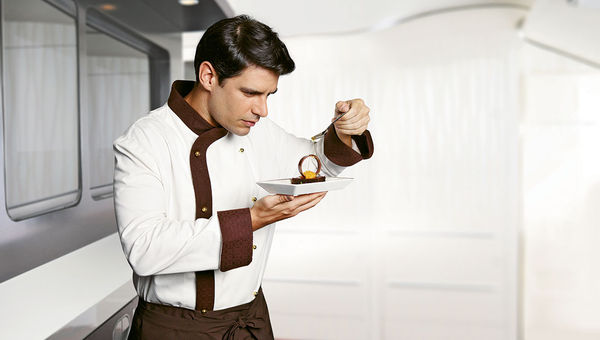
One of Etihad’s In-Flight Chefs puts the finishing touches on a dessert.
Like many airlines, Etihad has aligned itself with a
celebrity chef, in this case Vietnamese-Australian chef Luke Nguyen, known
mostly for his TV work in Australia.
But Etihad takes at least as much pride in its In-Flight
Chef program, which is peopled by nearly 200 highly trained professional cooks
hailing from 35 countries.
According to Linda Celestino, the airline’s vice
president of guest services, only individuals with at least six years of
experience on a cruise line, at a luxury hotel or in a fine restaurant are
eligible to be hired. Etihad also wants its candidates to have customer service
experience. Piroska had previously worked at the Casa Marina Waldorf Astoria in
Key West and a fine dining restaurant in Ireland.
“As an award-winning airline, we recruit the best chefs
who have proven experience and a desire to achieve and exceed guest
satisfaction,” said an online Etihad recruiting ad. “This is your chance to do
what you do best whilst flying all over the world.”
Chefs who make the grade go through a training program
that lasts eight to nine weeks. Then comes the fun part: preparing and serving
fine meals without the benefit of a true chef’s knife. Because of aircraft
security rules, Etihad chefs must make due with a plastic knife that is just sharp
enough to cut meat and vegetables.
And then there’s that kitchenette.
“With this galley, you have to work with tiny space, and
every inch feels like a meter in a kitchen,” said Piroska, who negotiates that
space alongside a server during each flight he works on.
Piroska and his fellow chefs aren’t preparing meals from
scratch aboard the airplanes. Before the food is loaded onto an aircraft, for
example, fresh vegetables are chopped, and the cuts of meat are portioned.
But fine touches, such as the way a customer wants the
meal prepared, are handled onboard with the help of the galley’s two ovens and
an assortment of pans as well as its chopping board and the plastic knife.
For example, the current first-class menu for Etihad’s
service between New York and Abu Dhabi includes several a la carte options. But
passengers can also select from a lounge-and-grill menu in which they pair
their meat or fish course with a specific side as well as one of three sauces.
Also on the menu are sandwiches made to order. And for breakfast, one of the
options is eggs cooked to order.
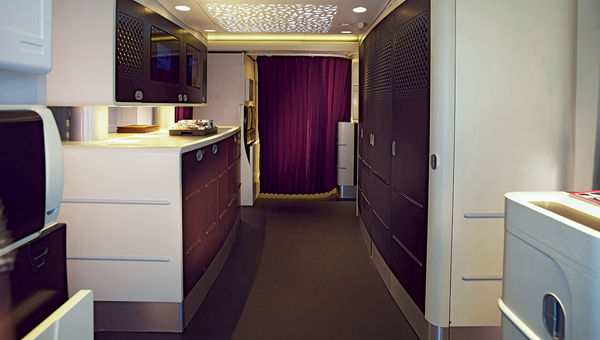
The galley on an Etihad Airbus A380.
Piroska and Celestino said that a key part of the
In-Flight Chef experience is the dialogues chefs have with passengers
throughout the journey about how they want their food prepared and about
wine-pairing options. Passengers can also order off-menu items, as long as the
ingredients are available onboard.
With the Residence customers from New York to Abu Dhabi
paying $32,000 and more for a flight, one might expect that passengers would
sometimes be quite demanding. Not so, Piroska said.
“I have to say that the guests are really humble,” he
said. “Sometimes they only order green juice. They are very humble guests and
very happy with the service and the way they are treated.”
Piroska recalled one customer who made an advance request
for Skittles candy months before his flight. On the aircraft, Piroska delivered
the Skittles with an ornamental presentation that surely exceeded what one gets
when buying a pack at the convenience store.
“He was very surprised,” Piroska said of the passenger.
“He had forgotten [about] the Skittles.”