 The tourism industry continued to reel last week from the financial losses suffered as a result of the shutdown of the country’s national parks, museums and monuments, all of which remained closed for business as the week ended.
According to a survey conducted by the National Tour Association (NTA) last week, 82% of member operators said they had made changes to itineraries to accommodate closed national parks, museums and/or monuments; 46% reported customers canceling because of the closures; and 26% said they had been forced to postpone tours until the federal government reopened its most popular attractions.
The NTA estimated that the economic impact on its 600 operator members, many of which do business in the inbound tourism market, already had exceeded $14 million by midweek.
The Coalition of National Park Service Retirees estimated that as of last week, more than 7 million visitors had been barred from national parks due to the shutdown, resulting in the loss of an estimated $750 million in visitor spending.
A hotel operator in Yosemite National Park pointed out that the government shutdown was the second catastrophe the park had faced recently: It had just begun to recover from the losses incurred as a result of the August Rim Fire, which hit during peak season, when the shutdown forced it to close.
Tour operators and travel suppliers recounted nightmare stories about itineraries that had to be reworked or canceled, of disappointed travelers visiting the U.S. from near and far, and of their frustration over their lack of voice and influence in the government’s decisions and process.
The Globus Family of Brands said last week that 28 departures across its Globus, Cosmos and Monograms brands had been affected in some way by the shutdown. Like many tour operators, the company rerouted some itineraries that were supposed to include national park visits to nearby state parks.
In all, Globus had to cancel six departures in cases where it felt that the closed national parks damaged the itineraries too severely. In total, those canceled departures represented more than $500,000 in revenue for the company.
Trafalgar President Paul Wiseman said the financial impact of the shutdown had not yet been fully realized as of last week. In addition to refunds for canceled departures, Trafalgar was also paying supplier cancellation penalties to coach companies and hotels for bookings that were canceled at the last minute.
On the first day of the shutdown alone, Trafalgar saw up to 40 vacations affected, and that number continued to grow through the first eight days. The impact ranged from minimal — an itinerary that maybe had one quick national park visit — to severe in the case of Trafalgar’s Trailblazer or Scenic Parks Explorer itineraries, where the majority of the tours include national park visits.
“There are silver linings,” Wiseman said. “Our product team worked tirelessly to find alternatives, and in doing so, they uncovered some hidden gems as replacements.”
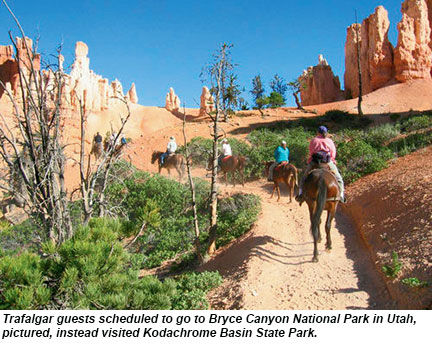
For example, Trafalgar rerouted guests who had originally been scheduled to go to Bryce Canyon National Park in Utah to nearby Kodachrome State Park, where guests could still view the hoodoo-like formations for which Bryce is known.
Tales of innovation and creative reroutings, of finding enjoyable alternative sites and activities, were plentiful among the tour operators that found themselves facing the same dilemma.
Some businesses actually benefited from the reroutings. For example, several Trafalgar tours that were originally headed to Shenandoah National Park in Virginia ended up overnighting at a Hilton in Charlottesville, Va., instead.
“We rerouted 150 passengers to this hotel,” Wiseman said. “This is revenue this small town would not have had from us.”
If there is one other small silver lining, it is that the shutdown came just after the peak summer travel season.
“The impacts would have been much more severe had this occurred a month ago,” observed Tom Armstrong, corporate communication manager for Tauck.
Armstrong said there had been 12 published departures in September for the company’s America’s Canyonlands itinerary, which features stays inside four national parks. The same trip has just six departures in October.
Tauck’s Yellowstone & Grand Teton National Parks itinerary had 10 published departures in September and none in October. Nevertheless, as of last week, the company had been forced to cancel five tour departures and to reroute others.
Overall, the losses the industry has sustained appear to be far greater than any gains, not to mention damage to the image of the U.S. and disappointments experienced by travelers.
The first week of the government’s partial shutdown coincided with Golden Week, a period designated by the Chinese government as a time for its citizens to travel and thus a heightened period of inbound tourists to the U.S.
“Many Chinese visitors have saved for years to take the trip of a lifetime to our country,” said Haybina Hao, director of international development for the NTA, which oversees the China Inbound Program. “They wanted to see Yellowstone, the Statue of Liberty and the Grand Canyon. But they’re seeing none of it. They are extremely frustrated and confused by U.S. politics.”
The shutdown clearly did not make for good public relations at a time when the U.S. travel and tourism industry is working overtime to compete against destinations around the world.
“Already, you have countries like Germany telling their citizens to beware of problems and delays when traveling to the U.S.,” said Roger Dow, president and CEO of the U.S. Travel Association. He was alluding to the travel warning Germany issued on Oct. 1, cautioning its citizens about the U.S. government shutdown.
“With so much positive progress in place, our country doesn’t need to take steps back in pursuit of welcoming millions of new international travelers,” Dow said.
The $2 trillion travel industry represents America’s primary services export and has added jobs at a rate three times faster than the U.S. economy as a whole since 2010, U.S. Travel noted.
But that growth and contribution to the U.S. economy, U.S. Travel said, is being put in jeopardy by the shutdown, a fact that has frustrated those in the travel industry who still feel underrepresented in the government.
In effect, the U.S. government shutdown has put the travel industry into a very difficult and precarious position, said Gavin Tollman, CEO of Trafalgar and chairman of the Travel Corp., who wrote an in-depth opinion piece about the issue on his blog, GavinTollmanBlog.com.
“What resonates most profoundly with me, beyond the insanity of the U.S. government, is that the tourism sector has no voice when it matters,” he wrote. “We need to have an equivalent of a minister of tourism, who defends our industry within government. ‘Closed for business’ is not an option, [not] for tourists or for the millions working in the tourism industry.”