Intern Emma Weissmann is on a press trip to Ixtapa-Zihuatanejo, Mexico, to see what the area has to offer. Her second of three dispatches follows. Read her first dispatch here.
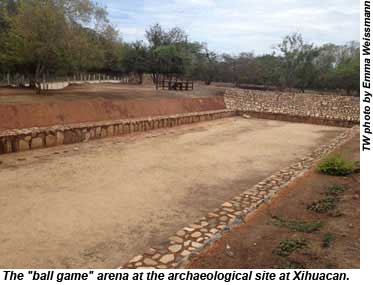 On our final full day in Ixtapa-Zihuatanejo, my group traveled to Xihuacan, an area just outside Zihuatanejo, to visit a (mostly) "virgin" archaeological site -- a 60-acre area which had already undergone six years of excavation. We arrived at the Museo de Sito Xihuacan and met Rodolfo Lobato, the area's excavation leader.
Funded by the National Institute of Anthropology and History, the museum is frequented by schoolchildren and occasionally foreigners yet is rarely visited by Mexican tourists. We learned about the artifacts (fragments of pots, tiny figurines, jagged pieces of clay wall), circulating the room and examining the ruins of the ancient city piece by piece. We then moved to the site itself, visiting the arena used for a type of "ball game" similar to polo but resulting in human sacrifices -- many decapitated skeletons had recently been found in the arena -- and a ball lit with fire. I think it's safe to say that back then, I would have stuck with jogging. (Hear Lobato talk about the "ball game" in the video at the bottom of the page or in this link.)
Just beyond the arena was a magnificent pyramid deemed "Pyramid B," which took a team of 50 people six years to uncover (it is in the process of being restored to look exactly as it did as early as 1500 B.C.). Our interpreter, Luis, informed us that there were still approximately 75 virgin sites left to be uncovered, and in one year's time the team will excavate many more pyramids in the area adjacent to Pyramid B. He pointed to a large hill topped with unkempt brush.
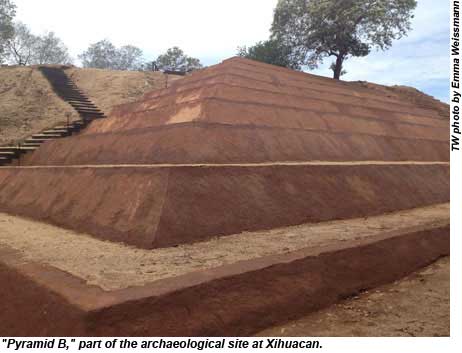 "Like that one," he said.
My mouth dropped open. "There's a pyramid under that?"
He nodded. I looked back and forth from the hill to the steep sides of Pyramid B, amazed that the foundation of an entire city was still hiding just under our feet.
At dinner that night, I asked Ana Luisa Fernandez, our guide from the Ixtapa-Zihuatanejo Convention and Visitors Bureau, why, after I had visited Lobato's site (which was, seemingly, in the middle of nowhere), I had been left with the impression that very few people outside of the area knew about the work he has been doing. She explained to me that because Ixtapa-Zihuatanejo does not have the famous buildings or monuments that initially draw the history buffs, it won't attract tourists who are looking to experience the culture and history of Mexico on their vacation. But, as I have found out, the area is rich with it.
I was embarrassed to admit to her that, before coming to Ixtapa-Zihuatanejo on Thursday, I knew very little about the region. But while Ixtapa-Zihuatanejo doesn't boast the monuments in Palenque or near Cancun, I felt extremely fortunate to venture beyond its beautiful beaches and learn a little more about what is being, and still continues to be, uncovered.