.jpg "***ArnieWeissmann-full") Certain hotels both reflect and define the city they’re in. The Plaza wouldn’t be the Plaza were it not in New York (and New York would not quite be New York without the Plaza).
Certain hotels both reflect and define the city they’re in. The Plaza wouldn’t be the Plaza were it not in New York (and New York would not quite be New York without the Plaza).
In Hong Kong, it’s the Peninsula. Memphis has the Peabody. And the Hotel de Paris, despite its name, is inextricably tied to Monte Carlo.
Peabodys, Peninsulas and other iconic brands might have branches elsewhere, and these properties might even exhibit the same qualities, standards and duck parades as the original, but the branches are seldom iconic.
When you think Waldorf-Astoria, you do not think Orlando.
New Orleans has several properties whose identity is wrapped up in the Big Easy. The Hotel Monteleone, Cornstalk Hotel and Bienville House are rooted in New Orleans, and it’s no coincidence that they’re all in the French Quarter.
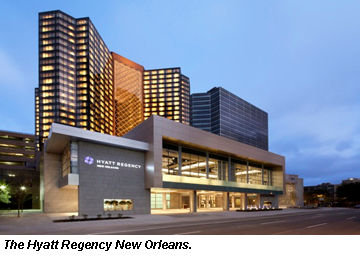
It’s interesting, then, that the reopening of the downtown Hyatt Regency New Orleans earlier this month literally brought tears of happiness to the eyes of many of the city’s residents and was celebrated by all who have followed New Orleans’ recovery from the devastation of Hurricane Katrina six years ago.
In many respects, it is a typical Hyatt. It’s large (32 floors, 1,200 rooms, 200,000 square feet of meetings space) and has the brand’s defining atrium and glass elevators. It is, in the words of John Pritzker, whose family developed the brand, a classic “urban big box.”
I went down for its opening weekend, my fourth visit to the city since Katrina. The reason the reopening of the Hyatt is so emotional for those who love that city is that the hotel’s long closure — it all but imploded during the storm — and its prominent location adjacent to the rebuilt Superdome were highly visible, stubborn reminders of a catastrophe that caused as much psychic damage as physical devastation.
But on this visit, I saw a joyous rebuke to the doubters — and there were many — who had predicted the city would never again rise to its former stature.
For years after Katrina, one could simply stroll into Galatoire’s and be seated right away. Cafe du Monde would be half empty on a beautiful morning.
But those days are gone. To my surprise, 70-plus fellow tourists joined me at a Monday morning cooking class to learn the secrets of red beans and rice, cornbread, pecan pie and pralines.
 And the airfares to New Orleans the weekend I went confirmed that demand for the city’s pleasures is high.
The streets of the French Quarter were bustling. New Orleans is back.
But to return to the Hyatt: Its public spaces had been packed with black-and-gold jerseys Sunday afternoon before the evening Saints game against the Colts, and it seemed clear that this property will be the pregame headquarters for fans.
The building itself looks great, with two giant atrium windows soaring 25 stories on either side, providing views of the Superdome and the Crescent City Connection.
The entrance to the hotel has been moved to the opposite end, which allowed for an additional 100,000 square feet of meetings space but also means guests must walk farther to get to their rooms after checking in.
Although I stayed in an executive suite, I actually preferred the layout of the single-queen standard room. The suite’s small second room was dominated by an L-shaped sofa that made it feel cramped, and my suite’s only vent was in that room, which meant I needed to lower the thermostat a few extra degrees to cool down the bedroom.
On the other hand, all the rooms have the latest version of Linksys software, which enables guests to do everything from order pizza to print documents from their TV.
And rather than gouge guests with a minibar, the hotel has a reasonably priced, 24-hour convenience store, and each room has a small, empty refrigerator.
Many national chain hotels have found success in New Orleans. The Hilton Riverside, the Royal Sonesta and Marriott properties are among those that have been embraced by visitors and residents alike as true Crescent City hotels.
But the Hyatt, I suspect, will always trigger a special emotional reaction among those who feel connected to the city. It’s as if one worked for six years on a complex, often frustrating jigsaw puzzle, and at last you put the final shape in place and gazed at a masterpiece.
Email Arnie Weissmann at [email protected] and follow him on Twitter at twitter.com/awtravelweekly.