Germany's answer to TED Talks is the Q Conference, held in
Berlin last week and featuring 14 speakers, ranging from last year's Nobel
Peace Prize laureate Nadia Murad to avant-garde musician Holly Herndon.
Scientists, writers, urban planners, feminists, computer
theorists and social activists each presented for about 15 minutes, all
touching on the unofficial theme, "In what kind of future do we want to live?"
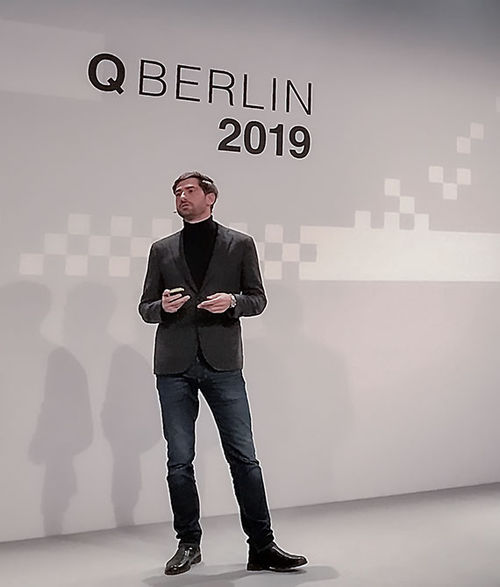
Dr. Max Neufeind: Worried artificial intelligence will eliminate your job? "Embrace messiness." Photo Credit: Arnie Weissmann
Although I had been invited to attend the conference by VisitBerlin,
I was surprised to discover that the conference itself had been created by
VisitBerlin CEO Burkhard Kieker and was run under the auspices of that
organization. It's an extraordinary undertaking for a destination marketing
organization to bring in speakers from four continents to talk about ideas that
only touch tangentially on tourism (I heard the word "travel" mentioned only
once) and most presentations had no direct connection to Berlin.
Kieker views the conference's totality in a broader connection
to Berlin, particularly its post-war tradition of tolerance and as a magnet for
free spirits and forward-thinkers. At its heart, he believes, the Q conference
itself is reflection of "Brand Berlin."
The one speaker who mentioned "travel" was digital policy
advisor Dr. Max Neufeind. He discussed artificial intelligence vs. human
intelligence, and cited travel professionals among those who are not likely to
be replaced by artificial intelligence. Travel is a field that taps
individuality, he noted, as opposed to repetitive tasks, which are likely to be
automated.
I had heard that observation before, but what particularly
struck me was his admonition to "embrace messiness." Humans are less than
perfect, and our messy lives stimulate original thinking and spur creativity,
Neufeind asserted. Computers, on the other hand, are rules-based, constructed
to impose order.
That concept was fresh in my mind when I returned to my
hotel for dinner at the five-star, 41-room Orania.Berlin.
It's run by a young couple, general manager Jennifer Vogel
and managing director (and chef) Philipp Vogel. I had dinner with Jennifer that
evening, and by the end of our conversation I saw in their operation two
near-perfect examples of embracing messiness and turning it into success.
Don't misunderstand -- the hotel is not "messy" in regards to
housekeeping, service, design or F&B. It is well-organized, with a vibe
that suggests attention to detail and a fine-tuned appreciation of the 2019
zeitgeist.
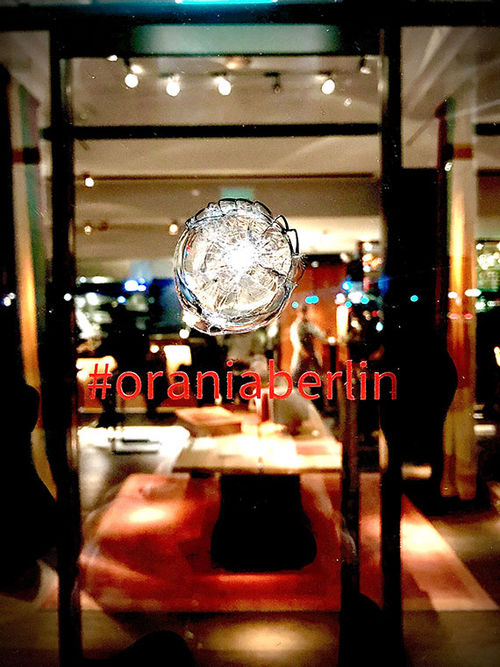
After windows at Orania.Berlin were damaged by protesters, the hotel's managers decided not to repair the panes, but embrace the damage as part of the hotel's history. Photo Credit: Arnie Weissmann
I had noticed earlier that a few of the window panes In the
lobby were laced with a webs of impact cracks. After ordering dinner, I asked
what had happened.
As mentioned in my previous dispatch,
the Kreuzberg neighborhood, where the hotel is located, has become a focal
point for those fighting gentrification in Berlin. Vogel said that when the
hotel had opened two years earlier, there were protests -- a luxury hotel in Kreuzberg
was the most prominent symbol yet of changes in the neighborhood.
One night, she said, after all the dinner and bar guests had
left, someone had struck the windows, likely with a hammer, leaving the cracks
I saw.
Jennifer and Philipp's first instinct was to replace the windows,
but upon reflection, they chose instead to embrace the messiness of the situation.
The protests were, they realized, now part of the hotel's history. They
decided, in essence, not to clean up the mess. The cracks are an authentic and
now integral part of the hotel.
It's hard to imagine programming a computerized hotel
maintenance system, even one that learns to mimic human thought, to not
automatically have the windows replaced.
The enormous success of their restaurant, Restaurant.Orania,
is likewise the result of embracing messiness.
As their first Christmas approached, the kitchen staff
gathered to decide what to feature on the holiday menu. Goose or duck were the
customary choices. Philipp (who had previously earned a Michelin star) had
worked for a period in Shanghai and thought that offering Peking duck would be
a good differentiator. It would, however, require ordering a special oven from
China.

Ordering this massive Peking duck oven was a mistake. It's now integral to the Restaurant.Orania's success. Photo Credit: Arnie Weissmann
He thought an 80-centimeter (34.5 inches) oven would
suffice, and ordered one from China. When it arrived, he was in for a shock -- it
was large enough that he himself could fit into it. It turned out that 80
centimeters was the width only of the lid.
There wasn't time to replace it, but it inspired him to
wonder: If he was stuck with an enormous duck oven, what could he offer diners
year-round that would make such an oven a good investment?
Thus X-Berg Duck was born, a four-course meal for two that
incorporates almost every aspect of the duck except the bill, webbed feet and
feathers.
Since then, orders of X-Berg Duck have kept the restaurant
full every night. The huge oven stays busy.
There is, of course, a difference between sloppiness and
messiness. And it's instructive that in both instances, the Vogels didn't plan
messiness. To paraphrase a well-known expression, messiness happens. The
challenge is to convert mess to success.