Where Old Ships Go to Die Slideshow
Click here to see a slideshow of Peter Knego's visit to Alang, India.
Streaked in rust, its twin funnels a sun-parched shade of green, the Independence drifted through melting fog across the San Francisco waterfront on Feb. 8.
An attending tugboat gave the oceanliner a symbolic watergun salute as it passed under the Golden Gate Bridge, under tow and reportedly bound for Singapore. However, its likely final destination might actually be a distant ship-breaking yard in India, China or Bangladesh.
Built in 1951 to serve American Export Lines' New York-to-Mediterranean service with its twin sister, the Constitution, the U.S.-flagged Independence carried hundreds of thousands of passengers in its heyday, including movie stars, diplomats and presidents.
The ship's last operator, American Classic Voyages, succumbed to bankruptcy in 2001. Thus, after 21 years of cruising the Hawaiian Islands, the Independence, redubbed the Oceanic, was left languishing in San Francisco. Norwegian Cruise Line purchased the vessel in 2003 with talk of bringing it into its newly formed NCL America division.
But the ship's deteriorating condition and NCL's own challenges in Hawaii sealed its fate; the line quietly sold the vessel to a scrap buyer last summer.
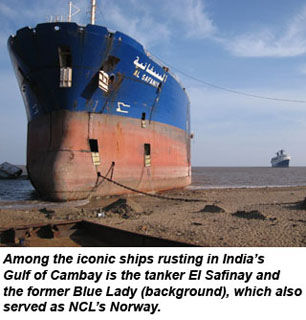 The Independence/Oceanic will have company at its likely last port of call. The Blue Lady, once the French liner The France and later NCL's celebrated Norway, has spent a year on a muddy embankment at Alang/Sosiya, a 10-mile stretch of beach in India's Gulf of Cambay.
The tip of its once-arced bow was "snipped" and now dangles tendrils of metal. The suites added to its structure in 1990 have mostly vanished, along with its lifeboats, davits and radio mast.
The vessel's blue hull is scarred by large holes cut for removal of fittings and furniture. It's the final port of call for this 1,035-foot liner, the longest passenger ship in the world until the Queen Mary 2 debuted in 2003 and the first true megaship, in the wake of its rebuilding as the Norway in 1980.
The storied ship's final days have been extended by concerns about the removal of tons of asbestos insulation still onboard and questions about the legality of its beaching, from both environmental activists and the Indian Supreme Court.
On either side of the Blue Lady, ships in various states of demolition line the shores of Alang. The last keel plates of the missionary ship Anastasis, the former Lloyd Triestino liner Victoria of 1953, are being scraped off the mud for delivery to smelters. Dozens of tankers, container ships, trawlers, ore carriers and ferries occupy the neighboring plots.
A familiar arrival is the Lucky, built in 1961, which most recently sailed as the Odysseus for Royal Olympic Cruises. It takes several weeks for customs to clear it, then the scrapping begins.
Beachfront junkyard
Alang was once a pristine beach lined by agricultural land and fishing villages. In 1983, Indian businessmen capitalized on the growing demand for scrap metal and favorable conditions for beaching vessels on the gently sloped embankment at high tide. Starting with a small ship, the experiment was soon echoed in neighboring Pakistan and Bangladesh, to great economic success.
The beach at Alang quickly filled with vessels of all shapes and sizes, peaking at 361 vessel beachings in 1999. Workers throughout impoverished India came to Alang to work for meager wages, the equivalent of $1.50 per day, and at great risk to support their families.
At Alang's height, a shanty town built from discarded ship panels sheltered a population of some 35,000. A strip of merchants trading materials removed from the vessels developed along the road to Alang, at one time numbering some 500 vendors, selling everything from engine parts to chairs, life jackets, doors and furniture.
The first of my five visits to Alang was made during a peak period in February 2004. Photography is forbidden, but a local agent sneaked me and my photo equipment onto a partially demolished supertanker.
As the tide receded, we climbed a 10-story network of exposed ladders to reach our vantage, avoiding large air holes cut into the decks.
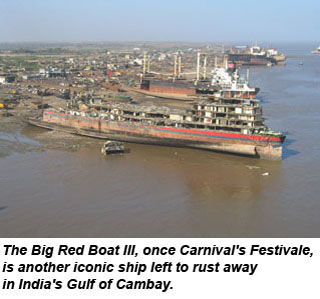 On either side of the tanker, as far as the eye could see, a gloomy gathering of once-proud ships surrounded us. Facing north, I watched in disbelief as a portion of the ravaged keel of the neighboring Big Red Boat III, once Carnival's Festivale, was torn off and sent crashing into the embankment. Workers soon scurried into the cloud of debris to begin cutting the twisted section into smaller parts. Missing bow and stern, the Stella Solaris lay on the distant horizon, its superstructure untouched, save for a few holes cut to access its fittings.
Just aft, the Genoa rested with tenders alongside, filled with fittings lowered from holes cut into its hull. Built as the Cunarder Sylvania and rebuilt for Sitmar as Fairwind, it later sailed for Princess as the Dawn Princess before its final career as the Germany-based Albatros.
South of us, the New Orleans, last in service for Commodore Cruises as the Enchanted Isle, sat with bow, stern and a large portion of its structure missing. Next to it, steam still emanating from its funnel, lay the freshly beached Salona, originally Cunard's transatlantic liner Ivernia and later the glamorous, Franconia in the '60s.
A mile or so away, the partially demolished Assedo was stranded on a reef. Farther down the shore, amid the thudding cacophony of hammered metal echoing around the desolate seascape, the once-regal silhouette of the Apollo, the former Carnival Mardi Gras, sat with a large portion of its bow consumed. The acrid stench of acetylene cutting torches filled the hazy, sweltering air as my guide and I finally clambered down to safety just before the tide returned.
I spent the next day onboard the forgotten Apollo, the ship that built Carnival Cruise Lines' empire. I wandered its once-elegant Canadian Pacific Line public rooms, which still sport their original etched glass, mahogany and nickel fittings, as workers busily cut, hammered and pried her apart. A visit to the Salonia led to the rescue of original Cunard fixtures. The former Franconia was a ghost ship, still perfectly intact but devoid of passengers and life, its stair towers and ballrooms illuminated by our flashlights.
Three months later, the first of five 40-foot containers arrived at my California home, each filled with treasures I had purchased from the broken ships at Alang: mahogany balustrades, rosewood and maple cabinets, etched-glass light fixtures and panels, nickel railings, paintings, ceramics and artwork from a dying maritime era.
Toxic toll
The impact of the ship-breaking business on the environment at Alang has been disastrous, releasing toxins such as asbestos and PCBs into the air, land and sea.
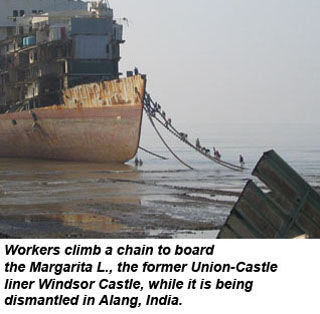 The environmental activist group Greenpeace has lobbied against poor safety conditions for workers at Alang as well as pollution violations, and the tarnished beach is a focus of international scrutiny. But a clean, cost-effective solution to the problem of ship disposal remains complicated, at best, and the required facilities and labor costs to do the job properly in Western countries is prohibitively high.
In response to the furor, some ship breakers now provide their workers with hard hats, respirators and boots. Meanwhile, safe disposal plants for various toxic elements are reportedly under construction.
Although the ship tonnage going to Alang has decreased dramatically in recent years, the death march continues. The cruise industry is one of many contributors to this ship disposal process, but as massive, veranda-enhanced, state-of-the-art ships are built at increasing rates, they displace older tonnage, which trickles down to secondary and remote markets and finally to places like Alang. Increasing oil prices are also forcing some older, less fuel-efficient survivors out of the fold. The final blow will be the 2010 SOLAS regulations, which will spell the end for any passenger ship built with wood in its infrastructure, which includes just about anything built before 1970.
Also, increased demand for scrap metal has made scrapping more lucrative. Once-popular ships, such as Costa's Riviera, the Greek veteran Lapalma, Dolphin's Dolphin IV, MSC's Symphony, Chandris/Fantasy's Amerikanis and Royal Olympic's Orpheues embarked on one-way voyages to Alang.
I followed, to document the sad but historical process of the demolition of these ships. In my four return visits to the Indian beach, I've tendered out to ships in monsoonal deluges, climbed rickety ladders and endured sweltering heat, disease-carrying mosquitoes and the daily challenges of negotiating with jaded ship breakers. But when the next floating, faded icon arrives, I will do it all again to bid a final farewell and rescue a few more bits of maritime history.
Peter Knego is a maritime historian and a collector of mid-20th century ocean liner furniture and fittings that he buys from agents in Alang, India. His worked is documented at www.midshipcentury.com.