The 220,000-ton Oasis of the Seas, the biggest, most-talked-about cruise ship on the planet, was finally revealed to the world this month when it arrived at its Port Everglades home port.
Travel agents, along with members of the media, got their first views of the ship’s massive interior during a series of pre-inaugural sailings, while the first shots of the ship were beamed to the public at large during a two-hour segment Nov. 20 on ABC’s "Good Morning America" show.
The 5,400-passenger Oasis, the largest, widest, and tallest cruise ship afloat, did not disappoint.
The immediate reviews from both the agents and members of the press onboard tended to focus on how much of a departure from any other cruise vessel the Oasis represents.
Whether or not you’re a fan the big ship experience, it is difficult not to be impressed by this one.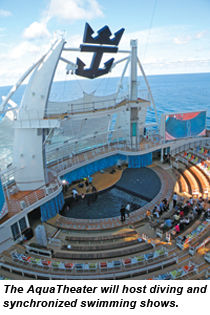
Architecturally, what sets the Oasis apart most is its split superstructure, which is what enabled Royal Caribbean International to build the ship’s two most interesting and unique features: the Boardwalk and Central Park outdoor "neighborhoods" in the central spine of the ship’s interior.
Harri Kulovaara, executive vice president of maritime for Royal Caribbean Cruises Ltd., the self-described "father" of the split superstructure idea, said the concept evolved from centrally situated atria, the Royal Promenade concept that started on Royal Caribbean’s Voyager-class ships and was enlarged on the Freedom class.
On the Oasis, the ship’s width enabled its designers to open the central spine of the ship to the sky and essentially add another level to the Royal Promenade: Central Park, which also serves as a roof to the Royal Promenade. Two huge skylights on the Park filter natural light to the Promenade below.
Royal Caribbean CEO Adam Goldstein said that in the early stages of planning what was to become the Oasis, his team felt that the ratio of indoor space to outdoor space on such a large vessel would be "wrong" if it was built with a traditional enclosed design.
By opening the central corridor to the elements, Goldstein said, the ratio of what was external to what was internal changed.
"It still allowed us to not only provide incredible options, but better options than ever before," he said, citing more parts of the ship under open sky, many al fresco dining options and the ability to transit the length of the ship in either the outdoor Central Park or the indoor Royal Promenade.
"This made us confident we were onto something special," Goldstein recalled.
Kulovaara said that the quantity of natural light, even in the ship’s interior spaces, is one of the Oasis’ most remarkable elements.
Traditional ships, he said, "usually have low ceilings, with decks stacked like pancakes and with no daylight inside. Opening the ship from the top changes all of that."
You say you want a revolution?
Royal Caribbean executives continually explain that the Oasis, like the Royal Caribbean ships before it, was designed as a three-part concept: one-third familiar, one-third evolutionary, one-third revolutionary.
It is a mantra that was repeated by many of the ships’ architects and designers present at the unveiling.
RCCL Chairman Richard Fain explained that the line’s old hats would be "at home in the Schooner Bar," which represents a traditional area of the ship. Evolutionary areas would be the Royal Promenade and the ship’s theater, both bigger and designed with some differences, but still familiar. The ship’s Central Park neighborhood and the AquaTheater are examples of revolutionary aspects.
While Central Park is a revolutionary idea, it came about in an evolutionary way.
Scott Wilson, principal of Boston-based Wilson Butler Architects, one of 14 firms involved in designing the Oasis and one of seven firms on the Central Park design team, explained that in the beginning, the idea was to make the ship’s Royal Promenade an open space.
 They quickly realized, however, that since it was the main artery of the ship, it would need a roof for rainy days.
They designed a Central Park that would be a grassy lawn with rolling hills and meadows.
RCCL had undertaken grass testing when it introduced the grass-area concept on Celebrity Cruises’ Solstice-class ships. But the Solstice grass, on the vessel’s top deck, gets sunshine all day long. Central Park is built into something of a canyon, bordered by six deck levels, and only gets three hours of full sunshine per day.
During the winter of 2006-2007, the designers went back to the drawing board. When they returned, they presented Royal Caribbean with the idea of a tropical garden, still designed with elements from New York’s Central Park, like winding pathways and different vignettes. But no grass.
And there would still be physical connections between the Royal Promenade and the Central Park, with the two massive skylights and the Rising Tide, a bar that takes people from the Promenade on Deck 5 three decks.
The Rising Tide concept derived from a simple order the designers got from the top: Come up with an interesting way to transport people from Deck 5 to 8.
Decisions, decisions
With 37 cabin categories to choose from, deciding where to stay on the Oasis could be daunting.
For the well-heeled, the ship’s 28 split-level loft suites offer a living area, a guest bathroom and, up top, a loft bedroom, overlooks and a full bath.
The wall that faces out to sea is made entirely of glass, offering soaring ocean views. Looking down from a Deck 17 loft balcony, you realize that you are truly on a ship the size of a tall building.
The top level Loft is the Royal Loft Suite, which at 1,524 square feet, Fain has pointed out many times, is larger than the average American home.
Other accommodations found only on the Oasis are the balcony cabins overlooking the Boardwalk and Central Park neighborhoods.
These are the first balcony cabins that don’t overlook the sea (the Boardwalk cabins face the interior Boardwalk neighborhood, but they offer a partial ocean view by looking to the sides beyond the AquaTheater).
Since Royal Caribbean gets a premium for these cabins compared with the balcony cabins overlooking the ocean, people clearly find this appealing, which Fain said has vindicated him.
"Back when we introduced the Voyager, I told Brian [Rice, RCCL’s CFO], that we’d do better with the cabins overlooking the Promenade than the ocean view, and I was wrong," Fain recalled. "I told him that we would get premiums for the Central Park and Boardwalk cabins on this ship, and this time I was vindicated."
Just as real neighborhoods differ from one another, the same is true on the Oasis.
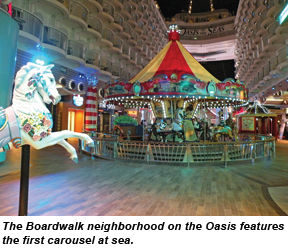
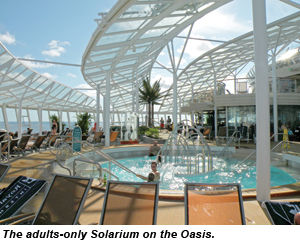
Central Park is a quieter and more "adult" space than the family-friendly, Coney Island-style Boardwalk.
Pricing, fees and freebies
Royal Caribbean CEO Adam Goldstein said he was displeased with the way the Oasis pricing issue has been reported. Pricing questions have dogged the line’s executives since they mentioned in September and on RCCL’s earnings call that there was still room available on the Oasis’s inaugural December sailings.
 But Goldstein said then — and he repeated during an interview on a pre-inaugural Oasis sailing — that the line did not want the ship at capacity in its first month, in order to let the crew get its bearings.
What the press also overlooked, Goldstein said, was that after Jan. 2, "the Oasis of the Seas is booked at higher prices and a higher load factor than any other ship in the Royal Caribbean fleet for 2010.
"For three quarters in a row we have said that we are pleased with the booking profile of Oasis of the Seas. And we are."
Goldstein also shed more light on another Oasis pricing issue: the fact that ship offers so many culinary options that carry an extra fee.
"We have included in the ticket price, by far, more than we ever have," Goldstein said. "We also never had so many additional charge opportunities."
Goldstein said that without the extra charges, the amenity could not be offered.
"You can’t expect all of our guests to subsidize what some of our guests do," he said. "If 2,000 people want to gorge themselves on premium ice cream for free, it’s not fair for the rest of our guests to subsidize it."
On the other hand, the Oasis offers many amenities for free that could have carried an extra charge, such as the zipline, the rock climbing wall, the carousel, the FlowRider surf simulator, the mini-golf course and ice skating. But Goldstein said that if Royal Caribbean wants to portray itself as the "Nation of Why Not," where people can do all those activities at sea, they should be part of the ticket prices.
"It’s clear people would pay to do the zipline," Goldstein said. "But we include it in our price so the message is consistent that we offer an active vacation experience."