ABOARD THE KONINGSDAM — Among the most attractive of many attractive spaces on Holland America Line’s Koningsdam is a three-story, midship atrium that sets the tone for the brand’s newest vessel.
The space has a wonderfully light and airy feel and conveys more modernity than some of HAL’s previous ships, while not being so contemporary that it is out of character.
Illuminated from the top by a faux skylight, the circular atrium is defined by arcing chrome grills that give the feel of an upward spiral to the open area, which permits views between the first three decks of the ship.
The Deck One space at the bottom is for Journeys Ashore, the excursion desk, as well as a cluster of small meeting rooms.
Deck Two is where the atrium gets interesting, with the combination of HAL’s top alternative dining venue, the Pinnacle Grill, and its newest offering, the French-inspired seafood brasserie Sel de Mer.
A transparent wine tower, rather than being housed in the Pinnacle Grill itself, impinges on the space surrounding the atrium, displaying its vintages to anyone on any deck of the three-story space.
Deck Two also has the Ocean Bar, a convenient pre- and post-dinner meeting spot.
Adjacent to the atrium on Deck Three, in addition to the guest services and future cruises desks, is the Grand Dutch Cafe, another new piece in HAL’s culinary lineup. It offers pastries and light snacks; draft and bottled beers; coffee; tea; and liquor.
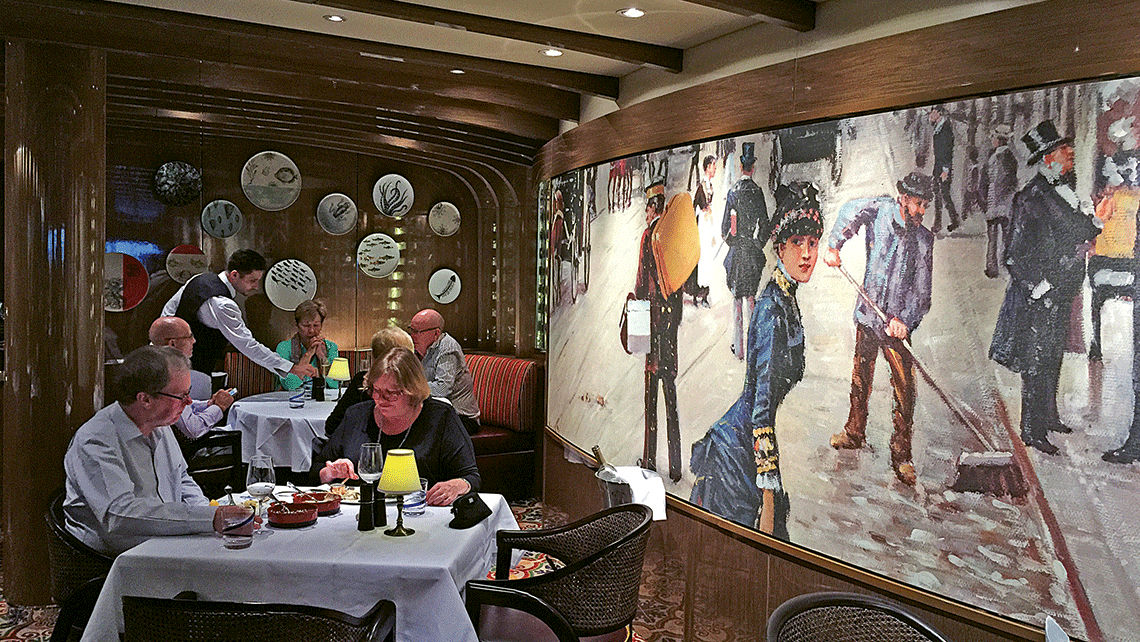
The Sel de Mer restaurant has a mural of 19th century French street life on one wall. Photo Credit: Tom Stieghorst
Again, in a light and fresh way, the cafe reinforces HAL’s Dutch heritage. Draft beers include not only the ubiquitous Heineken but lesser-known names like Brand and Hertog Jan. The menu is full of Dutch treats, such as pea soup, herring and several variations of pannekoek, the Dutch version of pancakes.
The display signage setting out the menus cleverly incorporates the distinctive stepped gables and other roof shapes of the houses that line the canals of Amsterdam.
I had the chance to sample the cuisine in Sel de Mer on the first night of our 12-night Mediterranean Mosaic cruise as it departed the port in Civitavecchia, Italy, an hour northwest of Rome.
The 44-seat room is intimate, with less than a dozen tables. One side is dominated by a large mural of late-19th century French street life. A vertical line of mirrors on the opposite wall makes the room look bigger, and it is decorated in a warm, brown palette.
Sel de Mer is one of a new breed of alternative restaurants in which pricing is a la carte rather than covered by a fixed charge. Entree prices range from $16 for moules frites, the French/Belgian steamed mussels served traditionally with french fries, to $32 for a Maine lobster.
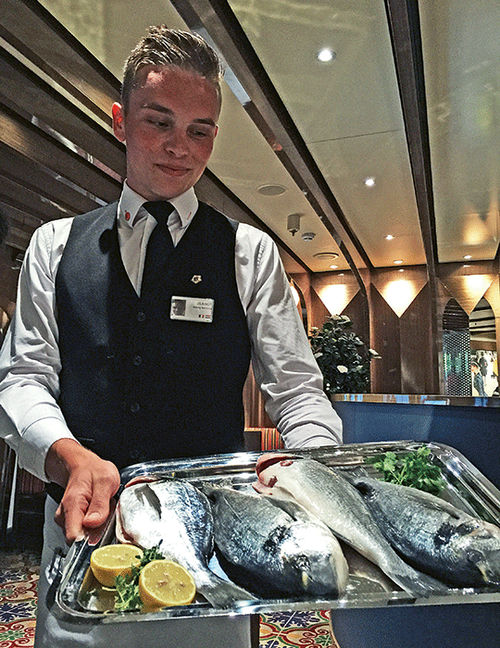
A waiter at Sel de Mer displays sea bream bought fresh in the local market that day. Photo Credit: Tom Stieghorst
The seafood menu is augmented by a selection of classic brasserie plats du jour, which starts with foie de veal (pan-fried veal liver) on Mondays and concludes with rack of lamb persillade on Sundays.
I was tempted by the Wednesday offering of daube de boeuf, a braised beef in wine sauce ($18) but the chef had a special treat for us: sea bream purchased fresh in the Civitavecchia fish market before departure.
Our waiter brought several bream on a platter for display before the whole fish was grilled in the galley. The resulting dish was hot, soft and savory with a squeeze of fresh lemon. I ordered a lemon-butter sauce on the side, but I really only tried it to see what it added. The unaccompanied fish was splendid on its own.
My fish was preceded by a crab appetizer: a tower of three salads, each made with a different type of crab. I skipped the sweet desserts in favor of a platter of four French cheeses. My tablemates said the tarte Tatin, another brasserie classic, was excellent.