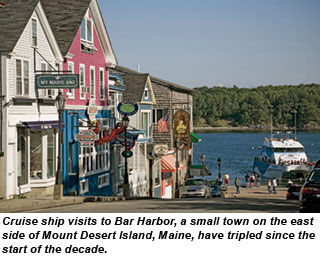
 Two years ago, the quaint New England village of Bar Harbor, Maine, found itself facing a conundrum brought on by success.
Cruise ship visits were increasing, a result of the port's efforts to lure more traffic to its shores. But instead of being happy about it, local businesses were beginning to question whether the thousands of people who descended on the small town were providing any benefit to the community.
Anne Krieg, Bar Harbor's planning director, recalls that "there was a lot of concern" from the Chamber of Commerce and from bed-and-breakfast owners "about what the asset was for the town from cruise ships. There was congestion, and people were saying, 'What are we getting from this?' "
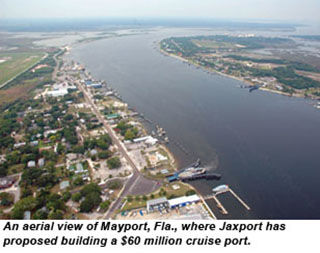
At about the same time, another seaside village much farther down the East Coast was awash in controversy, as well. Tiny Mayport, Fla., where many of the 5,267 residents work in the shrimping and fishing industries, was mulling a plan to build a port to serve the nearby city of Jacksonville.
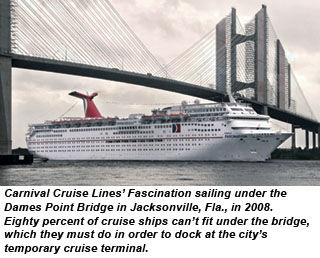
Jacksonville has no permanent cruise port. The one it has been using lies west of the Dames Point Bridge, which is too low to allow passage to 80% of cruise ships, according to Jaxport, the Jacksonville Port Authority.
So Jaxport floated an idea to build a $60 million cruise ship port east of the bridge, in Mayport. The plan ran into immediate local opposition, including lawsuits, and it has so far failed to win approval.
The issues in these two locations, as well as the outcomes, are starkly different. But each serves as a reminder of the friction that can arise between the small floating cities that are cruise ships and small coastal communities that serve as their hosts.
Protests often focus on environmental issues or on concerns that thousands of cruisers descending on a small town can harm its quaint character.
There are also questions of the economic benefit cruising brings, and at what cost to the community.
In Mayport, no amount of money would have convinced the fishing community that a rise in cruise ship arrivals wouldn't have threatened their greatest asset: clean water.
Jaxport began a search for a new cruise port location in 2004.
"Cruise ships are getting too tall, and we are going to put ourselves out of business if we stay where we are now," said Nancy Rubin, Jaxport's director of communications. "At the temporary terminal, we serve one cruise ship, the [Carnival] Fascination. We want to serve more, it has done so well."
In April 2008, Jaxport purchased property from private developers in Mayport and asked the village council to approve building a terminal on the St. John's River there.
The Mayport Village Civic Association, along with many residents, objected to the construction of the cruise ship terminal on grounds that the ships would pollute the waters that feed its fish and shrimp industries and that the onslaught of passengers would ruin the local character of "the oldest fishing village in America."
They also noted that Mayport is accessible only by a two-lane road, which couldn't sustain the traffic the megaships would create.
 "This is not the right place to put it," said David Fisher, former chairman of the Mayport Waterfront Partnership and past president of the civic association. "It should be someplace where people don't live. This is a working waterfront where fishermen tie up their boats and make their living. People live right across the street.
"Everybody knows cruise ships pollute. They burn bunker fuel, they've been fined millions of dollars for dumping every place they go. It's ugly."
The civic association sued Jaxport, seeking an injunction to block the project. Several environmental groups have since joined the fight, including the Public Trust Environmental Legal Institute. Two local filmmakers made a documentary in opposition of the project, titled "One Village, Same Ocean."
The Mayport concept is now on the back burner. The plan was pulled earlier this year, but the reason, Rubin said, was the economy, not the protest.
Divided opinions
"While some of the residents were very vocal in their concerns, there are many people in Jacksonville and in the Mayport area who said they believed that a terminal would be a catalyst for revitalizing the economy there, Rubin said.
Jaxport argues that a thriving cruise industry could help the community supplant a dying fishing industry. A University of North Florida projection of the economic impact of a Mayport Cruise Terminal predicted that construction and operation over the next six years would bring in about $160 million and create 5,000 jobs.
The Mayport opposition is not swayed by dollar signs. In fact, part of the protest seems to be that the behemoth cruise industry is trying to muscle its way on a small town and its powerless residents.
"They'll probably wind up building it," Fisher said. "They got money, and we don't. They'll figure out a way to jam it in there."
The root of concern in Bar Harbor was very different than it was in Mayport.
"The cruise ship industry has grown very quickly in Bar Harbor, from 30 ships in 2000 to over 90 this year," said Chris Fogg, executive director of the Bar Harbor Chamber of Commerce. "That's a big increase for a small town like ours, and we needed to find ways to better manage the traffic ... for both the community and to improve the visitors' experience."
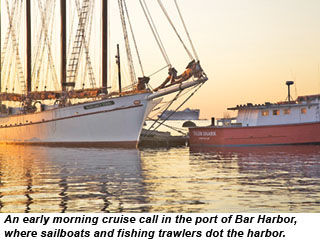 Town residents were concerned about congestion. They also worried that as the ships got bigger and dropped off several thousand passengers, they could ruin the small-town feel that drew people to Bar Harbor in the first place.
Beyond that, business owners said the cruisers weren't spending money in local business.
"We said, 'Let's look at this. Let's see how we can manage this better and coordinate this better,' " Krieg recalled.
The town and the Maine Port Authority commissioned an $80,000 study of the issue by Miami-based Bermello Ajamil & Partners, which assessed traffic conditions, analyzed cruise-related activities, did an environmental review and looked at the economic benefits to the town.
It was completed in May 2007, after which the town council formed the Bar Harbor Cruise Ship Task Force to review the 88-page study and make recommendations about cruise tourism in Bar Harbor.
As a result, ships will be assessed a new, bundled anchorage and head tax, simplifying what the town called a "hodgepodge" of cruise ship fees. The tax will be used to finance improvements to the port and visitor experience, such as public rest rooms.
Recognizing that ships are getting increasingly larger, the current two-ship limit in Bar Harbor will change, beginning next year, to a cap of 5,500 passengers per day, which drops to 3,500 passengers per day in August, Bar Harbor's high season.
To encourage spending in local businesses, a post-tour coach drop-off location has been created in the Village Green, an area up the hill from the cruise port where many shops and restaurants are located. Previously, passengers were dropped back at the ship.
Fogg said the changes have worked well, enabling "visitors to experience more of what makes Bar Harbor so special."
Some local business owners agreed.
"We have seen an increase in business," said Jen Lozano, owner of the Parkside Restaurant, located up the hill. She said she has heard from other business owners who have also seen an increase in business and in foot traffic.
"I was finding that the cruise ship clientele would not want to walk up the hill," she said. "That hurt my business."
She also said the changes have altered her attitude toward cruise ships.
Krieg said that the town has also been able to convey to the community some of the benefits of cruise tourism they might not have considered and to dispel some of the myths associated with it.
One of the myths, for example, is the notion that cruisers create traffic. Krieg pointed out that land-based visitors in cars create more congestion issues.
Cruisers, she said, "are pedestrian visitors, so there are no cars and parking issues. It's a 15-minute congestion issue, and then they are dispersed. ... After that, everybody is gone."
She also said cruisers represent direct, measurable revenue.
 "With land-based visitors, we don't have a toll that comes into Bar Harbor," she said. "What we get from the land-based visits is the taxes. The largest taxpayers are all hotels, so we get the benefit once removed. With cruises, we get revenue direct from the provider."
Even so, economic impact to a port from the cruise industry is always tough to measure.
In ports such as Bar Harbor, the infrastructure to receive cruise ships has been there for a long time and has not needed massive investment.
In places like New York, it is part of a much larger tourism industry.
In the ports along Canada's St. Lawrence River, many of which are difficult to get to except by water, cruising is seen as the best long-term strategy for sustained tourist arrivals.
David Russell is principal of DMRussell Consulting, a firm that consults on tourism development and land-use planning. He argues that investing in cruise tourism over land-based tourism is a mistake.
"It is much better for most countries to build up stay-over tourism," tourists who stay for more than one day, Russell said. "They spend more per person, they rent cars, eat in restaurants, get hotels.
"If you chase cruise tourism alone and don't build your stay-over tourism, you spend a lot to get not as much in return."
As an example, he cited the case of Belize. The Central American country decided to chase cruise ship tourism with great success in the early part of this decade, managing to increase passenger visits from 20,000 to almost 1 million in about five years.
But Russell said it wasn't the best use of their tourism development dollars.
In 2004, cruisers made up 77.4% of the total tourist arrivals to Belize, but they spent just $22 million of the $156 million in tourist spending, or only 14.1%, Russell said.
Russell said that embarkation points in general fare better than ports of call.
"It works for a country to be an embarkation point," he said. "People do pre- and post-stays; they fly in. Those ports are provisioning points, which means the ships are buying things from the country. People buy much more than just trinkets and some food and drink."
The cruise industry would argue that being either an embarkation port or a port of call is an economic benefit. CLIA's annual economic impact study released last week found that in 2008, a 2,550-passenger ship generated approximately $320,000 per U.S. port call visit in passenger and crew onshore spending, compared with $333,000 to homeports. CLIA also found that the North American cruise industry created more than 357,710 jobs and generated $19.07 billion in total economic output in 2008, 2% more than in 2007.
Florida receives the most direct economic impact, with 57% of all U.S. embarkations.
Numbers are comparable at ports around the world. In the Baltic, the cruise sector was expected to generate between 6,300 and 13,200 jobs and pump $652 million into the economy, according to Cruise Baltic, the region's cruise marketing arm.
But many of these ports, along with major ports in the Mediterranean and in the U.S., were already handling massive container and cargo ships well before anyone had thought about cruising. They didn't need much investment to add cruise ships. For the largest cities with thriving cruise sectors, like Miami and Tampa in Florida and Barcelona, cruise traffic does not stretch the communities' resources.
"For ports trying to get into the business or even to expand existing business, unless they are a major cruise port like Barcelona or Venice, it is difficult to get a decent return on investment if they invest in fancy terminals or megaberths," said Tony Peisley, a U.K.-based cruise industry analyst. "Too many ports spend too much money on terminals and other infrastructure that cruise lines do not want or need at what are primarily transit ports."
Peisley explained that in most of Europe cruising is a seasonal business with little or no traffic in the winter; the ports usually earn more money directly from a cargo ship call than from a cruise ship.
"The real value of cruise tourism is to the city or region around the port," he said. "So, if a port is owned by the city, the broader economic benefits can be factored into the infrastructure investment. If the port is privately owned, it is hard to justify the investment on those grounds."
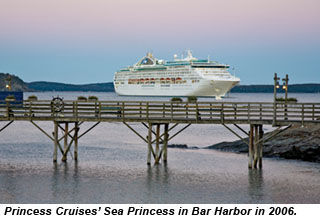 For many ports around the world, there is a very simple reason to lure cruise tourism: It has registered continuous growth.
This was cited by Quebec's minister of tourism, Nicole Menard, when she said in June that the government aimed to make the St. Lawrence "a major cruise destination" with a $137 million investment to improve or create cruise facilities at small ports and to market Montreal and Quebec City.
She noted that while visits from the U.S. overall had fallen significantly since 9/11, the cruise industry had continued to grow.
Yet, those numbers can only carry the argument so far. As the case of Bar Harbor shows, selling the benefits to the community also requires good planning and the ability to accommodate the unique requirements of cruise tourism.