ABOARD THE VIKING STAR — It’s a rare event when a brand-new
cruise line debuts along with a brand-new ship, so the arrival of the Viking
Star offers cruise passengers a chance to try something genuinely fresh.
The 930-passenger ship, currently on a 50-day shakedown
cruise, will be christened on May 17 in Bergen, Norway, where the mayor has
invited 20,000 guests.
In its design, the Viking Star shares some similarities with
the fleet of river ships that Viking Cruises has operated for the past 18
years, though on a much bigger scale.
Not that the Viking Star is big. It fits with the fleets of
small-ship lines running the gamut from Windstar Cruises up to Crystal Cruises.
First and foremost, it is for guests who think small is beautiful.
Two other factors stand out to me about the Viking Star. One
is the fact that parent company Viking Cruises is privately owned, which leads
directly to the other factor: the ship’s distinctly Nordic identity.

The Viking Star in Istanbul.
Viking Chairman Torstein Hagen, a native Norwegian, has put
his stamp on the ship. The main lounge, an intimate pre- and post-dinner
hangout, is called Torshaven. In another lounge there is a Norwegian-style deli
that features recipes from Hagen’s mother and a menu with family photos.
As the chairman of a private company, Hagen can indulge his
whims a bit. But the Scandinavian theme is consistent throughout the ship, as
strategic as it is personal.
The decor is what Americans call Danish modern, with a
clean, spare appearance that has been around since the post-World War II era
but still seems contemporary. As on the river ships, the uncluttered look helps
the ship feel more spacious. Many of the public rooms bear Nordic names
(Juveler for the jewelry shop), but others such as the Restaurant for the main
dining room are generic in that modern way.
Beyond its Nordic flavor, the Viking Star’s identity comes
out in Hagen’s specific passenger targeting. There is no kids’ club on the ship
because it is aimed squarely at couples age 55 and up.
On the shakedown cruise, guests were in their 60s and early
70s, many from the Western U.S. The lion’s share of the 633 passengers had
cruised previously on Viking’s river ships.
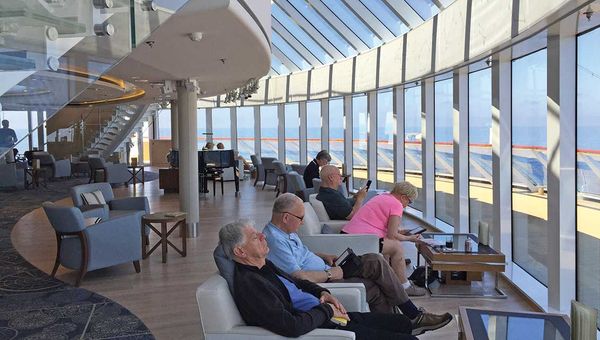
The Explorer's Lounge and its panoramic windows. Photo Credit: Tom Stieghorst
Since Viking is privately owned, there is less pressure to
deliver onboard revenue, starting with unlimited free Internet, which almost no
other cruise line provides.
There is at least one free shore excursion in every port and
no charge for specialty restaurants. Wine and beer are free with lunch and
dinner, and most drinks in the lounge are a modest $4 to $6.
The included amenities on the Viking ship compare favorably
with — and in some cases exceed — the inclusives offered by the luxury cruise
lines.
Staterooms on the Viking Star all have balconies and come in
five categories, from the 270-square-foot Veranda to the 757-square-foot
Explorer suites.
Stacked against two lines Viking is often compared to —
Azamara Club Cruises and Oceania Cruises — the rooms are bigger than Azamara’s,
category for category, and a shade smaller than Oceania’s two newest ships.
There is also a true owner’s suite, labeled “private
residence” on maps of the ship and situated on Deck 7, convenient to the
Norwegian deli and isolated from other cabins.
The Viking Star has several nifty public rooms. The
light-filled Wintergarden is a novel flex space, with sliding glass panels on
three sides that open onto corridors and the ship’s main pool. It is popular
for a daily afternoon tea, though a little underused otherwise.
The Living Room is a comfort space on Deck 1, with a bar and
inviting sofas. Rather than have a library, the Viking Star has books on shelf
spaces in this room and other nooks and crannies around the ship.
The ship’s single-story theater is one area where
understated elegance was a bit too understated, more functional than dramatic.
The best show I saw was in Torshaven, a standing-room-only “Rat Pack Revisited”
tribute to the Las Vegas-era Frank Sinatra and friends. It was superbly
executed and well targeted to the ship’s demographic.
The food was of good quality. One interesting concept
(although a bit of a misnomer) is the Chef’s Table, a 120-seat restaurant with
a menu that cycles every nine days through one of five themes, such as Venice
Carnival or Asian Panorama. In effect, it creates five specialty restaurants
out of one. (There is also an Italian specialty restaurant, Manfredi’s,
available every night.)
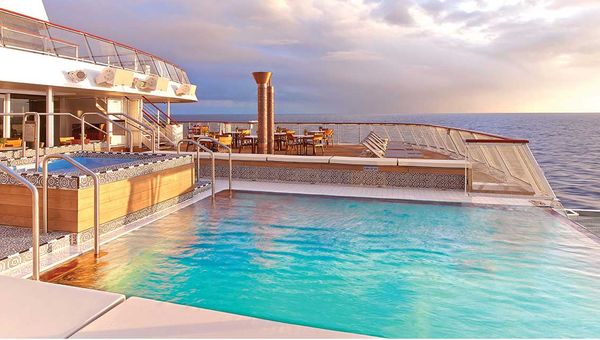
The Viking Star's infinity pool.
Inevitably, there were glitches on the first cruise:
problems balancing the air conditioning and hot/cold water in some rooms; an
in-room coffeemaker that baffled passengers and lacked instructions; and an
excursion billed as “easy” that was too strenuous for some passengers.
The most notable lapse was the total breakdown of the TV
system for the first few days of the cruise. That resulted in an apology letter
and a $100 onboard credit from Viking management.
But most passengers seemed understanding.
“What saved us is we have a good crew that has been well
trained and has great motivation,” said Erling Freydenberg, Viking’s vice
president of hotel operations.
The Viking Star, which will primarily sail in northern
Europe during the summer with occasional forays back to the Mediterranean, will
be joined by two sister ships, the Viking Sea and Viking Sky, in 2016.