With multiple glacier visits, wildlife-viewing opportunities and the presence of national park rangers onboard, Glacier Bay National Park remains a key draw for the Alaska cruise itineraries that include a visit there.
The effects of climate change, however, are impossible to ignore.
I was able to witness it myself on a September sailing aboard Holland America Line's (HAL) Koningsdam.
The park's marquee Margerie Glacier is visually receding, rangers said. And even first-time guests like me were able to understand the scale and rate of the shift, thanks to national park programming offered onboard.
As the park changes, visits there and the accompanying programming are evolving in real time, encouraging guests to enjoy the splendor of the park but making them fully aware of the science.
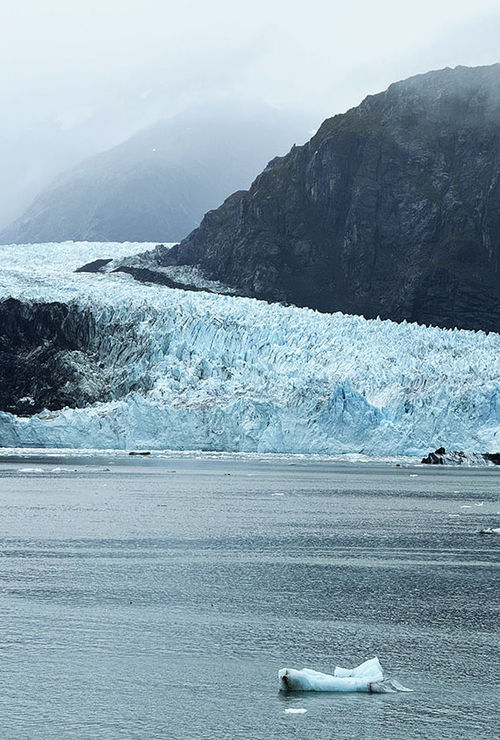
Margerie Glacier as seen from Holland America Line's Koningsdam in Glacier Bay National Park in September.
"I think it will continue to be the same amazing place that it is today, with a different story being told over time," said Bill Fletcher, HAL's senior director of sales enablement.
On the Koningsdam, park ranger Allison Culliney presented a talk in the theater about optimism and the climate. She offered visuals of the impact of climate change by showing images of Margerie Glacier in 2015 and 2025, but she also shared ecological success stories that she said offer reasons to believe that change is possible. Those stories included the recovery of the ozone layer and the rebound of the humpback whale population after whaling was banned.
"It's only natural to feel overwhelmed and scared at this challenge that we're facing, which is arguably the biggest challenge of not only my generation but of this entire century," Culliney said. "But we can still feel overwhelmed or scared or even avoidant at times and still attend to the world's very near and immediate problems."
Fletcher said HAL polled guests on behalf of the park service and found that while glacier viewing is high on the list of reasons to book an itinerary that include Glacier Bay, so is the wildlife and the fact that a cruise is, for many, the simplest way to visit the remote park.
Wildlife and history lessons
Guest excitement was palpable on the Koningsdam the day we arrived at Glacier Bay. The first ranger program was at 7:45 a.m., where in a packed room guests learned how the rangers had boarded the ship earlier that morning, transferring to the moving ship from a moving catamaran. We also learned about the history of the bay and the Tlingit people, for whom it is an ancestral homeland.
Afterward, on a low deck where the wraparound promenade offers the closest access to water-level views, guests gripped binoculars and intently searched for wildlife in the surreal landscape as a park ranger's voice occasionally offered nature or history facts over the loudspeaker.
The first highlight for me was spotting an otter that gradually swam closer to the ship until its features were visible without binoculars. Seeing it float and dive that close to me was a bucket-list experience.
The second was in the theater, where Kevin Skeek, an Alaska Native who boarded that morning with the rangers, presented an exceptional talk about the Tlingit people, their relationship to the land and the realities of what happens when that land becomes a national park.
Skeek spoke about some sobering realities, including how the creation of the national monument, the park's predecessor, displaced his ancestors. But he also explained how working alongside park rangers has been a plus, as he has found them to be compassionate and culturally sensitive. A terrific storyteller, Skeek was able to infuse an often-serious talk with the perfect amount of humor.
Other unique onboard opportunities during a Glacier Bay visit include a pop-up gift shop and the chance for children to become certified "junior rangers" like they can at national parks on land.
And Margerie Glacier? It's still stunning, even as climate change takes its toll.
"I see how small it is and how far it's gone, [but] for our guests it's the most magical thing in the world," said HAL business development manager Ryan Baird. "It's the most impressive glacier that they've seen."