Booking Auvergne
Restaurant Emmanuel Hodencq: (011) 33-47 331-2323; www.hodencq.com
Vulcania/Parc Naturel Regional des Volcans d'Auvergne: www.vulcania.com
Le Boudes la Vigne: (011) 33-47 396-5566
Hotel Le Parc des Fees: (011) 33-47 381-0177; www.parcdesfees.com
Sofitel Vichy: (011) 33-47 030-8200; www.accorhotels.com
Golf de la Foret de Montpensier: (011) 33-47 056-5839; www.golf-montpensier.com
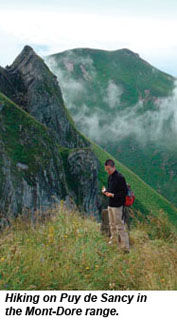
My first reaction while gazing at the steep volcanic slopes on Puy de Sancy, the highest in France's Mont-Dore mountain range, was one of trepidation. Our half-day trek with a mountain guide was supposed to be about scenery, not climbing sheer rockface.
True, the 6,188-foot summit isn't exactly nosebleed-high, but reaching it looked like more of a challenge than my companions and I were prepared for.
Our fears were quickly put to rest when we were hustled into a funicular at the base station and transported up the side of the mountain to a scenic trail just wide enough to negotiate single-file.
The payoff was instant: panoramic vistas high above the clouds, wildflowers of every color and size all around us and even a sprinkling of cattle and horses in the distance. Picture Julie Andrews leading the Von Trapp children across the mountaintops at the end of "The Sound of Music" and you get the idea.
The trek, which requires only a normal level of fitness but sturdier shoes than mine, was the centerpiece of a weeklong exploration of the Auvergne region of France, which boasts calendar-worthy landscapes, historical architecture, a robust spa culture and not a lot of tourists.
 In short, Auvergne might be the prettiest part of France you've never heard of.
Our exploration of the region started in Clermont-Ferrand, the region's capital and a town that deserves more attention than it gets from tourists. Air France operates the hourlong flights from Paris several times a day, and the airport is about four miles from the city center.
The heart of Clermont-Ferrand is the Place St. Pierre, presided over by a 13th century Gothic cathedral constructed primarily of volcanic rock and flanked by pedestrian walkways and appealing shops.
Because the Michelin tire company started in this area, we made time to stop in the logo store, where we shopped for T-shirts and other souvenirs emblazoned with the Michelin Man, known in France as Bibendum.
City center sights
Other noteworthy sights in the city center include the beautifully preserved Notre-Dame-du-Port Romanesque basilica, dozens of old fountains fashioned from lava stone and a statue of Vercinetorix, a hero in early French history, sculpted by Frederic Bartholdi, who also created the Statue of Liberty.
Although Auvergne doesn't have the international culinary cachet of the Dordogne region nearby, there are highly touted restaurants in the region, including the Restaurant Emmanuel Hodencq in the Place St. Pierre. Here we ate our way through a multicourse menu that included such gourmet fare as foie gras, prawns and a dessert simply called "the history of chocolate."
Food lovers can also visit the Nivesse Cheese Dairy in the town center, where the most important local cheeses, St. Nectaire, Blue d'Auvergne and Cantal, are among the products available for tasting and purchase.
While exploring Clermont-Ferrand, it is impossible to miss the Chaine des Puys volcanic mountain range that forms the city's dramatic backdrop. The highest peak is the Puy de Dome, which makes a great vantage point from which to view the city.
To get a better idea of the geographic turbulence that formed the region eons ago, we spent the next day at Vulcania at St. Ours les Roches, about nine miles from Clermont-Ferrand. Although described variously as an eco-park and a theme park, Vulcania is a little of both.
The intent here is to provide "edu-tainment" through a series of virtual rides using technology that theme park fans will recognize from high-tech U.S. attractions.
The Dragon Ride, the Awakening of the Giants of Auvergne and the Magma Explorer entertain via 4-D movies and virtual rides. Fans of more relaxing exhibits can enjoy the re-created Great Geyser that shoots a giant stream of water into the air or hop on an electric car that follows a track around the grounds. In all, the park is expected to draw some 300,000 visitors in 2009.
In addition to volcanoes, the Auvergne region boasts 11 towns that have been officially designated among the Most Beautiful Villages of France by the French government, and we spent the next several days exploring some of the most prominent.
View from the villages
Usson, for example, perched on a volcanic peak, once served as the site of Queen Marguerite de Valois' exile in the late 16th century, but nowadays the medieval church and the stellar views make for a scenic day trip. As in many of the region's towns, there is a huge statue of the Virgin Mary on its highest peak, overlooking the surrounding countryside and visible from miles away.
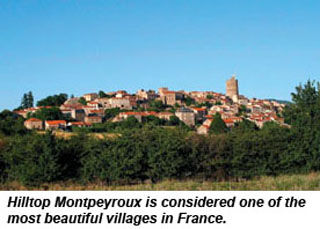 The village of Montpeyroux, also situated on a hill, boasts a tower that once served as a prison but now offers spectacular views of the countryside.
No trip to France is complete without a tour of a chateau, and we saw several. The Chateau de Parentignat in Issoire, open to the public in the afternoons, is noteworthy for its vast English garden and mansard roofs. The Renaissance chateau in Villeneuve Lembron, on the other hand, boasts an impressive interior, complete with frescoes, Aubusson tapestries and period furnishings.
Our favorite restaurant on the trip, Le Boudes la Vigne, is located nearby in Boudes and offers rabbit and lobster dishes, a cheese cart and a trio of desserts, all served with an extensive wine list.
On the day of our hike along the Puy de Sancy, we spent the late afternoon soaking our tired limbs at the Residence Choussy Espace Beaute Spa in La Bourboule. Here we experienced the spa's signature water treatment, which turned out to be a pummeling with what seemed to be a power washer, followed by a soak in a hot tub.
The overall effect was surprisingly relaxing, and we were all rubber-legged as we made our way to our hotel, fortunately located just across the street. The Au Parc des Fees hotel turned out to be the most congenial of our stay, thanks to its friendly staff and picturesque location on the banks of the Dordogne River.
The importance of spa in the Auvergne region came further into focus at our last stop: the city of Vichy. Known for having housed the puppet government that collaborated with the Nazis during the occupation of France, the city respects, without trumpeting, its complex history. There are no plaques commemorating Philippe Petain, who headed the Vichy government during the occupation, for example, but the tourist office is happy to provide materials that will point out where he lived and worked from his office just off the main square.
Vichy tourist train
Fans of the tiny tourist trains that operate in France's most visited cities will find one here in center square, and the half-hour ride is a relaxing way to see the sights and get a layout of the town.
Although Vichy boasts plenty of architecture dating from Napoleon III, including the Opera Palais de Congres, the real draw for most visitors is the selection of spas. The Hall of Sources, for example, offers spouts connected to six sources of mineral water, each known for its effects against certain ailments.
Although the waters are available for tasting, serious spa goers follow a prescription when choosing which ones to drink, as the wrong ones are said to exacerbate medical conditions.
The other principal spa, Le Dom, boasts an ornate interior studded with ceramics and an Arabic-inspired decor. For a more modern experience, the Sofitel Spa, attached to the Sofitel Thalassa Vichy les Celestins hotel by an interior walkway, offers clean lines and a more antiseptic feel.
The signature treatment, a Vichy water bath, involves lying on a bed in a white, tiled room and getting doused by warm mineral water from above while two attendants dressed like nurses massage your skin in tandem.
Visitors to Vichy who prefer to stay dry will also find a number of other recreational activities in the town. There are several golf courses nearby, including the Foret de Montpensier; 45 annual horseracing events in the Vichy hippodrome; a man-made lake on the river Allier for boating and water sports; and the Napoleon III park with its English-garden ambience.
Over dinner at the Sofitel Vichy's Le N3 restaurant on our last evening in Auvergne, it became clear that the region's relative obscurity among Americans won't last long. Particularly for repeat visitors to France who long for an authentic French experience, free from chain stores, generic hotels and English-speaking locals, Auvergne might just be the country's next hot leisure destination.
For more on Auvergne, visit www.franceguide.com/us.