"Very vertical, very green." Those were the first notes I jotted down as United Airlines' inaugural flight descended toward Funchal, the capital of Madeira, in June.
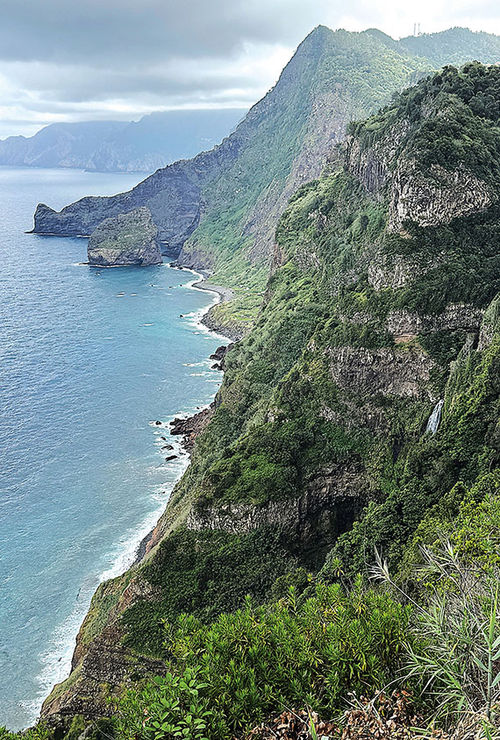
Madeira’s southern coastline is dominated by cliffs rising straight up from the sea. Photo Credit: Arnie Weissmann
Those defining physical characteristics are in no small part why this Portuguese island receives 2 million visitors each year: its cliffs jut dramatically out of the ocean, and birds from three continents have seeded the volcanic soil into a lush carpet. In the middle of this 35-mile-long, 14-mile-wide island, peaks reaching 6,000 feet play hide-and-seek among the clouds.
Madeira is United's fifth Portuguese destination, and it's the only airline offering nonstop service to Funchal from the U.S.
Matt Stevens, United's vice president, international network, said that Madeira traffic via Lisbon has doubled since 2019, leading the airline to initiate nonstop service three times a week from Newark, with the possibility of expanding frequency.
Given the number of annual visitors to the island and its 250,000 residents, I was expecting to see crowds. While I was by no means alone, its streets, even in Funchal's touristy Old Town, weren't particularly congested. The weather was pleasant, all the restaurants and shops were open -- so where was everyone?
It turns out that despite pleasant summer weather, the high season is winter. Not only do a lot of German and British visitors go there to escape the cold, but it's also when most of the 320 annual cruise visits occur, bringing 700,000 passengers.

The pink Reid’s Palace sprawls across a hillside in Funchal. Photo Credit: Arnie Weissmann
I stayed at the island's grande dame, Reid's Palace, now managed by Belmond. Perched on a cliff above Funchal's harbor, its large footprint gives support to its self-proclaimed "palace" designation: It has gardens, a detached spa, a large pool area, multiple restaurants and bars and significant public spaces in addition to the lobby (its lobby, in fact, is a quite modest size).
Both the staff and (mostly British) clientele I encountered could have walked out of a 1950s drawing-room film. There's a charming "Little Britain" feel to it, with its housekeepers in classic maid uniforms and a clientele enjoying finger sandwiches, scones and pastries on the terrace overlooking the harbor (I'm sorry, harbour) at teatime.
I did meet one gentleman who said he visits annually and never leaves the property once he arrives. Nice as Reid's is, he's missing a lot. Funchal is a resort town with a local feel and a sense of history. The Centro Plaza is beautiful, boasting cafes that claim to have been established in the 1840s and where waiters still wear white tunics. The patterned cobblestones and wall tiles in the central area remind you that yes, you're in Portugal.
Modern vibes, vintage transport
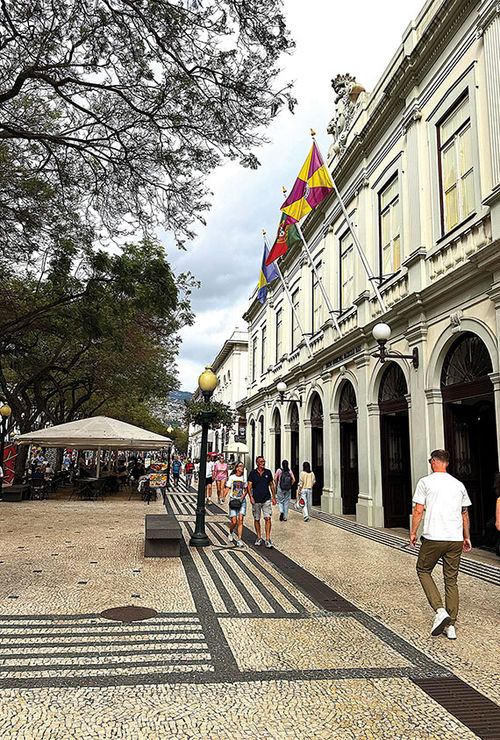
Sidewalk designs similar to ones found in mainland Portugal cities are present in Funchal’s plaza. Photo Credit: Arnie Weissmann
While the feeling in central Funchal is 19th-century Europe, modernity has grafted itself onto the tableau. The imposing Royal Savoy Ocean Resort was built in the 21st century, and the Design Centre Nini Andrade Silva, near the entrance of the cruise ship pier, has a strikingly modern look.
The eponymous owner's restaurant on the top floor has incredible views and was where I had my favorite meal among the handful of excellent restaurants I dined at in the city. (Kampo and Audax are two other excellent choices. Reserve any of these as far in advance as you're able.)
Tourism clearly is the island's economic engine, even in low season, and I found the town's covered farmers market to be unabashedly touristy; you wouldn't miss much more than artful displays of produce if you skipped it.
But there's one unapologetically tourist attraction that's a must-do: tobogganing.
These are not snow toboggans but rather comfy wicker chairs on runners that slide down steep streets, steered, after a fashion, by two men who begin it with a pull and a push and brake by putting their sandaled feet on the pavement (they have attached used auto-tire tread to the soles).
You careen down the street, hopeful that the police at intersections are watchful and stop the cross traffic. It's apparently how the wealthy once got from their homes high up the hill above Funchal into town. It's a wild ride.
Alternately, today there's a calm cable car descent with great views over the town and ocean.
Madeira is also the name of a fortified wine, similar to port, produced on the island. You can learn everything you ever wanted to know about it at Blandy's Wine Lodge in central Funchal.
Beyond Funchal
A popular excursion is to the town of Camara de Lobos, on the southern coast west of Funchal. It was a favorite of Winston Churchill, who liked to set up an easel and paint the local scene. Its harbor is still quite picturesque, and it, too, is home of several excellent restaurants.
Still farther west is Cabo Girao, where a transparent observation deck extends out from a 1,900-foot cliff that seems to rise perpendicularly up from the ocean.
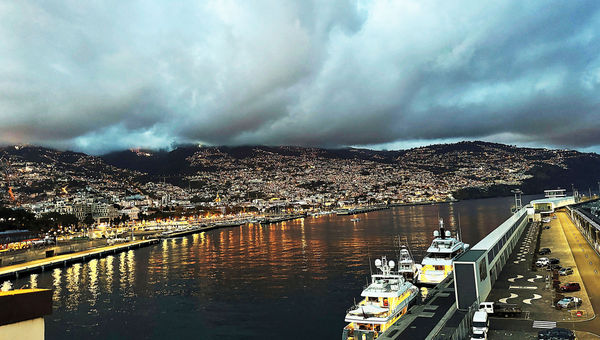
Funchal’s harbor at dusk, seen from the rooftop of the Design Centre Nini Andrade Silva restaurant. Photo Credit: Arnie Weissmann
One of the greatest pleasures of Madeira is hiking or hiring a four-wheel-drive vehicle -- preferably with a driver -- to explore the sparsely populated interior of the island.
In addition to stunning vistas, when I was there in June the dense vegetation included beautiful purple Pride of Madeira flowers side by side with stands of yellow Scot's Broome.
Most of the population lives along the more developed southern coastline, but the black-sand beaches on the north are wider and less crowded.
In the end, "very vertical, very green" isn't an inaccurate impression, but there's more to Madeira than its physical beauty, more than I could possibly take in during the four nights I was there. Sooner than later, I hope to be to back on that United nonstop to see what I missed.