SeaWorld recently unveiled a new plan to build larger killer whale environments at its parks in San Diego, San Antonio and Orlando.
The news followed a disappointing second-quarter earnings report released last week and comes amid an onslaught of criticism about the company’s treatment of killer whales.
The Blue World Project, which encompasses new killer whale environments and a pledge to provide $10 million in matching funds for killer whale research and conservation projects, was widely reported as SeaWorld’s response to the mounting negative publicity, largely spurred by last year’s release of the documentary “Blackfish.”
 Aimee Jeansonne Becka, director of marketing communications at SeaWorld Parks & Entertainment, responded to questions from Travel Weekly, offering insight into where SeaWorld is hoping the new environments will take the company.
Q: In an increasingly competitive theme park environment, with Disney and Universal unveiling strong attractions and services like MyMagic+ and Harry Potter, what is SeaWorld doing to make sure it remains on families' travel radars?
A: We care for one of the largest animal collections in the world. Together, our expertise and innovation in animal husbandry have led to advances in the care of species in zoological facilities and in the conservation of wild populations. Through education and up-close experiences, our mission is to inspire guests to care for and protect animals.
In addition to our animal care, our parks feature a diverse array of rides, shows and other attractions with broad demographic appeal, delivering memorable experiences and value. We feature more than 600 attractions, including 91 animal habitats, 187 rides and 115 shows, with new experiences opening every year.
Q: The planned expansion of the killer whale environment received a lot of media attention. What are the highlights of the project?
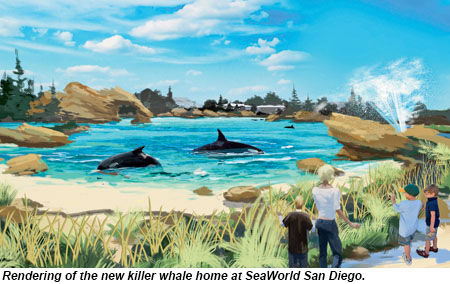
A: SeaWorld is building a new environment for our killer whales — the first of its kind in the world. It will revolutionize the way visitors experience killer whales, and also provide innovative features for the whales themselves. The Blue World Project is a massive expansion of the killer whale habitats in all three SeaWorld parks. It will feature a viewing gallery for guests that is four stories high – the largest of its kind in the world.
The new killer whale home will enhance the educational experience for guests, foster deeper knowledge of killer whales and their ocean environment and inspire them to celebrate and conserve the natural world. The scale is remarkable: fifty feet deep with more than 10 million gallons of continually filtered and chilled seawater and surface area of more than an acre and a half.
Q: With a lot of the negative media attention surrounding SeaWorld's killer whale environments, is the hope that these new environments will dissipate the criticism?
A: This is the latest step in an evolution that began even before we opened our doors 50 years ago. This announcement is the next step in that evolution — a giant step into our next 50 years. A new killer whale environment has been contemplated for a while.
The reality is, the conceptual work on this project began more than a year ago, and the internal planning has been underway for several years. A project of this size requires a minimum of 36 months of planning, design and construction, and we were finally at a point in the process where we were comfortable to share with the public.
Q: For travelers that have been following the media attention surrounding the documentary "Blackfish," and are confused about whether they should go to SeaWorld, what would you like to communicate to them about the SeaWorld experience?
A: We’re proud of our history of education and inspiration, and our work to advance the scientific understanding of killer whales and other marine animals. The millions of visitors hosted by SeaWorld each year know us for our founding principles: making connections between animals and people and doing so in a way that is inspiring, educational and memorable.
The power of a SeaWorld visit to effect change is a matter of fact. Today there are marine scientists, veterinarians, educators and conservationists around the world who drew their first inspiration from a visit to SeaWorld, and we’re immensely proud of that.
Q: In a recent interview I conducted with People for the Ethical Treatment of Animals (PETA), the animal rights group suggested that SeaWorld modernize its animal interactions and, for instance, create open-water environments for the orcas and allow guests to see and interact with them in a more natural habitat. Is this something SeaWorld would consider?
A: Despite PETA’s claim to the contrary, SeaWorld’s animals are well cared for and their health and well-being is a responsibility we take extremely seriously. We are proud of our world-class standards of care. There is a vocal minority of people who don’t believe that zoos and aquariums should exist. For them, the only alternative is the wild. We don’t agree.
We believe your children and grandchildren should have the same opportunity you did to learn from animals in human care and be inspired to conserve the natural world and help protect endangered species. And, that’s what the Blue World Project is all about: advancing global understanding of killer whales to educate, and to inspire conservation efforts to protect these animals in the wild.
Q: Have travelers or travel agents reached out to SeaWorld with suggestions or concerns?
A: The vast majority of consumers recognizes and supports SeaWorld and all the good that we do, and these criticisms — and circulation of misleading claims — come from a small vocal minority. In fact, our fans and supporters have been quite vocal about reaching out to give us positive feedback. You only need to look online at groups such as Stand with SeaWorld to see examples of that passion, as well as reviews from millions of guests who have visited the parks and had an amazing time.
In 2013, we hosted more than 23 million guests — including 3.7 million international guests — placing our parks among the most highly attended in the industry.