I've been to India many times, but never on a river cruise and never to the country's northeast corner in the state of Assam. That changed last November when a friend and I spent a week on the Brahmaputra River that started even before we stepped onboard the 46-passenger Mahabaahu.
We were met at the airport in Guwahati by our guides and on route to the boat stopped at the 17th-century Kamakhya Temple complex, with its traditional beehive domes and tantric history and practices, including animal sacrifice.
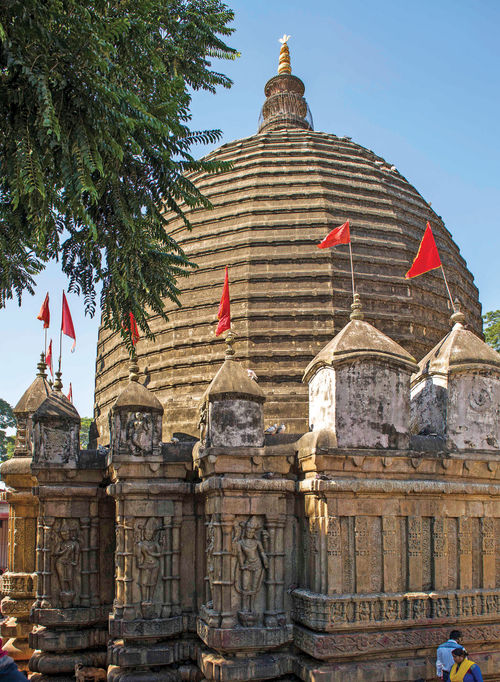
The Kamakhya Temple in Guwahati, India, is dedicated to the Hindu goddess of desire. It is a pilgrimage site for newlyweds who hope to start a family. Photo Credit: Noni Chawla
Dedicated to the goddess of desire, Kamakhya Devi, and her various avatars, stone sculptures of female deities were smeared in blood-red paint and kumkuma powder to symbolize fertility. An important Hindu pilgrimage site, especially for newlyweds who want to start a family, we watched devotees swipe a bit of the red powder from the statue's groin and put a dash on their own foreheads for blessings and good luck. Our small group walked amid nosy goats spared from sacrifice and sadhus (holy men) with dreadlocks and wild eyes. It was classic India in overdrive.
After an hour or two we were back in our convoy of comfortable taxis heading for the Mahabaahu, a boat as quirky as its itinerary. A bamboo gangway connected us to the vessel, with its funnel and red davits poking out from the stern. Inside, lots of wood and Indian fabrics created a homey feel, like a visit to Grandma's house.
It's not cookie cutter in the least, so I loved it, and so did the other 25 passengers, a mix from the U.K., Australia, Canada, India and the U.S. Owned and operated by India-based Adventure Resorts & Cruises, a subsidiary of tour operator Far Horizon Tours, the Mahabaahu was built in 2011 and is one of the few tourist riverboats on the vast, remote and fascinating Brahmaputra River system.
From Guwahati, we sailed more than 232 miles upstream, ending our seven-day journey in Jorhat. Neither city is particularly attractive, but what's in between them is magical. The vast Brahmaputra is braided with sandbars for much of the year, born of the sediment brought down from the Himalayas.
The boat's top deck chaise lounges are the favorite place for gazing at the sandy scene, looking for leaping Ganges river dolphins — I saw several — and watching government skiffs mark the river's navigable channels with bamboo poles. The excessive silt and shifting sand can be an issue for boats if the river isn't dredged regularly.
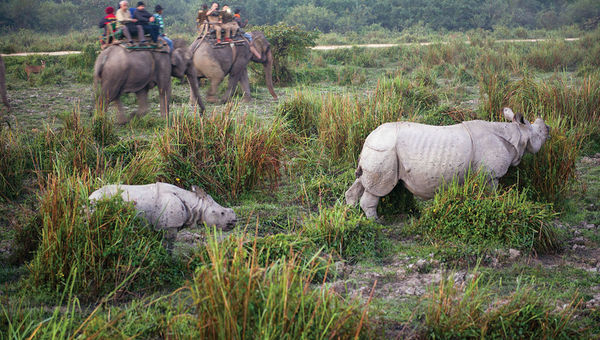
Kaziranga National Park is the world’s largest habitat for the endangered one-horned rhino. Photo Credit: Noni Chawla
Sanjay Basu, chairman of Far Horizon Tours, cited the operator's close relationship with the Assam and Indian governments for the deployment of dredgers who keep the navigation channels open.
Our November trip was smooth sailing from start to finish.
The Mahabaahu's pair of comfortable, open-air excursion boats shuttled us to the riverbanks for one or two daily excursions. The highlight of the week was the Kaziranga National Park, a Unesco World Heritage site and the world's largest habitat for endangered one-horned rhinos, with more than 2,000 there. The day started before dawn in heavy mist and just as the sun was rising. My friend and I were on the back of an elephant, sandwiched between a mahout (the driver) and a park guard toting a shotgun. Our female's adorable baby followed behind as we tramped through the tall grass. It was a sign, our guide told us, that the elephants on our safari were well treated and not separated from their young. Within minutes, we spotted wild water buffaloes with their impressive horns and soon after, several large rhinos, swamp deer and wild boars.
Other days, we walked through villages with our trusty naturalist and guide Venky in the lead, peeking inside basic, wooden houses on stilts and shopping for inexpensive, hand-loomed saris and fabrics that were slung over fences and washing lines for our visit. We admired old stone temples with their spare Assamese lines, tea plantations, fields of peanuts and turmeric and a Dickensian Victorian-era jute factory. Folk dances, music performances and plays added color and culture to the ports.
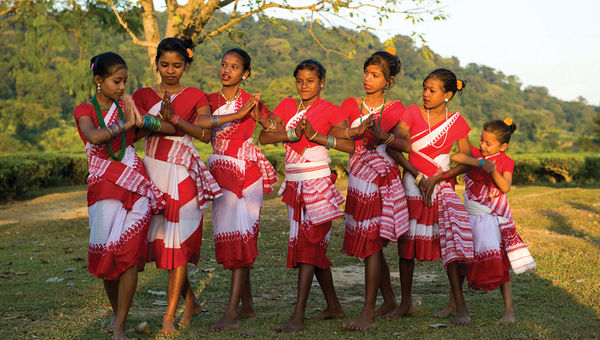
The children of tea plantation workers were a dance troupe who performed during a shore excursion. Photo Credit: Noni Chawla
Back onboard, when we weren't soaking up the serene river views, some of us hit the spa for reasonably priced Ayurvedic massages, classic treatments that incorporate herb-infused mustard oil and firm kneading.
Another calming ritual was morning yoga led by cruise director and resident yogini Neena on deck, and once on a sandbar next to the boat. Informative port talks from Venky were a daily affair and so were predinner "happy hour" bonfires set up in the sand (the boat never sails at night). This was a cruise of simple but profound pleasures, including mealtime.
Lunch buffets were our favorite, thanks to the flavorful seafood curries and Indian-style eggplant, spinach and breads (Continental options were offered, as well). At dinner, there was a Western choice along with a yummy Indian medley often served on a thali, a metal plate holding several small bowls — the original tasting menu.
At the end of each long, fulfilling day and after a few glasses of Indian-made Sula wine with new friends, we found ourselves ready to call it a night by 9:30 or 10. It was off to our cozy cabins — all with minifridges, TVs, roomy bathrooms with showers and large windows or balconies — for a night of deep, peaceful slumber.
Seven-night cruise fares start at about $2,353. Book the Mahabaahu direct or though partners, including Pandaw Cruises, Saga Holidays, Fred Olsen Travels and International Expeditions. Travel agent commissions range from 10% to 15% for FITs and 20% to 25% for groups. For more details, go to www.adventureresortscruises.com.