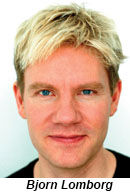
 Danish economist Bjorn Lomborg, who will be speaking at the World Travel and Tourism Council Global Summit later this month in Hainan, China, says that mankind should "be joyful" rather than worried when contemplating the future. "Things are getting better and better, and are likely to keep getting better in the future," he said in a pre-summit interview.
While he acknowledges there are problems that need to be fixed, he just finds a great deal of comfort in patterns of history, which he says read as an overall record of remarkable accomplishment on the major issues that have confronted mankind.
"We have this sense that everything is a problem and getting worse, that we go from one crisis to another," he said. "But actually, the fundamentals are moving in the right direction. Overall, we have solved more problems than we have created new ones. Our track record is pretty good. For example, in 1900, average life expectancy was 30 years. Today, it's 69, and in 2050, it's likely to be 74. In a sense, we live two lifetimes now."
Focusing on accomplishment does not mean turning a blind eye to problems, he said, but rather offers guidance on how to move forward to fix them.
 "We still have lots to do," Lomborg said. "Global warming is real, and it's something we need to fix. But we need to focus on the right solutions and not get caught up in incorrect worries. In the 1970s, the energy crisis led to a lot of poor decisions that [needlessly] restricted private mobility and led to fewer benefits for mankind. Yes, there are problems, yes, we must remain vigilant and attentive, and we must fix them. But we need to get our priorities right."
As regards aviation as a source of carbon emissions that contribute to global warming, Lomborg thinks that the transport sector "is the last place we'll see dramatic cuts in carbon. There's a much more obvious need to cut carbon in heating and cooling. Planes can one day be powered by CO2-neutral fuels, but it'll be one of the last technologies to come around. Airplanes contribute [only] 1% to 3% of global emissions. That's not where we have the greatest need."
Focusing on innovation and technology, rather than on limitations, is a key to moving forward, Lomborg believes. "The major breakthrough that will change the way the world works will come thought innovation," he said.
He points to an example from history that he feels is representative of the way humans simultaneously solve problems and better their quality of life.
"Back in 1860, whales were hunted almost to extinction because their oil burned brightly and was a good source of light. The solution was found not in regulating whale hunting but in the invention of kerosene, which provided better light at a fraction of the cost.
"The beauty is that it's very cheap to support research for disruptive solutions: better solar cells, better wind turbines, better batteries," he said. "We shouldn't be subsidizing production but investing in innovation. Most new ideas will not work, but we just need a few to work, and they will power the 21st century."
Email Arnie Weissmann at [email protected] and follow him on Twitter.