This article was updated on Dec. 17, 2013.
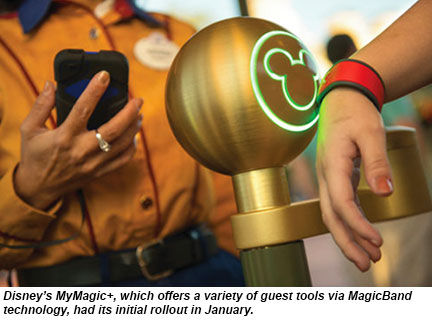 Although the initial partial rollout of the MyMagic+ program at Walt Disney World has played to enthusiastic reviews, sporadic, mostly minor issues affecting reliability have Disney hedging on the timing of a full rollout of the most challenging and expensive technology initiative ever undertaken for a theme park.
MyMagic+ technology centers on a bracelet-like device know as a MagicBand, a color-coded, encrypted wristband outfitted with radio-frequency identification (RFID) technology, which was first developed in the 1970s and has become increasingly popular over the last few years with companies such as Nike.
The MagicBand creates a new level of customized experiences for guests, enabling them to better enjoy visits as a family and creating a highly personalized product to match their needs and timetable.
Using their MagicBands, guests can book reservations for top attractions or character greetings weeks in advance. They can also use it to opt for a cashless system for dining and merchandise purchases, as well as for admission tickets and hotel room access.
Analysts see MyMagic+ as a game changer not just for theme parks but for many other aspects of the travel industry. While Disney’s immediate goal is to revolutionize the way guests spend their vacations at the company’s theme parks, analysts predict it will also mold expectations of consumers about the level of customized experiences and interactions with other travelers they will get from other suppliers.
Douglas Quinby, a senior analyst with PhoCusWright, predicted, “This initiative will move travel agencies and the industry from a volume-based model to a specialized and personal model. How do you make 1 million customers feel like one in a million?”
Moreover, the impact of the MyMagic+ program could extend to other trades, as well.
Henry Harteveldt, travel industry analyst with Hudson Crossing, called MyMagic+ “an initiative that travel sellers and organizations and entertainment venues should study. It is only a matter of time before other theme parks, resorts, cruise ships and casinos implement their own version. Any venue that attracts or is home to large volumes of people can [use the technology to] improve efficiency and ensure an enjoyable experience for the traveler, and make sure they come back.”
The component technologies themselves are not new, Harteveldt said, but it was Disney that “realized its power to be used in a creative way.”
With the costs of technology continually dropping and the size of electronic components shrinking, he said, “Disney has found a way to make it work in their infrastructure and came up with what I think is a blockbuster idea and distinctively positive.”
Alluding to MyMagic+, Quinby said, “Disney continues to be an example — and the one to follow.”
New levels of customized product
The options for personalization with MyMagic+ go far beyond just scheduling FastPass. Guests can opt in to use the MagicBands and add a credit card and other personal information to their account, such as a child’s name, age and favorite preferences, which can be accessed with a secure four-digit PIN. If lost, the bands can be deactivated remotely so that no personal information can be accessed by a thief or finder.
“It is tangible, useful and digestible, wearable computing — what I call ‘frictionless commerce,’” Harteveldt said.
 On the other hand, some analysts and Disney fans remain cautious about the potential impact of the technology on privacy and personal security.
“There are substantial risks,” Quinby allowed. “And Disney will need to make sure adequate security is in place to secure credit cards and other personal information. Disney understands it is a matter of personal choice to opt in to this program and will let people do what they are comfortable doing.”
In the end, however, Quinby predicted widespread buy-in to MyMagic+.
“It’s all about speaking to the benefits of the program and managing security,” he said. “When the industry proves it will be a better experience and that a company will pay attention to a consumer, that will push people to use it.”
Many years in development
The company’s commitment to ensuring security while maximizing personalization has proved more challenging than anyone could have predicted.
MyMagic+ was launched in January, after more than five years of development using an initial group of 1,000 testers. Over the past year, Disney senior executives have repeatedly stated that they hoped to have the entire program in place by year’s end.
Walt Disney Parks and Resorts Chairman Tom Staggs wrote on the Disney Parks blog last January that MyMagic+ would roll out a collection of tools over the following few months.
Then, in May, Disney CFO Jay Rasulo told analysts at a conference, “By the end of this fiscal year, you’re going to feel like it is rolled out.”
Finally, in August, Disney Chairman and CEO Bob Iger told analysts that “the project was designed for a probable full rollout in the early part of fiscal 2014.”
Today, Disney officials will say only that the project remains in a “test and adjust” phase to integrate improvements and modifications in accordance with guest feedback and experiences. As of last week, they were not offering a specific date for the program’s full integration. In fact, Disney has gone silent on the entire project.
Yet sources knowledgeable about the inner workings of the company say the executive team remains happy with the rate of progress.
Some of the ongoing work involves adjustments to the My Disney Experience website to make it more user-friendly. In addition, some guest users have reported system glitches in such activities as accessing the online app or FastPass tickets. In a few cases, MagicBands have failed to sync up with a user’s online account.
Currently, MagicBands are available to guests at all 23 Walt Disney World resort hotels, plus Fort Wilderness Resort and six vacation clubs in Orlando, totaling nearly 25,000 on-property guestrooms.
Annual passholders, off-property visitors and day guests will reportedly receive MagicBands in the next phase of the rollout.
As for widespread speculation that the bands will be available at the company’s other theme parks or on its cruise ships, Disney will say only that it continues to research the technology’s potential and will avoid a “cookie-cutter rollout.”
Further, the company has said that until all guests have access to the technology, it does not want to create unrealizable expectations among consumers.
Harteveldt said he agrees with that strategy.
“The consumer is the critical path and will decide when they are ready to use and are comfortable,” he said. “Disney will need to learn how it works in the United States and strategize and plan for international implementation.”
Positive response
Travel agents say feedback from has been positive so far and that clients are excited about the enhanced experience.
“Kids love it because parents will be able to guarantee that they will be able to ride a particular attraction or reserve a Disney Character Greeting,” said Cara Goldsbury, a veteran travel agent, chief executive concierge with Glass Slipper Concierge in San Antonio and author of “Luxury Guide to Disney Vacations.” “This delivers a whole new level of excitement before you arrive at the park.”
Harteveldt said the technology offered many potential benefits, such as recognizing special guests or children who are celebrating a birthday. In theory, he said, the band could store pertinent information about a child’s birthday that could be shared with their favorite characters during a greeting to make the experience as personal as possible.
Guests who have used the MagicBand say they like the idea of not having to carry a wallet and hotel key. They also like having the ability to secure FastPass access to some of the most popular attractions before they walk through the gates.
“I was surprised at how much easier it was to get into the park and use FastPass,” said Matt Roseboom, the editor of Attractions magazine in Orlando and a lifelong theme park fan and Disney World annual passholder.
While Disney has released few details about future uses for the bands, fans have been buzzing about possibilities. Roseboom said some of his readers suggested the bands may integrate with attractions like It’s a Small World.
Younger guests could make a drawing at home and upload it so that when they ride the attraction, their image will display on large video screens.
“It’s as personal as you can get,” he said.
Future implications
Disney has remained tight-lipped about how much development of the program has cost, although the Orlando Sentinel reported that analysts estimated initial spending on the project at about $800 million.
Following a November interview, the Sentinel quoted Doug Mitchelson with Deutsche Bank as saying, “Clearly, they would have to be north of $1 billion at this point in time.”
Still tourism analysts remain optimistic that MyMagic+ will prove itself worthy of the investment.
 “It’s a new way of doing things,” said Duncan Dickson, associate professor at the Rosen College of Hospitality Management at the University of Central Florida and former director of casting for Walt Disney World. “When you do new things, it’s hard to put your arms around it, [but] standing in line is unproductive for theme parks and guests, so they are trying to create a better experience for them, not just in line but utilizing other areas of the park.”
Dickson said the program would be watched closely by other theme parks, including Universal Studios, SeaWorld and Six Flags, all of which currently use smaller, less complex, automated queue systems to shorten guests’ wait times.
More importantly, Quinby argued, this type of personalized service is the key for all travel and tourism organizations, from hotels and airlines to theme parks and cruise ships, to remain competitive. Each will have to take a different approach with wearable technology, he said, to create their own personalized experience with guests. This will require closely studying their clients’ travel habits.
Airlines, he said, could review travel itineraries to learn passenger preferences. Hotels could be notified when high-value members of a loyalty rewards program arrive at the airport, enabling them to ascertain expected arrival times at the hotel and have a staff member greet and escort the guests to their room, with food and beverages waiting.
And among the greatest benefits to accrue to Disney from MyMagic+, say travel analysts, is the amount of marketing data it will receive from consumers to better identify travel and purchasing habits. With a treasure trove of analytic, real-time data, Disney could target particular products to guests and offer a new level of personal, real-time customization.
“Disney will be able to better identify visitor habits and find what days are busiest in the park, look at street-traffic flow to make staffing changes, alert retailers on popular shopping times,” Harteveldt said. They could create shopping specials based on popular items at stores or stock different merchandise based on transactional sales, he added.
In the end, he said, “Disney wants the competitive advantage and the revenues these theme parks will generate.”
Clarification and Correction: This article was corrected to remove a reference to GPS technology; the MagicBands do not have GPS capabilities. In addition, the headline and a portion of the lead were changed to better reflect the content of the article.