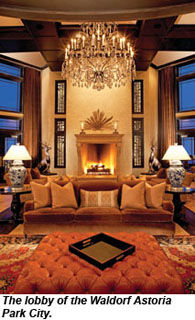
 PARK CITY, Utah -- The first thing you notice when you walk into what used to be Dakota Mountain Lodge (after the numerous and very attentive doormen, of course) is the sheer elegance.
There are no rustic Western themes or mountain kitsch going on at this ski lodge. It is luxury through and through. In fact, the only real clue that you're at a ski resort (besides the snow) is the huge fireplace in the lobby.
And although there is no clock in the lobby, this is a Waldorf Astoria. The new and fast-growing Waldorf Astoria.
While the mention of Park City and Waldorf Astoria in the same breath confuses some people at first, the brand's entrance into this high-end resort area exemplifies the new direction Hilton has quietly but aggressively implemented over the past few years to become a real competitor in the luxury arena.
"In the past, Hilton was never thought of as a luxury hotel company," said John Vanderslice, who heads the company's luxury efforts. "We've done a pretty good job at changing that."
Indeed, the company has made great strides under Vanderslice, but only after a major stumble.
In 2008, one year after Blackstone bought the company, its then-new CEO, Christopher Nassetta, and his senior management team lured Ross Klein and Amar Lalvani away from Starwood's luxury and lifestyle group to grow its luxury offerings and develop a new lifestyle brand.
Unfortunately for Hilton, Klein and Lalvani also were alleged to have brought along more than 100,000 electronic files that Starwood claimed were proprietary. Starwood sued, leading to a shutdown of Hilton's barely launched Denizen lifestyle brand and throwing into question the company's plans for expanding its luxury offerings as Starwood sought injunctions on all fronts.
The litigation was finally settled in January. But while it played out, Hilton brought in Vanderslice, a former CEO at both Miraval Spa and Club Med Americas, who has quietly but methodically expanded Hilton's two luxury brands, Waldorf Astoria and Conrad, and changed its approach to its most storied brand, Waldorf Astoria. For hundreds of years, that brand had just one hotel, its legendary New York property.
The most significant change under Vanderslice was the elimination of the Waldorf Astoria "Collection."
Initially, after Blackstone bought Hilton, the company brought in a number of former LXR resorts and other iconic properties, such as the Arizona Biltmore, simply adding the tag "Waldorf Astoria Collection" after their names. And while the hotels carried that famous name, service standards at some properties were definitely below what one might expect of a true luxury enterprise.
 At the same time, the company was also developing the Waldorf Astoria Orlando, which was to be only the second property to carry the name without the "Collection" qualifier.
But not long after the Dakota Mountain Lodge joined the collection, Hilton made it the brand's third Waldorf Astoria property, and Hilton quietly dropped "Collection."
The brand is now called Waldorf Astoria Hotels & Resorts. Most of the two dozen properties still carry their original names, i.e., the Arizona Biltmore, a Waldorf Astoria hotel, or the Roosevelt New Orleans, while newbuild properties like the Park City and a just-opened Shanghai hotel, which don't have an iconic or historical name or location, are called simply Waldorf Astoria.
"It got a little confusing for agents as well as consumers," Vanderslice said. "What I have done over the last year and half is really unify the brand into one single-minded luxury brand."
Industry consultant Rick Swig, president of RSBA & Associates, said the move was important for Hilton.
"By bringing forward the Waldorf Astoria as a full-fledged brand, Hilton is achieving parity with Marriott and its Ritz-Carlton, as well as Starwood with its St. Regis brand," he said. "This gives Hilton vertical branding from luxury [Waldorf Astoria] through to economy [Hampton Inn], as Marriott goes from Ritz-Carlton to Fairfield Inn. The investment community responds very well to this, while it means very little to actual hotel customers."
As part of his strategy, Vanderslice said he issued brand standards across the entire portfolio, which he said has produced huge jumps in consumer satisfaction ratings.
None of the properties made this year's AAA Five Diamond list alongside brands such as Ritz-Carlton and Four Seasons, which consistently lead luxury brands in service ratings. But during a recent visit, the Park City property certainly offered amenities and service that rivaled the finest hotels in the world.
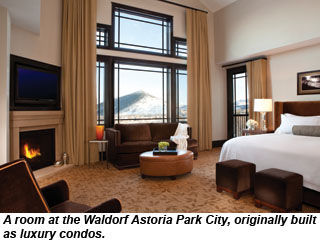
Originally built to be luxury condominiums, the resort offers the best of both worlds. A one-bedroom unit, for example, has two full bathrooms, fireplaces in the living room and bedroom and a full kitchen with top-of-the-line appliances, including full-size washers and dryers. It also has many luxuries that even the finest condominiums can't match, such as a full-service restaurant and bar and room service.
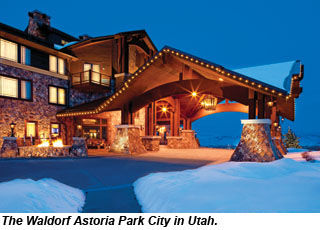
 Situated at the base of the Canyons ski resort in Park City, the resort is across the street from a gondola that takes skiers to the base of the mountain. And it offers regular shuttle service to Park City lifts and to town.
Because the resort was originally built to be condos, it doesn't carry signature trademarks of the brand, like the lobby clock and bathroom tile patterns that were replicated in Orlando, or the brand's signature Bull & Bear Steakhouse.
Vanderslice said some of the brand's more famous features will be incorporated in other new properties, where appropriate. But many new Waldorf Astoria hotels will be conversions. And newbuilds like London's Syon Park Waldorf Astoria, which opens this week, give a nod instead to their surroundings. That property, for example, built near a park known for its butterflies, will have a butterfly garden rather than a clock in its lobby.
"We basically think about the brand but design toward the market," Vanderslice said.
With the recent openings of Waldorf Astorias in London and Shanghai, the brand boasts 24 hotels, compared with just four when Blackstone bought Hilton in 2007. And others are under development in Jerusalem, Beijing, Montreal and Panama.
"We're looking for opportunities everywhere," Vanderslice said. "Suffice it to say China and Asia and India are really key areas of focus. And I am just approving a release for a hotel in Ras al Khaymah, about an hour outside of Dubai. It's going to be a palace hotel on a private beach."
Vanderslice is also overseeing the expansion of Hilton's Conrad brand, which currently flags 16 hotels around the globe and another 13 under development. Much of that brand's growth, Vanderslice said, will also come in Asia, the Middle East and India, although it will open its first New York property later this year in Battery Park.
Asked to sum up the difference between the two brands, Vanderslice said, "Waldorf Astoria is our timeless luxury brand. And two words that would sum up Conrad are 'smart luxury.' Waldorf would be a Rolex, and Conrad would be a Tag Heuer watch. ... Waldorf would be a Bentley, Conrad would be an Audi A8."
While Vanderslice is busy growing Hilton's luxury portfolio, he is also overseeing development of a lifestyle brand, plans that were put on hold by the Starwood lawsuit.
Although the settlement prohibits the company from introducing anything in that space before January 2013, Vanderslice said, "Mark my words, we are introducing a lifestyle brand."