AGRA, India -- India, or at least the small portion of it that I saw this week on a trip to New Delhi for IATA's Annual General Meeting, is an intense place. It's a cacophony of noises and smells. The glorious scent of curry for a few steps, the smell of sweat a few steps later. Garbage, too.
Horns blare perpetually. For the pedestrian, cars, motorbikes, tuk-tuks, hand-wheeled carts carrying goods and even the occasional goat come at you from all directions. Often, at least in central parts, there's a sea of people as well. And always in early June, there's the heat.
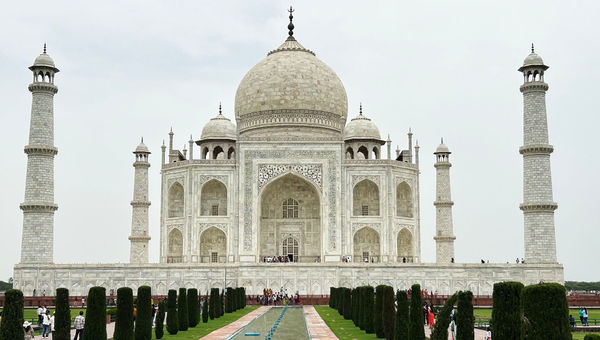
The Taj Mahal in Agra, India. A fellow journalist told me I had to visit the monument. It would be a long day, he said, but one I would cherish. Photo Credit: Robert Silk
But inside the walls of the Taj Mahal compound, mostly there is just tranquility.
I hadn't planned to make the approximately three-hour journey from New Delhi to Agra to see this iconic monument when I arrived in India. But during the IATA conference, a fellow journalist told me I had to. It would be a long day, he said, but one I would cherish. So, after my work in the capital wound down, I booked a last-second tour through TripAdvisor's Viator network (better planning should have involved a travel advisor), paying less than $100 for a private round-trip ride to and from Agra and a private guide to show me the Taj Mahal and other Agra sites, most notably Agra Fort, itself a Unesco World Heritage site. My Taj Mahal entry fee of approximately $13 wasn't included.
To be brief, the Taj Mahal was magnificent. We all know this from photographs. And in the midday light, it was as extraordinary in person as I would have imagined. I'm told it's even more so at sunrise and sunset, when the horizontal light plays most strikingly against the thousands upon thousands of semiprecious gemstones inlaid into the mausoleum's white, crystalline marble.
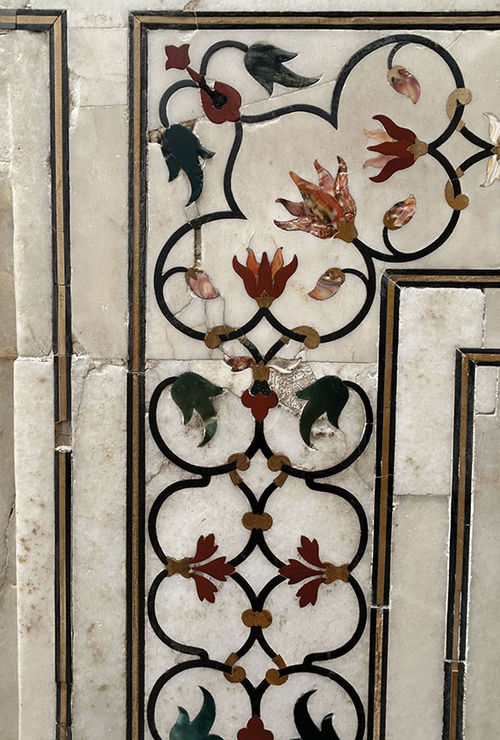
Intricate stonework inlaid in marble near the entrance to the Taj Mahal. Photo Credit: Robert Silk
Especially vital to the Taj's gleam, as I learned from my guide, Suraj Mani Sharma, and later during a demonstration at a local artisanal marble works, is its orange carnelian stone, which is particularly luminescent. Near the entrance to the mausoleum, Suraj made sure I carefully examined the detailed work of the gemstone inlaid in floral patterns. Cuts of stone, tiny sometimes, are fit together like a jigsaw puzzle. Workers still do this meticulous work today to repair and maintain the nearly 400-year-old monument, which was commissioned by the Mughal emperor Shah Jahan to house the remains of his favorite wife, Mumtaz Mahal, and eventually his own remains as well.
The 42-acre, walled Taj Mahal complex was busy enough during my Wednesday afternoon visit, though not overly crowded. To my surprise, there were very few Western or East Asian tourists to be seen. It was a happy revelation. It's rare for me these days to visit an iconic attraction and find it largely peopled by the local population.
As for me, I made a rare decision that day. I'm normally averse to posing for pictures. A handful of posed shots over the course of even an exotic trip feels like more than enough. But encouraged by Suraj, I hired a local photographer just outside the Taj Mahal compound entrance for a short photo shoot.
On the long drive back to Delhi that evening, I looked over the photos, both print and digital. Even the corny one where it looks like my finger is touching the top of the Taj Mahal dome made me smile. I think it's because I know I'm lucky; lucky to have made it to this grand and singular edifice.