The cruise industry saw mixed first-quarter results amid an uncertain macroeconomic environment, but overall it delivered a more positive outlook than recent reports from the airline and hotel sectors.
And cruise industry executives and travel advisors firmly believe that the product is especially resilient due to its perceived value over land-based vacations.
Royal Caribbean Group's Q1 results were nothing but positive, while Norwegian Cruise Line Holdings (NCLH) came in below profit expectations.
And while Royal Caribbean increased its earning expectations for the year, NCLH held to its previous outlook.
NCLH saw "choppiness" in April, CEO Harry Sommer said on the company's April 30 earnings call, particularly in its third-quarter Europe bookings. The decline lasted about three weeks in April and rebounded in the final week of the month, Sommer added.
NCLH's Q1 adjusted net income of $31 million was $7 million lower than it had forecasted, and its total revenue of $2.1 billion was about 3% lower than the same time last year. The company had two Norwegian Cruise Line ships -- Norwegian Bliss and Norwegian Breakaway -- in drydock getting enhancements during Q1. The reduction in ship capacity and a foreign-exchange loss of $23 million contributed to the Q1 net loss.
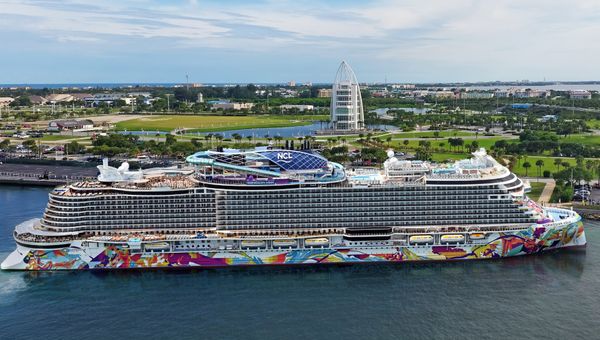
Norwegian Cruise Line Holdings reported some "choppiness" in Europe bookings, but the Caribbean continues to be strong. Pictured, NCL's new Norwegian Aqua. Photo Credit: Norwegian Cruise Line
Royal Caribbean, meanwhile, more than doubled its net income from Q1 2024, a jump from $364 million to $736 million. Its two ships scheduled to debut later this year, Royal Caribbean's Star of the Seas and Celebrity Xcel, have exceeded booking expectations, CEO Jason Liberty said on the company's April 29 earnings call.
He also said that there hasn't been any change in cruise cancellation rates, and following its strongest Wave season ever, Royal is now 86% booked for the year. The company has even been able to raise prices on cruises in the second quarter due to a surge in demand, Liberty said.
"There is no real change in how our consumers are acting outside of that they are a little bit more short-term focused," he said.
Outlook for airlines and hotels
The mostly positive cruise earnings came after several airlines -- including American, Southwest and Delta -- each pulled their 2025 full-year guidance due to uncertainty. In the hotel sector, both Hilton and Hyatt revised their 2025 forecasts downward from previous projections.
However, because cruises are generally booked further out than flights, pressures on the cruise industry "would mostly not really show up in quarterly earnings results until two to three quarters from now," said Truist analyst Patrick Scholes in a note responding to NCLH's earnings.
As good as Royal Caribbean's results were, Liberty said the company is not immune to potential impact from the changing economy.
"At this point, it's still too early to determine how exactly the current macro environment could impact the broader economy or consumer behavior," he said. "What I want to emphasize is that we are focused on what we can control: delivering the best vacation experiences for our guests, optimizing revenue, managing costs and executing on our long-term strategies."
But Liberty also said the cruise industry can be protected in times of economic uncertainty because of the value gap consumers perceive between cruises and land-based vacations.
"In times like this, and we've seen this in other markets, when there's economic concerns, that value gap is actually a pretty good buffer across delivering our vacation experiences, and our guests willing to pay for those experiences and for us to meet our financial expectations," he said.
Sommer said on NCLH's Q1 call that among the reasons cruising has "significant runway for growth" is its "differentiated value proposition, multiple destinations, world-class service and onboard entertainment all at a better value than comparable land-based vacations."
And despite the booking hesitancy on travel to Europe, Sommer said continued strength in the Caribbean leads him to believe that the current macroeconomic climate makes cruisers more comfortable staying close to home and taking shorter trips. He noted that NCLH's Caribbean capacity in Q4 will be up 10% year over year and represents 40% of the company's quarterly ship deployment.
The company's strategy is to maintain pricing over occupancy to put it in the strongest position for when demand is back to normal, he added.
The cruise booking window has contracted
Leaders from major travel agencies said they had expected positive results overall, as they too are not seeing increased cancellations, although they cited more hesitation to spend money, which has led to a shorter booking window.
Cruise.com has seen a lot of last-minute bookings for tickets that were priced quite high, said president Anthony Hamawy.
Any promotions he's seen are for shorter trips in the fourth quarter, which he considers to be a strategic move from cruise lines looking to book up and get ahead of any potential slowdowns.
"A down stock market is very bad, usually, for demand," Hamawy said. "We've been very strong through it. Part of that is there's a lot of deals out there in the marketplace."
Theresa Scalzitti, chief sales officer at Cruise Planners, similarly said she hasn't seen an uptick in cancellations, but she has also noted the shrinking booking window.
"I do think that there are people who are on the fence now more than ever just kind of holding on to their money a little bit longer," she said. "We're still seeing a lot of close-in bookings coming in."
But even when the economy is uncertain, people who love to travel will continue to do so, she added.
"I think, right now, everybody's kind of just going, 'OK. My life is OK. My job is fine. I'm going to take my vacation,'" Scalzitti said. "If we've learned anything from Covid, it's, 'I'm not going to give up spending time with my family and making memories and having a vacation.'"