Fourteen months after Carnival Corp.'s five North American brands instituted a policy prohibiting travel agencies from bidding on their trademarks as keywords in online search engines, some of the brands have seen a surge in their share of cruise-focused Web traffic.
The policy, which went into effect Jan. 1, 2010, for Carnival Cruise Lines, Princess Cruises, Holland America Line, Cunard Line and Seabourn Cruises, prohibited travel agents from purchasing trademarked keywords such as Carnival, Princess and Seabourn, on Internet search engines such as Google, Bing and Yahoo.
At the time, many travel sellers expressed frustration, because they employed search engine optimization, i.e., buying keywords to improve their search engine results, as a key element in their online marketing strategy.
More than a year later, Travel Weekly followed up with some of those major keyword buyers to ask how the policy had affected their business.
Travel Weekly also asked the cruise lines how the change had affected their business, but only Carnival Cruise Lines and Princess Cruises responded.
First, a little background.
When the Carnival Corp. brands made the decision to prohibit travel sellers from purchasing their trademarks as keywords, the rationale for doing so varied slightly among the cruise lines.
They all said a key motive was to eliminate consumer confusion. In addition, Princess and HAL said the move would drive down the costs of the keywords by diminishing the number of competing bidders.
Travel agents suspected another motive: to increase the cruise lines' direct business by driving more customers to their own websites. The cruise lines denied that was among their reasons.
Last week, Travel Weekly asked the cruise lines if their stated goals had been achieved.
"The change to our search marketing policy has had the desired effect," said Jim Berra, Carnival Cruise Lines' chief marketing officer. "Site traffic generated via both natural and paid search has increased, and we've experienced a 40%-plus decline in the cost-per-click for brand terms.
"The policy change has made it easier for consumers searching for Carnival to find our website, which has the deepest product and brand content. By providing the consumer with richer information, they can more easily move from shopper to buyer, which benefits all channels of distribution."
A Princess official said only, "We're happy with the results and think it has reduced consumer confusion."
Carnival has managed to increase its market share of cruise-focused websites in the U.S. (sites that include cruise operators, agencies with a focus on cruise holidays and information on cruises or cruise ships).
According to data collected over several years by Hitwise, a company that compiles online usage metrics and search behavior data from a sample of 10 million U.S. Internet users, until the keyword ban was in place, VacationsToGo.com had consistently topped the list of the Top 20 websites in the "Travel-Cruises" category.
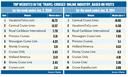
That suddenly changed when the policy went into effect in January 2010 (click on the image at right for a larger view of the stats between the years). Since that time, Carnival Cruise Lines has topped the chart every week.
However, the data also suggest that Carnival might have a very strong argument in asserting that it deserves that placement: Data also show that the search that most often delivers Web surfers to those cruise lines is "Carnival Cruise" (usually followed in the ranking by "Royal Caribbean" and the generic search term "cruises").
That was also true when Vacations to Go was the top-ranked site and was buying Carnival keywords from the search engines.
Vacations to Go declined to say if visits to its website had decreased as a result of the policy and if it had any impact on its bottom line. But judging by how high its placement still is relative to non-Carnival cruise lines and travel agencies, it is still a powerful online player.
On the other hand, Emerson Hankamer, president and COO of Vacations to Go, said the policy actually might not have produced the cruise lines' desired effect.
"Carnival's move has shifted Internet shoppers away from their most dedicated partners, like Vacations to Go, who are experts at closing leads, to rogue agencies that refuse to follow the new policy," he said.
Sites like Cruises-4-Free.com, CruiseNetwork.com and TripMama.com now show up when a person searches for a phrase like "Carnival Cruise," because they continue to pay for the keywords.
Carnival spokeswoman Jennifer de la Cruz said that those sites "are not actual travel agencies and therefore are not subject to our search policy. They are ad-supported sites that may contain advertising from travel agencies. ... A consumer can click through on one of the ads and get to a travel agent site, but it is a two-step process."
Agents counter that such sites prove that the policy simply allowed another party to step in and make online marketing more expensive for the agencies without directing traffic to the Carnival brands.
"These policies have helped these travel portals that bid on these cruise line terms," said Anthony Hamawy, president of Cruise.com, a major online travel agency. "The travel agents are buying traffic through them. They're having a field day with this."
However, he noted that those companies also sell more than just cruises, adding, "I'm not sure that was the expected result."
Another cruise seller who asked to remain anonymous said the policy had lost his company 50% of its HAL business, pushing it out of HAL's top 100 producers.
"We have no way of attracting new clientele to the Holland product," he said. "We were down 50% with them in a year that many other brands were up significantly."
Another unexpected result, many travel agents said, was the better placement that competitors now have when they search Carnival brands. A search for Cunard, for example, pulls up a paid result from Crystal. A search for Princess yields Regent Seven Seas.
Another result, agents say: The cost of generic cruise keywords has skyrocketed. Hamawy said agencies simply shifted their online advertising budgets to other products. "Whatever I was spending there, I spent elsewhere," he said. "We got stronger on other terms by shifting our budget to something else."
But he said the cost for top keyword placement had "dramatically increased," from between $1.45 and $1.87 before the policy to more than $3.80 per click for some keywords. Prices for luxury keywords, he said, are even higher.
Hamawy acknowledged that the increase was in part attributable to Google making changes that raised the minimum bid for first-page search results. But he said he also believed the cruise lines were driving up the keyword costs.
"Due to the aggressive nature of the direct piece of their business, they are also eating up a lot of these terms," he said. "They are in the game, and they are looking to hold top positions on these terms, as well, so they are bidding up the prices."
Most travel sellers say the policy has not reduced traffic to their sites, because they've compensated with generic keywords and other cruise brands' keywords.
But in terms of targeting, agents say it's hard to make up for the qualified leads that branded keywords yield.
"By the time somebody is searching for something as specific as a Seabourn cruise, as compared to a Mediterranean cruise ... they are further down the buy cycle," said Marc Wymar, chief strategist of interactive marketing for Frosch Travel in Woodland Hills, Calif.
People typically "know what they want" by the time they start searching for brands, he said.
"The better a seller can target ... the better the lead," he said. "If you can direct that person to a page that shows we've got a deal on a Seabourn cruise to the Mediterranean in July, you've got a lead."