I came for the northern lights and stayed for the food.
And the drink. And snowmobiling. And dog-sledding. And immersion, for a few fascinating hours, in Sami culture.
What initially attracted me to join Hurtigruten's North Cape Express cruise was the company's Northern Lights Promise: If you book a 14-day North Cape Express cruise along Norway's coast, Hurtigruten guarantees you'll see the aurora borealis at least once. If not, you'll get a seven-day version of the sailing for free.
The company even recently hired astronomer Tom Kerss as its "chief aurora chaser."
There is one caveat: If the bridge announces the borealis are visible, and it's 3 a.m., and it's really, really cold on the top deck, and you decide your bed is just too cozy to leave ... that's on you. You had your chance.
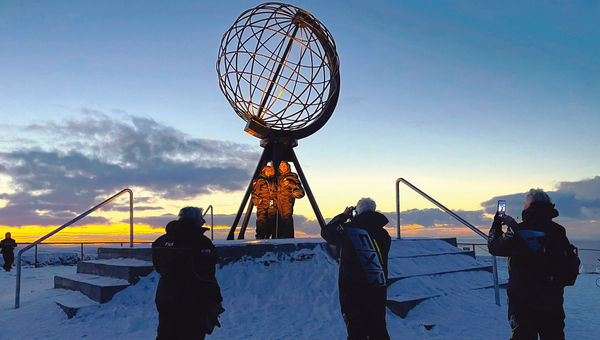
A snowmobile excursion went to North Cape, the terminus of the northernmost road in Europe, marked by a globe monument. Photo Credit: Arnie Weissmann
An elusive wonder
But even above the Arctic Circle, seeing the northern lights can be tricky. They may be there, but clouds or light pollution obscure them. Viewers aboard a ship, far from city lights, have an advantage.
I joined for only the seven-day version, boarding in Tromso, Norway. Guests who had been aboard the Trollfjord from the beginning of its northbound journey told me they had not yet seen the northern lights, but on my very first night, at around 11 o'clock, the announcement came that aurora borealis were being seen from the bridge.
I had been on the upper deck earlier in the evening, and it was very cold and windy. I layered up and joined a group standing against a wall that provided some protection from the wind.
But I wasn't sure I was facing the right direction. Everyone was taking photos of what seemed to be high, motionless, misty white clouds. "Is that them?" I asked the man next to me. He nodded.
I took out my phone, wishing I had invested in touchscreen-friendly gloves that I could have left on. I took a picture, and, to my surprise, my phone could see what I could not: Streaks of greenish-white light and a dusty red cloud near the horizon.
The whitish clouds didn't move perceptibly, but if I looked away for a minute, they were very different when I looked back.
I asked around, and no one was able to see anything other than the hazy, white clouds that I was seeing. But I found that other people's cameras were also recording colors and shapes that our eyes couldn't discern. The phone brand made a difference; these particular borealis were iPhone-friendly but didn't show up nearly as well on Samsungs.
Later, the captain told me the auroras are most intense in November, December and January, which includes the period when the sun never rises. By the time my cruise began during the second week of February, it was already light for six hours a day.
That had its own advantages. I was glad to begin shore excursions or walks around ports in daylight. On a snowmobiling excursion to North Cape, the goal was to reach the terminus of the northernmost road in Europe. It was dusk as we started out toward a globe monument marking the end of that road; we returned in the dark, which gave the countryside an entirely different mood.
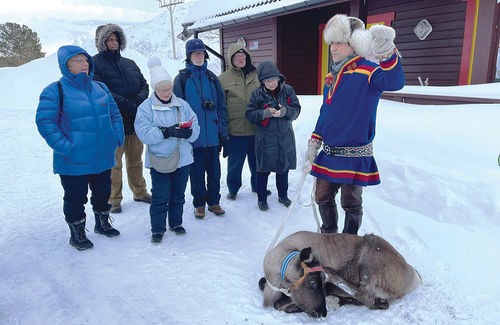
A Sami man, with his family's pet reindeer, explained the importance of the animals in Sami culture. Photo Credit: Arnie Weissmann
An opportunity to meet with a Sami family was offered from the port of Lodingen. The husband, son and the family's reindeer greeted us (the reindeer was tame; they had rescued it when it was orphaned). The husband explained the importance of reindeer in Sami culture and how the animal impacts so much of their life and worldview. Inside, his wife told the history of the Sami people and the attempts to dilute their culture through "Norwegianization."
The narrative was not sugar-coated.
After, we were offered reindeer hearts served with bread made from pine bark. A thin broth that contained reindeer meat and its blood was also distributed in cups. However that may sound, it was delicious; I went back for seconds of everything.
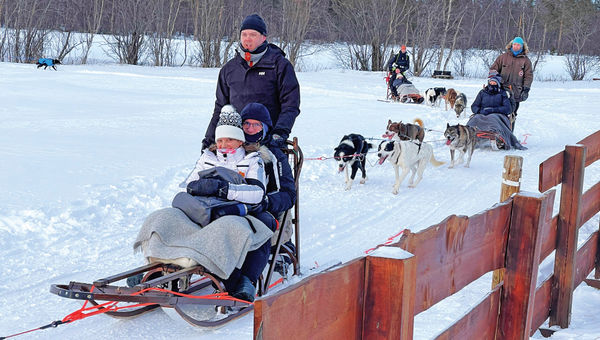
From the port of Alta, guests were offered a chance to ride in dog sleds and learn about the sport of dog-sled racing. Photo Credit: Arnie Weissmann
Luxury of a different sort
Back on the ship, Anders Lindstrom, Hurtigruten's head of global public relations, told me that the company does not promote this tour as a luxury experience.
I could see why he wanted to emphasize that. The ship was built in 2002 and refurbished for the 2023 season, and both its age and its updates are apparent. Among the indicators of the year of its birth, there are 15 suites but only five balconies. The auditorium, a pocket gym and small sauna (there is no spa) are not what you'd expect to find on most modern cruise ships.
The suite I was in was very comfortable; it would likely be called a junior suite on a modern ship. The standard cabins range from 96 to 161 square feet, and suites are 334 to 398 square feet.
Most of the public spaces feel quite modern and comfortable, particularly the 1893 Bar, a multilevel observatory. And for me the jewel in the crown was Rost, the fine dining restaurant, serving breakfast, a three-course lunch, afternoon tea and five-course dinners (lunch and dinner offer wine pairings). It is free for suite guests and available to others with a surcharge.
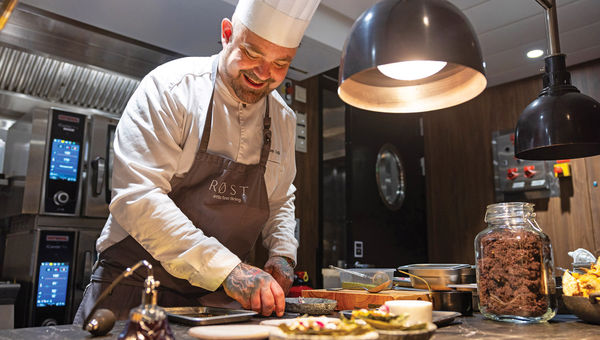
Chef Douglas Spiik in the kitchen of Rost onboard the Trollfjord. Photo Credit: Espen Mills/Hurtigruten
The menu, overseen by chef Douglas Spiik, is beyond what you'd expect even on a five-star cruise. Spiik, who had owned a restaurant in Goteborg, Sweden, has coached 10 national teams in cooking competitions. A practitioner of molecular gastronomy and other innovative techniques, Spiik works with food he finds in ports to create small works of art for each course, creating textures one wouldn't think possible for certain ingredients. Service was friendly and flawless.
Every meal was a treat, but on the final day, I wasn't feeling well and didn't go down to Rost. The restaurant's manager called my cabin to ask how I was doing. I must have sounded pretty good, because the next thing I knew, Spiik was at the door with fried cod tongue with dill mayonnaise; fennel four ways (pureed, fried, foamed and crudite); baked cod with truffled seaweed, sago, mussels and scallions; blueberry syrup brioche with blue cheese clumps; and porcini mushroom ice cream with coffee crumbles.
The sky may have remained dark that night, but my eyes lit up and my appetite returned.