Cruise lines are knocking harder on China’s door, knowing that if they can tempt even a sliver of its massive population into embracing vacations at sea, the rewards promise to be substantial.
A handful of lines are already committed to tapping into China as a source market. Their plans are still being developed, but as China’s middle- and upper-income classes continue to grow within the country’s population of 1.34 billion, the chances of eventual success seem good.
Star Cruises, Costa Cruises and Royal Caribbean International, all pioneers in the China source market, have been making considerable investments in deployment, regional marketing and onboard embellishments designed to attract Chinese nationals who have the money and the inclination to travel.
The number of millionaire households in China is estimated at 1.1 million, up from around 400,000 just five years ago. But it is the burgeoning middle class that these mass-market and premium cruise lines believe will fill their ships.
Experts disagree about the size of China’s middle class, but with estimates ranging from 70 million to 300 million, the potential for consumer sales is huge enough to go around. And around.
 The experts also disagree about what income level defines China’s middle class and whether those consumers have the discretionary income to spend on cruising, which remains a little-known vacation option among the masses.
“In the big cities along China’s eastern and southeastern coast, there are large numbers of very seriously rich people,” said China expert Clayton Dube, a professor at the University of Southern California and associate director of its prestigious U.S.-China Institute, which serves as, among other things, a social science research center.
“These wealthy Chinese are the ones who are going on safari in Africa or cruising to Antarctica or gambling in the casinos of Macau,” he said. “But the middle-class income is about equivalent to $10,000, depending on how you calculate it, and that’s not a lot when you consider how expensive it is to live in China.”
Even so, the emerging middle class is beginning to look outward and is keen to travel, said Dube, who lived in China in the early 1980s, travels there frequently and specializes in the country’s economic issues.
“The Chinese love to go to places like Japan, South Korea, Thailand, Vietnam and Taiwan,” he said. “Australia and New Zealand also are low-hanging fruit for that market, but the really affluent want to travel farther away.”
The pioneers
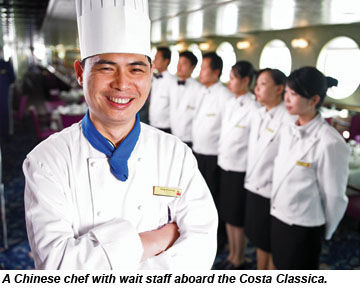
In 2006, Costa Cruises became the first Western line to commit a ship to the market and promote its sailings to a Chinese constituency, homeporting the 1,700-passenger Costa Classica in Shanghai. It will replace that vessel with the 2,400-passenger Costa Victoria next May.
The Costa Classica will operate a series of Asia cruises from Hong Kong and Singapore this winter before repositioning to the Mediterranean for summer 2012.
“Cruising, as a new product in China, has a market penetration that is still very low when compared to the other markets we operate in,” said Gianni Onorato, president of Costa Crociere, the parent company of Costa Cruises. “It’s not so easy to predict how big the Chinese cruise market will be in 10 or 20 years, because things are changing very fast in China.”
But at the moment, Onorato noted, growth in China’s outbound market is impressive.
“In the past decade, Chinese outbound tourism grew at about five times the international average, with an annual growth rate of 17% vs. the international average of around 3%,” he said.
Star Cruises was the first line to target the China-sourced market. Owned by Genting Hong Kong and headquartered in Hong Kong, the line was founded in 1993 and operates four ships in Asia.
In the past 18 years, its ships have made more than 1,100 calls to various ports in China, said spokesman Benson Chao, bringing close to 1 million passengers to ports in mainland China.
While most of its customers are Chinese, the line also sources from across Southeast Asia and, to a lesser degree, from Australia, the U.K. and the U.S.
“Star Cruises’ expansion in China will go up a notch in November, when our SuperStar Aquarius is deployed to Sanya, China, for five months, [offering cruises to] Halong Bay, Hue and Danang in Vietnam,” Chao said.
The lion’s share of passengers are expected to hail from mainland China, Taiwan, Russia, Japan, Hong Kong and Southeast Asian countries.
Michael Goh, senior vice president of sales for Star Cruises, predicted: “These passengers will be families, couples and honeymooners, as cruising is becoming an appealing travel option for all age groups.”
Goh said Star has also booked “quite a few” meetings groups since announcing its Sanya deployment.
The SuperStar Aquarius carries 1,500 passengers.
Royal Caribbean International’s China program focuses on Asian destinations. The line, which entered the market in 2008 with the 2,000-passenger Rhapsody of the Seas, will boost its capacity in China by 173% in 2012.
Its 3,100-passenger Voyager of the Seas is being deployed to mainland China, joining the 1,800-passenger Legend of the Seas, which has been operating there since 2010.
The total number of passengers these cruise lines expect to carry in coming years is less than miniscule when compared with the population along China’s eastern and southeastern coast, a treasure trove of potential cruise customers.
For example, 16 million people live in Shanghai, another 12 million in Beijing.
Other cruise lines operating in Asia and strategizing moves into the China market include Princess Cruises, Crystal Cruises and Holland America Line.
HAL, which deploys two ships on regional Asia cruises, recently appointed a general sales agent dedicated to mainland China. It already had a dedicated partner in Hong Kong and Taiwan.
This winter the Zaandam and the Volendam, each accommodating 1,432 passengers, will operate a series of sailings between Sydney, Singapore and Hong Kong.
HAL doesn’t yet market directly to China nationals.
“These are still maturing markets for us, so we have not dedicated resources to reach out to the consumer directly,” said line spokesman Jerrol Golden. “We rely on our GSAs to maintain and grow the travel agent distribution system.”
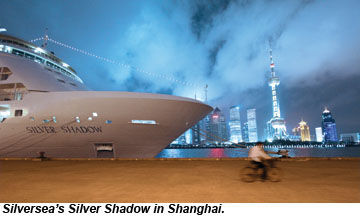
At the luxury level, Silversea Cruises is finding success with China’s wealthiest consumers, but as USC’s Dube observed, those passengers don’t want to cruise to and from their own cities.
Silversea spokesman Brad Ball said that Chinese passengers who book the line typically choose sailings that take them away from Asia altogether.
“We believe the Chinese market has huge potential,” he said. “But affluent Chinese consumers are more interested in booking cruises to our other destinations, such as the Med, Europe, Alaska, the Arctic and Antarctica, than the ones that visit China. The mainland Chinese market is our largest market after Japan in Asia. These Chinese guests are a younger demographic, 35 to 55, and they favor expedition-style cruises in the luxury sector.”
Royal Caribbean’s expansion
Between the Voyager and the Legend, Royal Caribbean International will operate 49 sailings from the country in 2012 and will add Xiamen as its fourth homeport after Shanghai, Tianjin and Hong Kong.
The Voyager of the Seas’ inaugural Asia season will start on May 26 in Singapore, followed by sailings from Shanghai and Tianjin.
The line also is moving forward with an agreement to charter the Legend of the Seas to China World Cruises for four months next year, starting in March.
China World Cruises is a unit of Shan-Hai-Shu, a property and theme park developer, according to Royal Caribbean International.
In partnership with the Xiamen municipal government, Beijing-based China World Cruises plans to invest about $5 billion in the Xiamen waterfront area and harbor district to develop a “Cruise Homeport City.”
Xiamen, located between Shanghai and Hong Kong, will serve as the homeport for 21 of the Legend’s chartered sailings, giving the line valuable exposure in what is expected to someday be a major cruise port.
“It’s kind of a triangular relationship between the city of Xiamen, China World Cruises and Royal Caribbean,” said Adam Goldstein, president and CEO of Royal Caribbean International. “We agreed to work together in certain respects to grow the China cruise business. Each party believes it will benefit from that.”
Goldstein said that China World Cruises’ charter commitment was “predicated on the fact the ship would be in Xiamen.”
The Legend of the Seas will operate between Xiamen and Shanghai, taking on passengers in both cities, Goldstein said.
“For those getting on in Xiamen, Shanghai will be a port of call, and for those getting on in Shanghai, Xiamen will be a port of call,” Goldstein said. “China World Cruises wants Xiamen to play a significant role in cruise development. It’s a wealthy city.”
Goldstein said it was too early to say whether Royal Caribbean International will become involved in developing the infrastructure of that or any other Chinese port.
“We’ve been involved in port development elsewhere in the world, sometimes as a direct investor or port manager or as a consultant/adviser,” he said. “Those are all possibilities that could pertain to China. We’re talking to a lot of people, and we’ll see how things unfold. It’s a dynamic situation.”
Star Cruises’ Goh said he was not concerned about growing competition in a region that his cruise line had virtually to itself for well over a decade.
“China’s vast travel and cruise markets can accommodate a number of cruise line operators,” he said. “More competition will create more business opportunities and expand the China consumer market.”
 Aside from several river cruise operators, Western lines are not yet having to compete in any meaningful way with indigenous cruise companies for a share of the China source market.
While China has developed a big shipbuilding industry — capturing 7% of the global market, according to AmericanEconomicAlert.org, a unit of the nonprofit U.S. Business and Industry Council — there appears to be a dearth of blue water cruise ships constructed for or operated by China businesses or governmental entities.
There have been some recent ship acquisitions, however. Capital Dragon Global, an investment firm in Hong Kong, bought the 500-passenger Oriental Dragon and plans to operate it from Shanghai.
Originally named the Sun Viking, the ship entered service with Royal Caribbean International in 1972 and has changed hands a few times over the years.
Hainan Cruise Enterprises, a Hong Kong-based ship management company, purchased the Delphin Voyager and renamed it the Hainan Empress. The ship had been under charter to German cruise operator Delphin Kreuzfahrten, which has faced financial difficulties for at least the past year. It isn’t clear where the 600-passenger ship will be deployed. Hainan province is a string of islands off China’s south coast.
Marketing to China
Costa’s Onorato noted that there are cultural differences between Chinese and Western guests, most notably in onboard entertainment and cuisine choices.
In 2006, he said, Costa invested about $14 million on “restyling” its first ship deployed in China, the Costa Allegra, so that it would “meet the needs and expectations of our Chinese guests.”
Royal Caribbean, when it announced its expanded deployment to China, said it would create on both of its ships a wider variety of products tailored specifically to Chinese passengers, “including more Chinese-language services, authentic Chinese food and culturally appropriate recreational activities.”
Goldstein announced early this month that Royal Caribbean’s DreamWorks Experience would be extended to the Voyager of the Seas before its China deployment begins.
“Throughout Asia and especially in China, DreamWorks movies are very popular. ‘Kung Fu Panda’ was enormously popular,” he said.
But overall, Goldstein said his cruise line would not make big changes on ships bound for China assignments.
“We will make our entertainment more visual, and less linguistic, so there’s no language barrier associated with it,” he said. “And we will continue to plan itineraries of interest and introduce [Chinese passengers] to as many new country experiences as possible.”
Each line operating in Asia used different marketing approaches. For example, Onorato said that preferred sales agents are Costa’s main distribution channel.
“These are travel agencies authorized to sell our cruises in China,” he said. “But [we also market] to build brand awareness. These channels include advertisements in local newspapers and magazines, TV commercials, in-store point-of-purchase displays and product placements.”
Costa also developed a website dedicated to Chinese customers and has a presence on China’s social media networks.