MIAMI BEACH -- Expedition lines have been leaders in sustainability efforts within the cruise industry, but in a competitive market, that doesn't mean they're ready to pass along related premiums to their customers.
Still, expedition cruise line executives say that sustainability is good business, or simply the right thing to do. And investing in it helps preserve the vulnerable ecosystems they've built their journeys around, can pay off financially down the line and may win over consumers.
"I don't think the market will sustain a significant premium for such a product," said Ashton Palmer, president of Expedition Trips. "If you look at a company like Ponant, their ownership has a lot of resources to the point where it's not so much driven by economics as it is by wanting to have a product that is the leading example of zero emissions."
The primary reason cruise lines and advisors say premiums for sustainability aren't coming any time soon is because they don't think customers will pay them.
Both Ponant and Hurtigruten executives compared the situation to the emission-offset option airlines offer, arguing that it's a rarity for even those with the means to opt to pay the extra fee.
"The consumer says they want sustainability, but yet they're not quite there," said Ponant CEO Samuel Chamberlain on a panel at the Seatrade Cruise Global conference in Miami Beach earlier this month.
Hurtigruten COO Gerry Larsson-Fedde, who was also on the panel, agreed.
"Right now, I think we obviously have to be competitive in our marketplace, and if we [instituted premiums], unfortunately, I think we would lose out," he said in a subsequent interview. "I don't think the customers are ready to pay a premium on top of the competitive pricing that's in the landscape right now."
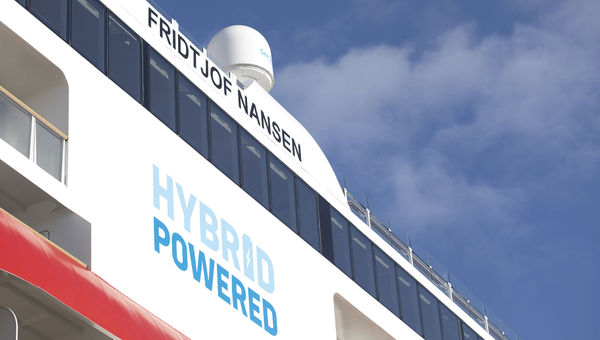
Hurtigruten's fleet has hybrid-powered ships, including the Fridtjof Nansen, to further the company's sustainability goals. Photo Credit: Hurtigruten
Advisors agreed. Palmer said the expedition market is quite competitive due to oversaturation, adding that the sector expanded greatly in the 2010s when many companies built ships and that demand hasn't caught up after the pandemic slowdown.
Claire Maguire, an expedition specialist with Cruise Planners, said she sees more price-conscious decision making from her customers.
"What's included [in the trip] is more important than the sustainability factor, from my experience," she said. "People are price driven."
Sustainability as good business
So why are the cruise lines putting money into building more energy-efficient ships and adapting those they already have? One reason is that they see it as an investment in business longevity.
"We've been operating on this course for 130 years," said Larsson-Fedde of Hurtigruten's Norway sailings. "It's a very sensitive area of the world, and we want to operate for another 130 years."
It is also easier to sustainably operate a smaller ship than one that carries thousands of passengers and moves between continents, he said.
Brands like Hurtigruten also see the financial investment in sustainable technology as one that eventually pays a return.
"If you invest $100 million and you reduce your emissions 25%, you also reduce your fuel consumption," said Larsson-Fedde. "Fuel is expensive, so it has an upside."
Ponant is developing a ship capable of transoceanic sailings that would be powered by wind, sun and "low-carbon, non-fossil energy," emitting no greenhouse gases. Hurtigruten is similarly working on a zero-emission ship. Both companies have set 2030 as their target for completion.
For travelers considering expedition cruises, the destination is almost always the primary determinant of who they might cruise with rather than the line's level of sustainability, advisors said. But sustainability practices can play a role, too.
For example, a traveler wanting to go to Antarctica who might have avoided cruising previously due to sustainability concerns would be happy to see that a cruise line composts to lower food waste, has eliminated single use plastics and uses shore-to-ship power.
"You're looking at some people doing [this] once in a lifetime, and they want to get it right," said Gari Senderoff, a polar travel specialist with Cruise Planners. "They also don't want a guilty conscience."
As green as some expedition cruise lines are, none operate zero emission vessels yet.
The new French expedition line Selar, however, will debut a primarily wind- and solar-powered polar expedition ship next year, with co-founder Sophie Galvagnon saying the industry needs to evolve faster than what customers are demanding of it.

Sophie Galvagnon
Selar's 36-passenger ship will only resort to biofuel when weather requires it and will travel slowly and free of set itineraries, with each trip crafted in real time.
But even if Selar guests prioritize sustainability, like other expedition lines, they are more willing to pay a premium for the experience than being sustainable.
"We don't want to charge the customer for sustainability because we estimate that it's our responsibility," Galvagnon said. "This means that we accept to lower our margin to make this sustainable effort, but at the same time we offer something unique in experience and we get that pricing power there."