 Chances are that Aarhus, the second-largest city in Denmark, is a place many travel agents' most well-traveled clients haven't even heard of. Not for long.
For one thing, local tourism officials are working with cruise lines to boost the city's presence as a more frequent port of call on Baltic cruises, according to Vibeke Jorgensen of VisitAarhus.
For another, the university town of about 300,000 has transformed itself in the last 20 years into a cultural and beach destination.
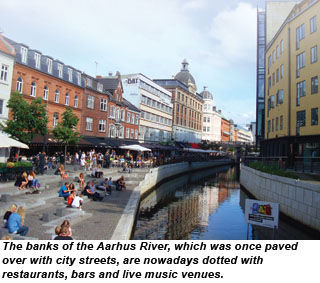
Part of the problem in the past was that the river that runs through the town, which is situated on the eastern coast of the Jutland region of Denmark, was covered over with streets in the 1930s, not only depriving the city of the beauty of the waterway but also cutting it off from the harbor.
In the 1990s, town officials came to their senses and uncovered the river, Jorgensen said, and nowadays there are walkways along the banks dotted with restaurants, bars and venues for live music.
Living Aarhus' history
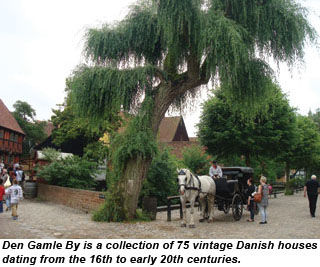
Those interested in tracing Aarhus' history can walk from the city center to Den Gamle By, a living museum comprising a collection of 75 houses dating from the 1500s to the early 20th century. In addition to the houses, which were brought to the museum over time, the grounds feature shops and landscaped gardens.
History in this part of Denmark goes much further back than 1500, however, and one of the most fascinating attractions in Aarhus pays homage to that past.
 The Moesgard Museum is home to the Grauballe Man, also known as "the bog man," who was discovered in a 1952 in a bog in nearby Nebalfard Fen. The 2,000-year-old remains are so well preserved, thanks to the properties of the bog mud, that experts have determined that he was murdered, and his expression and the gash in his throat tell the same story to the scores of people who come to see his remains.
From the museum, visitors can walk through fields to the sea, passing ancient burial mounds that date from the Iron, Bronze and Stone ages. The water at the beach is relatively warm in summer, and the beach itself is lifeguard-protected.
In Aarhus city center, art buffs can do damage to their wallets in the narrow streets of the Latin Quarter. So named for its many art galleries and funky cafes and restaurants, this part of Aarhus offers one-of-a-kind boutiques as well as franchise shops.
Doing modern Danish
Not all of Aarhus' cultural attractions are routed in the distant past, however, and fans of Danish Modern design can explore the Town Hall, designed by Arne Jacobsen. The inside of the building is known for its arresting circular staircase and Popsicle-stick walls, while the tower offers a set of huge bells and panoramic views of the city.
Fans of contemporary art can take in the ARoS Aarhus Kunstmuseum, with its cube-like exterior that unfolds on the inside in a vertical spiral. Said to have been inspired by Dante's Inferno, the museum offers nine rooms on the ground floor with temporary, ultramodern exhibits in pitch-dark rooms.
A highlight of the museum's permanent exhibition is "Boy" by Ron Mueck, a huge sculpture of a crouching child made of fiberglass. His enormous glass eyes seem to follow you around the room.
Overnight accommodations include the Hotel Royal, a four-star property in the city center, near the cathedral and the Latin Quarter. The 69-room property, which was built in the mid 19th century, has recently been renovated and offers Old World-style furnishings and marble bathrooms.
An AarhusCard, available for 24 or 48 hours and priced from about $20, offers free and discounted admission to local attractions and restaurants, travel on local buses and a free guided climb to the top of the Town Hall tower in July and August.
Go to www.visitdenmark.com.