Many families dream of traveling to destinations lost to time, mystical locales like Brigadoon that materialize only for those willing to suspend disbelief. For many families seeking the unknown, that enchanted realm is the Faroe Islands, an extraordinary archipelago of 18 isles in the North Atlantic that evokes a storybook escape of grass-roofed houses and grazing sheep with flocks of puffins and oystercatchers soaring above spectacular waterfalls that plunge into sapphire lagoons.
On the other hand, paradise for some intrepid adolescents might be the breathtaking vistas realized at the 1,500-foot summit of a snowshoe hike on the Greenland ice sheet, followed by a glacier cruise on Ice Force One into the second-largest fjord in the world.
Then again, maybe teenage adrenaline is best released at the wheel of an ATV speeding 50 mph over a black-sand beach and into the lava fields of southern Iceland. An adolescent thrill that could only be topped by the ingestion of fermented shark — a local Icelandic delicacy, which Anthony Bourdain described as the most disgusting thing he'd ever eaten — and then, for the adults, chased with a shot of fermented potato schnapps known as Black Death.
In other words, when families travel into the west Nordic region with the North Atlantic Tourism Association, adventure is a given, especially for budding aviators who live for flights that skirt some of Europe's highest sea cliffs. From the air, the Faroe Islands resemble Brobdingnagian bones or shimmering shards of submerged emeralds bobbing in the ocean midway between Iceland and Norway.
Formed by volcanic eruptions more than 50 million years ago, the Faroes retain a rugged, rocky terrain with craggy cliffs. They are some of the world's most remote locales. The population hovers around 50,000 people — alongside 70,000 sheep (that sustainably mow the grass in the verdant valleys).
Of late, Faroese national airline Atlantic Airways has been supplemented by private planes, many of which are flying in for a meal at Koks, the Faroe Islands' first Michelin-starred restaurant. Opened in 2011 by head chef Poul Andrias Ziska, the forage-based restaurant has generated global accolades for its ingenious indigenous cuisine.
Recently relocated to an 18th-century farmhouse alongside a pristine lake on the island of Streymoy, the remarkable dining experience commences inside a modified hjallur, a Faroese drying house for fermenting meat and fish — albeit one that has been retrofitted for comfort and culinary pleasure. Ziska has assembled a stellar global kitchen of young creative chefs who forage the hills and valleys and sea and then render the bounty into a somewhat miraculous, 18-course tasting menu that might include horse mussel, sea urchin, seaweed, langoustine and lichen.
While many people imagine the much-photographed puffin to be the national bird of the Faroes, it's actually the oystercatcher, and one of the best ways to witness them in flight is along the vertiginous Vestmanna bird cliffs. Families clamor aboard boat tours that maneuver through mighty swells and narrow straits on their way to the grottoes where thousands of seabirds swoop and dive from caves and cliffs. Even the most jaded adolescent succumbs to the dazzling terpsichorean display.
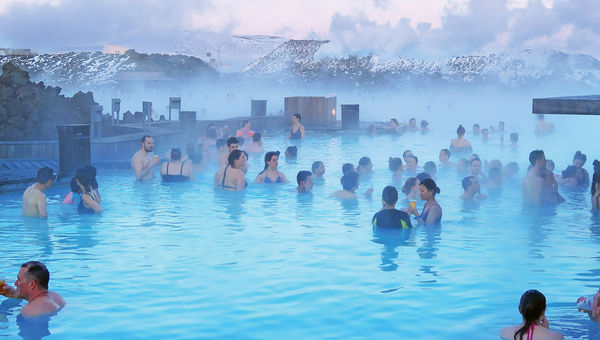
The Blue Lagoon is a geothermal spa that is a popular Icelandic attraction for families with young children.
Iceland: 'Land of Fire and Ice'
Equally daring are the pilots of Atlantic Airways who adroitly navigate the 90-minute flight from the Faroes to Iceland's Keflavik Airport, which was originally built by the U.S. military during World War II. An independent republic since 1944, Iceland ranks No. 1 on the Global Peace Index as the most peaceful country in the world while also claiming the top spot for gender equality.
Notable for a landscape so otherworldly that NASA astronauts trained on its lava fields before the first lunar expedition, Iceland is known as the "Land of Fire and Ice" for its active volcanoes and mammoth glaciers. Situated just below the Arctic Circle astride the Eurasian and North American tectonic plates, Iceland is technically on two continents, and at the Unesco World Heritage site Thingvellir, kids from around the world leap from Europe into North America.
Nearly 5,000 square miles of Iceland are blanketed by glaciers, one of which is Europe's largest. For families who wish to journey to the center of the earth, Into the Glacier offers a four-hour adventure deep into Langjokull, Iceland's second-largest glacier with an area of approximately 400 square miles. Modified military vehicles traverse the glacier to its center before parents and children descend from base camp into ice tunnels that lead into the glacier's blue heart.
Similarly, a journey into the lava tube known as Raufarholshellir is an extraordinary opportunity for children to witness the interior of a volcanic eruption that occurred more than 5,000 years ago. Following the lava path, visitors hike into the recesses of the cave, where spectacular ice sculptures form in winter.
While Iceland remains most recognizable to teens for its supporting role in films with Lara Croft, Batman, James Bond and the cast of "Game of Thrones," one of its most popular attractions for families with children as young as 2 remains the geothermal spa known as the Blue Lagoon.
Given that Iceland is one of the planet's most volcanically volatile areas, the country reaps the benefits of geothermal energy, and the Blue Lagoon, situated in a lava field, has become a phenomenal success complete with multiple restaurants and a luxury hotel. At the Blue Lagoon, families slather each other in silica mud masks — maybe the one time that deep-cleansing is also silly family fun.
When flying Air Greenland, the flight from Iceland to Greenland takes approximately three hours, weather permitting. From September through April, the sky above the world's largest island (80% of which is covered by an ice sheet) is illuminated by the aurora borealis. At that point, "Be a Pioneer" becomes more than merely Greenland's tagline: It's a lifelong mantra for families who live the west Nordic adventure.
See www.northatlantic-islands.com.