Six picture-perfect gabled warehouses and the 15th-century Holsten Gate are the first things most visitors see on entering the historical center of Lubeck, Germany.
The warehouses and gate are now iconic images for Lubeck, but those warehouses, former storage depots for salt, have a history that stinks to high heaven.
Some of the salt, brought from mines in nearby Luneburg, Germany, was sent on to Scandinavian fishing grounds and returned, for another session in storage, as salted herring — tons of it.
Even Lubecker noses accustomed to medieval sanitation standards weren't having that, which is why the warehouses were outside Lubeck's innermost defensive wall. (Not to worry — three additional concentric walls secured the warehouses and their valuable contents.)
I visited Lubeck and its salt supplier, Luneburg, on train journeys from Hamburg. But for drivers or cyclists, the two cities are the endpoints on a themed itinerary called the Old Salt Road suggested by the German National Tourist Office.
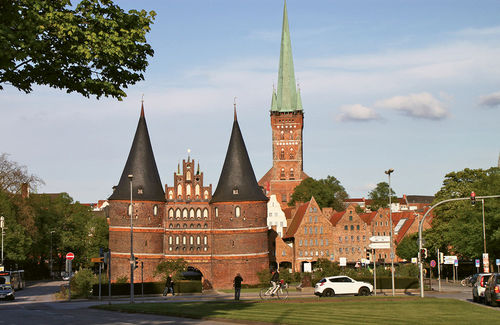
The 15th-century Holsten Gate with St. Peter’s Church in the background in Lubeck. Photo Credit: Nadine Godwin
Both cities were members of the Hanseatic League, a union of merchant guilds and market towns that dominated northern European trade in the 13th to 15th centuries and lasted until the 19th century. Lubeck was the group's capital.
Both cities became very wealthy and built exactly the kinds of churches, town halls, houses, city gates and even warehouses that 21st-century tourists chase with glee.
Museums provide the context. The latest of these is Lubeck's Hansemuseum, a 2015 newbuild in the Old Town. To illuminate the league's story, it combines classic museum exhibits with innovative storytelling techniques.
Entry tickets have computer chips that visitors customize by language. Placing a smart ticket on coded touchpoints for each exhibit produces narrative, on screens or via headphones, in the selected language.
Immersive displays include a re-created Hanseatic Hall where visitors can listen to a description of a 1518 Hanseatic League meeting presented in the style of a newscast.
The real Hanseatic Hall is nearby, inside Lubeck's town hall. Visitors can join guided tours of the still-active city building, but, on a perfect, sunny spring day in Lubeck, I nixed additional indoor sightseeing in favor of an elevator ride to the viewing platform at St. Peter's Church.
It delivered a dreamy overview of the Unesco-protected, mostly medieval cityscape.
About a quarter of the Old Town was destroyed in World War II, but important historical buildings, like the damaged town hall, were faithfully reconstructed.
Besides man-made fortifications, Lubeck always had water; the original town sits on an island in the Trave River, ideal for sightseeing cruises. I joined one for an hour's ride circumnavigating the island and another take on the Lubeck look.
I slowed my pace for dinner at Schiffergesellschaft, in a crow-stepped gable house, home to the Seafarers' Guild since the 1530s and site of this eatery since 1866. Decor includes model boats made by guild members.
Schiffergesellschaft serves the local red wine, Lubecker Rotspon, a Hanseatic-era creation. Medieval traders returned from southern ports with young Bordeaux, which was blended and aged in Lubeck. As late as 1900, 40 Lubeck firms made Rotspon; only two do so now.
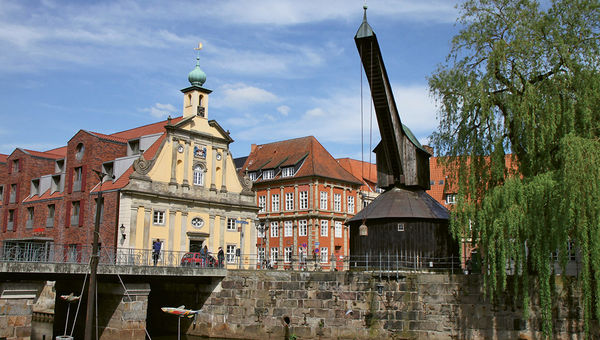
Luneburg’s 14th-century wooden crane was in use until the 19th century. Photo Credit: Nadine Godwin
Luneburg and 'white gold'
Unlike Lubeck, the smaller Luneburg escaped war damage; hundreds of buildings are monument protected. But, like Lubeck, Luneburg offers an elevated, 360-degree perspective, this time from an early-20th-century water tower.
The walk from Luneburg's train station leads straight to the port on the Ilmenau River where millions of tons of salt, dubbed "white gold," began the journey to Lubeck and beyond.
Protected buildings dot the waterside quarter, but the centerpiece is a 14th-century wooden crane used until the 19th century to lift loads of up to around 5,000 pounds onto or off boats. Visitors can step inside to see the two huge wheels that were each worked by five men, who walked in one direction to raise a load and in the opposite to lower it.
In some places, centuries-old houses tilt picturesquely; their foundations were undermined by the saltworks, which operated for 1,000-plus years, until 1980, by extracting brine from under the town. Aggressive 19th-century mining damaged the since-stabilized houses.
The salt plant is a 10-minute walk from the town center and now houses the German Salt Museum — plus a grocery store. Luneburg had walls and a moat, but the saltworks had its own walls, two sets. The single saltpan on display (out of an original six) produced 11 to 13.2 tons of salt daily.
Tourism is a better business now, and a few historical buildings near the port are hotels. But Luneburg still relies on its "white gold" for saltwater thermal baths.
Finally, Luneburg, a college town, is said to have the highest concentration of pubs in Germany. Traveling with a history buff has unexpected side benefits.