Booking Hurtigruten
Hurtigruten offers summer cruise vacations to Svalbard and Spitsbergen. The nine-day Spitsbergen Arctic Adventure includes two nights in Oslo, one in Longyearbyen and four days aboard the MS Nordstjernen. The 12-day Grand Arctic Expedition via MS Polar Star stretches the cruise to seven days. The 16-day Spitsbergen Ultimate Voyage (Nordstjernen) adds Hurtigruten's classic route along Norway's fjords from Bergen to North Cape.
Ice limits winter voyages in Svalbard but Hurtigruten offers coastal and inland voyages in Norway proper. Off-season voyages include themed trips such as killer whale or king crab safaris and "hunts" for the Northern Lights. Call (866) 257-6071 or see www.hurtigruten.us. -- S.K.
Very few have ever heard of the Norwegian archipelago of Svalbard or could guess where it is. But those travelers who investigate further and succeed in journeying there are rewarded with some of the most spectacular scenery, and splendid isolation, on Earth.
This territory above the Arctic Circle in the Barents Sea, midway between mainland Norway and the North Pole, is home to the world's northernmost communities. There are only 2,200 inhabitants on its three populated islands: Spitsbergen, Bear Island and Hopen. The natural environment, with 2,229 miles of coast, is one of the most pristine on the planet, the air among the purest.
Trees and other woody plants don't grow much above an inch in Svalbard; that's how tough the winters are. But short trees and tiny, ground-hugging flowering plants -- Arctic white bell heather, red mosses and orange lichens -- lend splashes of color to the stark Arctic minimalism.
Svalbard at sea
Several ships regularly navigate the fjords and coasts of Svalbard, such as the 100-passenger MS Nordstjernen, operated by Hurtigruten. Built in 1956, the ship was given a new life when modernized for passengers in the 1980s. Its versatile crew includes natural historians who play sea shanties on the accordion and are crack shots with powerful rifles.
The rifles are stowed in case of polar bear attack. Polar bears, never far from the mind of anyone in Svalbard, evolved from brown bears some 200,000 years ago into marine animals totally adapted to the rigors of Arctic life. Towns post rings of warning signs beyond which people dare not pass unarmed. For their protection, tourists on hikes and excursions are never allowed farther than 65 feet from a rifle-toting guide.
 Bear hunting was banned in 1972, and Svalbard's polar bears today number more than 3,000. The small island of Kongsoya has the highest density of polar bears in the world. But the bears of Svalbard are in danger. Warming trends are reducing the ice they require to hunt as well as the snow they need to dig proper dens. As the ice retreats, more hungry polar bears approach settlements.
Bear sightings are exciting, even from afar, but visitors can also see reindeer, seals, Arctic foxes and walruses. Whales, including belugas and the huge bowhead, sometimes follow Hurtigruten's ships. Speeding between blue icebergs by polar launch to get up-close views of towering glaciers, it's a thrilling surprise to suddenly see beluga whales surface nearby.
There are also 183 species of birds, from Arctic terns that dive-bomb hikers walking by nests to puffins, with their clownlike faces. Some 16 million birds summer annually in Svalbard.
Sled dogs in Svalbard's capital, Longyearbyen on Spitsbergen, get easily frustrated in summer months when they can't find any riders to pull. On a recent warm-weather visit, teams of eager huskies pulled riders on wide-wheeled buggies. In winter, the dogs take tourists out of town to watch the spectacular Aurora Borealis, or Northern Lights, that bring life to days of full darkness.
Underground insurance
Dog teams often pass by coal mines in the hills above Longyearbyen, skirting what is arguably the most important piece of real estate in the world. Three caverns are being blasted out of rock beneath the deep permafrost. Svalbard's permafrost is soil frozen solid hundreds of feet deep; the temperature inside each cavern is 24.8 degrees Fahrenheit year-round. Each cavern will hold 1.5 million seed varieties.
The Svalbard Global Seed Vault is a project of the Global Crop Diversity Trust and the Norwegian government to safeguard the world's crops against potential global catastrophes such as rapid global warming, new diseases or insect infestations.
Svalbard may have been discovered by the Vikings as early as the 12th century. A Dutchman, Willem Barents, definitely discovered the islands in 1596. In the 17th and 18th centuries, its islands were well-known to whalers. Coal became king in Svalbard in the early 20th century when a mining enterprise was established by American John Longyear, for whom Longyearbyen is named. There is a fine museum there detailing Svalbard's history and wildlife.
Coal mining remains a major industry. One of the more interesting parts of any trip to Svalbard with Hurtigruten is a shore landing at Barentsburg, a Russian coal operation, established in Soviet days, that's still home to about 500 people. The town seems straight out of the 1950s, complete with Lenin statue and Socialist Realist art.
One of the more haunting landings is at Ny-London, on a fjord on the island of Blomstrandhalvoya. Rusting machinery and artifacts add a surreal, end-of-times feel to the stark landscape of a marble mining operation and camp abandoned a century ago.
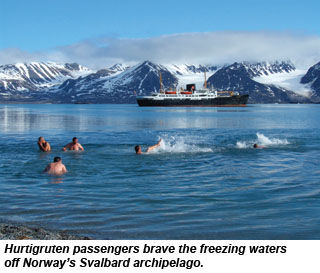
If it's sunny, passengers take a fast swim in 37-degree waters to earn ice swimming certificates, which are passed out when the MS Nordstjernen crosses north of the 80th parallel. Champagne is served to celebrate.
Visitors might wonder if there are problems with depression in Svalbard, given the isolation, harsh winters and, for a large part of the year, nights that never turn to day.
Actually, most locals live there by choice. Tourism workers, who often first came as tourists themselves, delight in helping newcomers experience the islands. Many are attracted to the quiet, solitude and purity.
Daughter Katie accompanied me on this Arctic sojourn, the perfect antidote to teenage maelstrom. No TV, just nature, a small but grand ship and exciting adventures on very different shores. She has maintained the friendships she struck up onboard.
Svalbard is changing -- faster, perhaps, than the rest of the world. This Arctic archipelago might always be unique but, in several decades' time, in a completely different way.