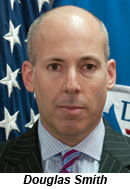
 Douglas Smith is assistant secretary of the Department of Homeland Security (DHS), Office of the Private Sector, and reports directly to DHS Secretary Janet Napolitano. He has worked closely with travel industry officials in rolling out programs like Global Entry, which allows approved and registered travelers to check themselves through airport immigration control at a kiosk, and TSA PreCheck, a domestic travel program administered by the Transportation Security Administration that features dedicated lines in airports so that registered travelers don't have to remove shoes or take out computers and liquids from their carry-ons. Travel Weekly Editor in Chief Arnie Weissmann interviewed Smith last week in Washington.
Q: I'm enrolled in both Global Entry and PreCheck, and they go a very long way toward taking the hassle out of travel. Is their deployment a result of developments in technology or changes in attitude?
A: Both. In the past, there was a "whatever" attitude. Lines are long? Whatever. Customs officers grumpy? Not our problem. But it is our problem.
It's not a choice between national security and economic security. We will not make that false choice. We will never compromise on security, but there are alternatives to putting up walls. We can be secure and allow the travel industry to work.
Q: How deeply involved is the travel industry in working with you on solutions?
A: Global Entry was a huge initiative. It started a couple of years ago, piloted out slowly. Then we decided we needed to light a fire under this. I called [Delta CEO] Richard Anderson and said we needed help. We wanted both to take it to a new level and test the system, to make sure it could absorb an increase in volume. The Delta marketing team was unleashed, and we saw a 400% increase in enrollment.
We saw we could absorb more, so we went to American Express. Again a big boost. Then to United, Sabre Holdings, Orbitz, Loews, Marriott. Marriott sent it to their [loyalty] program, put it in Bill Marriott's blog, and we saw a through-the-roof increase.
Q: And the system is keeping up with it?
A: Global Entry is important because it's efficient. We've been able to save frontline immigration officers 50,000 hours so far. But we've reached a catch-22. As another part of President Obama's travel and tourism initiative, we've reduced the wait time for visas in other countries like China and Brazil from months to days, so we're also seeing increases in the volume of arrivals.
The travel industry is doing a phenomenal job of getting people to come here, and the numbers keep improving, but we're working with systems that have limitations.
Q: How are you addressing that?
A: As regards Global Entry, the lines won't get long at the kiosks. We monitor how many people use them, how long each person took to use them. If we reach a saturation point, we'll drop a new kiosk.
In our dream world we'd see dramatic increases in usage. It's all related: Every person we can get out of the line, the quicker we can get the tourist from China through. They'll still have to see an officer, but the officer will have fewer people in the line.
I'm on the phone with managers of airports every day, with CEOs of carriers, regarding the PreCheck program. We're able to segment who travels, and that enables us to better use resources. PreCheck will be in up to 30 airports by end of the year, and it actually increases security and allows us to use our resources better.
Q: I typically don't see many people in the PreCheck line. Has it broken even in terms of the extra cost of maintaining it?
A: We didn't hire new people for it, but it did require enhanced training: There are unique things in that line. But it's really taking off. We've broken the 2 million mark.
Q: But it's unpredictable for travelers. When I traveled on Sept. 11, a high number of us who were "Pre" cleared were redirected to the normal security lines.
A: Unpredictability is built into the system. And this is a partnership between us and the carriers.
Each carrier has a different technology solution, and we've been sensitive to their needs when we sync up the system. They have their own requirements, and in case of a tie, the tie goes to the more thorough alternative. The airlines can't afford to have something bad happen.
Q: Are you working with other countries to have them accept Global Entry, as well?
A: Currently, if you have Global Entry and apply to similar programs in Canada and the Netherlands, you can use it there.
We'll have Global Entry in Germany, and that's due to [former Lufthansa CEO Wolfgang Mayrhuber]. We had stalled out, but he really wanted it, and pushed the German government -- it was the last thing he did before leaving his post.
The private industry part of this is really important. We're in the security business, and we can't get more people traveling without our partnership with private industry.
Q: Do you use Global Entry when you travel?
A: I always use Global Entry. The biggest problem with it, as far as I can see, is that you get through so quickly that you still have to wait 15 minutes for your luggage to come down the carousel.
Email Arnie Weissmann at [email protected] and follow him on Twitter.