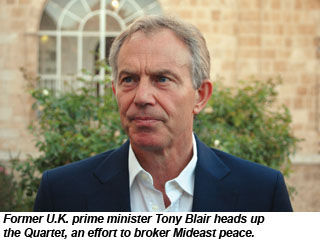
At the invitation of the Quartet and its leader, former U.K. Prime Minister Tony Blair, Travel Weekly Editor in Chief Arnie Weissmann traveled to Palestine and met with Blair at the Quartet's offices in the storied American Colony Hotel in Jerusalem. The day before they spoke, Israeli forces had boarded the Turkish flotilla headed for Gaza, with tragic consequences. The following day, Blair would address a Palestinian investment conference in Bethlehem on the topic of tourism. As dusk turned to dark on a large terrace outside the Quartet offices, Weissmann asked Blair about the convergence of politics and tourism, and what role tourism could play in the peace process and building Palestine's economy.
 Q: Are you concerned that all your efforts in tourism can be undone with one dramatic headline?
Blair:We are gradually getting to the point where one bad headline doesn't stop everything we do. We've had these ghastly tragic events with the boats that were headed for Gaza in the last couple of days. We have, tomorrow, the Palestinian Investment Conference, which is really showcasing the investments that can be made in Palestine. Maybe a few years back, the one would have derailed the other, but we're having the Palestinian Investment Conference. It will be done. It will be a successful conference. We'll be announcing new investments in the course of it.
The politics are very challenging and very difficult, and we hope we can resolve them. And of course, if they are resolved, everything becomes easier. But one of the things that helps resolve the politics is if we get the economy moving. We have trebled the number of visitors to Palestine in the last few years. Hotel occupancy is up significantly from where it was. But there's a lot more that could be done. We still get a fraction of the visitors who come to Jordan or Egypt, when there's at least as much here to see.
Q:Why dedicate so much of the Quartet's resources to tourism as an economic engine rather than other industries?
TB: We've put a lot of effort into a lot of industries, but the tourism potential of the Holy Land is obviously enormous. You've got some of the greatest sites in the world, so anybody who's a Christian, who's a Jew, actually anybody who's interested in history -- to come to the Holy Land, to see not just Jerusalem, but Jericho and the Jordan Valley, Bethlehem, Galilee, it's amazing. You couldn't get a better set of tourism locations than here.
Q: What do you think is the biggest obstacle to developing tourism? How do you plan to overcome it?
TB: Look, we've got to be honest about this. The biggest obstacle to developing tourism is the perception of the political situation. The reality is, people worry about security. But you can go anywhere in the West Bank as a tourist, and it presents no problem at all. The perception, however, is if you see things on the television news every night and those things look very bad, then you kind of think, "I'm going to a conflict zone." Well, you're not.
But that's the problem, and how we seek to overcome it is partly by word of mouth, But the whole purpose of this big launch we're doing in tourism is to get something more emphatic, more planned, more visionary in place so that we can really exploit what is this enormous potential [in] Israel and Palestine for a joint tourism operation.
The other thing people don't understand is that this is a very small bit of land. You stand on Mount Nebo on the Jordan side [and] you can see over the Palestinian side and into Israel. To get from Jerusalem to Jericho is an hour, hour and a quarter, maybe.
Q: Tell me Tony Blair's ideal tourist itinerary for Palestine.
TB: I think you do Israel and Palestine together, actually. And for me, definitely going around Capernaum, and Galilee, and then down to see Jerusalem, see the old city, go into Bethlehem, you come down to Jericho, you go to Herod's Palace, you go up to Sebastia, Nabulus, around there. Every single part of it.
The Jordan Valley, go along the Jordan River, down by the Dead Sea, up to the Mount of Temptation outside of Jericho. And then it's very easy to go, for example, just into the Jordan side and you do Mount Nebo, where Moses looked over the Promised Land.
So it's the simplest and easiest and also the most exciting thing in the world, particularly if you have someone who's interested in religion, someone from a religious background. But they're interesting in any event. And much of what you have seen in Sebastia, for example, it's extraordinary if you think about it: A church with the remains of John the Baptist, and then you've got Saladin having created the mosque there, and then you've got the Roman amphitheater and ruins. It's pretty hard to beat that. And you have one little kiosk at the moment. The tourist potential is enormous.
Q: But, as you say, there's not a lot of infrastructure around it right now.
TB: You can develop the infrastructure really quite quickly. And a lot of it is there, it just needs to be renovated or extended. But the Palestinian economy is now growing quite strongly; it's growing over 8% on the West Bank. There's a lot of building going on on the Palestinian side, and Israel obviously is a very successful, modern country. The politics of the whole thing overshadow everything, but actually, strangely enough, the politics, which are very difficult and very challenging, don't stop the West Bank and Israel from being great tourist attractions. The tourist potential is so totally underexploited.
Q: Should stability return to Gaza, is there any tourism potential there?
TB: Yes, there is tourist potential in Gaza, actually. Gaza, of course, is very ancient. There are a lot of historical sites there, and ruins and so on. Obviously, the politics there now are very difficult, but if the politics become like that of the West Bank, which is the largest territory of Palestine by a long way and where the majority of population live, if Gaza politics were to return to normal, then, yeah, without a doubt there would be tourism potential there.
Q: What will it take to have peace in the Middle East and create an appropriate environment to see tourism in Palestine truly prosper?
TB: To get peace in the Middle East, we need a joint shared vision, first of all. And actually, we have that. There is a joint shared vision, and the joint shared vision is two states: a state of Israel that is secure, and a state of Palestine that is viable as a piece of territory.
The second thing we need is a political process that is real and credible, where people negotiate the differences. What are the borders of the Palestinian state? Issues like Jerusalem, refugees, security for the Israelis, water. That can be done. We've got to turn these proximity talks into direct negotiation.
And the third thing we need, which is what we work on, is we need to build the state from the bottom up. Which means the Palestinian state is not just about territory, it's about how it's governed, it's about the rule of law. On the Palestinian side, there have been enormous steps forward in the last couple of years.
And it's about the economy. That's where tourism comes in. Tourism is potentially the single biggest dimension to the Palestinian economy, and if you have Israelis and Palestinians working together on tourism, if you get the tourism potential starting to be developed, that then supports, bottom up, the political process coming from the top down.
And that's the way to make peace. It may be hard to do, but it's not difficult to describe what needs to be done.
Q: You said that in some ways, this is easier than Northern Ireland. Could you elaborate?
TB: It's easier, because the first of those aspects that I mentioned, which is the shared joint vision, isn't present in Northern Ireland, not even today. One side says United Kingdom, the other side says united Ireland. Here, you do have a joint shared vision, which is two states. So that's why, in one sense, it should be an easier challenge.
Now we know all the reasons why it's not easy. It's very difficult. But you can describe very easily what it is we want to see. Getting there is the hard bit.
This report appeared in the June 21 issue of Travel Weekly. To see a video excerpt from the interview with Tony Blair, click here.