
Robert Silk
Arriving on a sunny afternoon last month at the Streamsong
Resort golf complex, about 30 miles south of Lakeland, I wouldn't have believed
what I was seeing if I hadn't prepared myself.
Seemingly out of nowhere, massive, jagged sand dunes towered
above the surrounding undeveloped Central Florida countryside. Beneath them,
the fairways of Streamsong's two courses meandered up and down rolling hills. Unusual as those sights are in the mostly flat Sunshine
State, it was what I saw on those fairways that looked most out of place for a
Florida golf resort. Golfers, lots of them, walked the courses, their bags
shouldered either by caddies or by themselves. If I hadn't known better, I
might have thought I was on the Oregon coast, or in golf's homeland, Scotland.
With its more than 1,000 courses and its year-round sun, the
Sunshine State is a worldwide golfing destination. In fact, Florida has more
golf courses than any other U.S. state, according to the National Golf
Foundation. And spurred by the international notoriety that comes from hosting
more PGA Tour events than anywhere else, the state has world famous golf
resorts such as TPC Sawgrass in Ponte Vedra Beach, Trump National Doral in
Miami and PGA National in Palm Beach Gardens.
But despite achieving such widespread success, Florida golf
has its share of naysayers, and not just among those who are averse to the
sport. Many avid golfers also dismiss Sunshine State golf, where the large
majority of courses are carved through flat terrain and then fortified with
man-made lakes. Purists also often decry Florida's resort golf culture, which
has turned askance at the game's tradition as a walking endeavor and has
instead aggressively promoted the use of golf carts as a luxury amenity.
Indeed, most resort and upscale courses throughout the state heavily restrict
walking or bar it outright.
Standing apart from that landscape is Streamsong, the
36-hole golf complex and full-service resort that opened to great acclaim in
late 2012. This year the Streamsong Red and Blue courses were ranked first and
third, respectively, on Golf Digest's prestigious ranking of Florida public
courses. Only the Stadium Course at TPC Sawgrass, home to one of golf's biggest
tournaments as well as the famous island-green 17th hole, prevented
Streamsong from achieving total dominance in the Golf Digest ranking.
Streamsong's towering dunes aren't exactly natural. But
neither were they sculpted by a golf architect. Rather, they are the result of
phosphate mining undertaken by Streamsong owner Mosaic. The company worked
the site from the 1960s to the 1990s, leaving behind dunes that rise 90 feet
high. When the machines left, native grasses came back. Meanwhile, the mining
trenches gathered water, and over time, became lakes.
Within such a landscape, it was a no-brainer that any golf
course built would be designed in the tradition of classic dunesland golfing
locales, such as the seaside links courses of Scotland and Ireland and the
acclaimed Bandon Dunes complex in coastal Oregon.
“To not have done what we have done would have been really
disappointing,” Tom Sunnarborg, Mosaic's vice president of land development and
management, said in a recent interview.
But in other respects, Mosaic could have chosen to mimic the
typical Florida golf experience at Streamsong. Instead, the company took the
opposite tact. It hired traditionalist golf course architects Tom Doak, Ben
Crenshaw and Bill Coore, who are known for altering as little of the landscape
as possible. The courses they built don't have cart paths, ornamental
landscaping or even ball washers. In the tradition of the world's oldest
courses, neither the Red nor Blue course returns to the clubhouse after nine
holes. Meanwhile, Streamsong runs a robust caddie program and promotes “walking
golf” on its website. In fact, the use of golf carts is banned on both courses
between Jan. 1 and April 15.
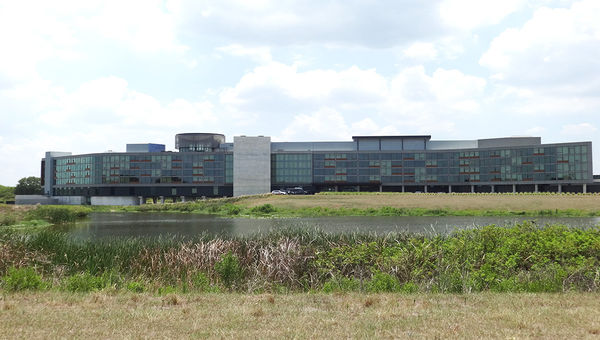
Streamsong Lodge Photo Credit: Robert Silk
Sunnarborg says that Streamsong's remote, inland location,
an hour from Tampa and 90 minutes from Orlando, dictated the strategy.
“We needed to differentiate ourselves from every golf course
in Florida,” he said.
By all appearances, the approach is working. Golfers already
travel to Streamsong from throughout the U.S. and around the world. This
winter, the two courses combined for an average of more than 300 rounds per
day, according to Sunnarborg. Meanwhile, in January the resort began construction
of a third course; a fourth course is also in the early planning stages.
Spurred by the 216-room Streamsong Lodge, which opened last
year, the resort has also begun to draw a crowd that is more diverse than
merely golfers. The lodge has nearly 25,000 square feet of meetings space. Its
grotto-themed AcquaPietra Spa has nine treatment rooms. And the three
restaurants at the lodge include SottoTerra, offering upscale Italian cuisine,
and Fragmentary Blue, a rooftop lounge with
vast views of the adjacent Little Payne Creek and the surrounding landscape.
So, now that Streamsong has proven that a Florida golf
resort can excel by offering a more traditional, and even rugged, experience
than what is typically available in the state, will that lesson have a broader
impact on Florida's destination golf culture.
Sunnarborg, for one, is dubious.
“I hope so,” he said. “But I think what we have done at
Streamsong is a result of specific decisions we made because of our site
location.”
Still, here's to hoping that other Florida resorts will see
that by offering caddies, or even just by giving players the option of walking
the course, they can appeal to the segment of the golf market that has largely
turned its back on golf in the Sunshine State.