Four years after its launch, Margaritaville at Sea is preparing to welcome its third ship. The Beachcomber, scheduled to debut next year, will be the largest ship in the fleet and Margaritaville's first to homeport in Miami. Cruise editor Teri West sat down with Margaritaville at Sea CEO Christopher Ivy in Miami last month to discuss the brand's positioning and evolution.
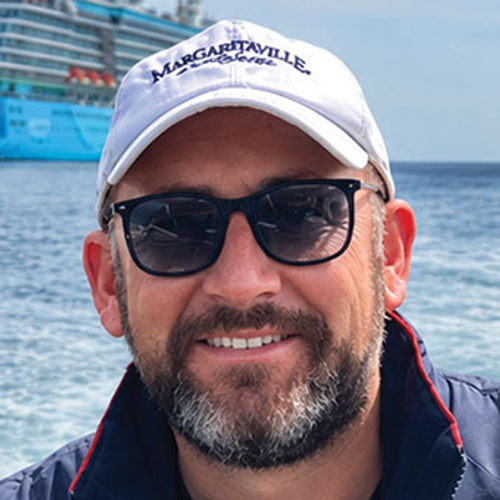
Christopher Ivy
Q: In the contemporary cruise space, we're seeing brands elevating the experience through upcharged experiences. Where does that position your brand? Do you see Margaritaville following that trend?
A: I think the ethos of the Margaritaville brand is very inclusive. Think about going to your favorite outdoor concert. Yes, there's seats that are closer, but the best party's on the lawn, right? We introduced two new suites on Beachcomber, yes, which are super fun, and they're unique, and they're a little more expensive, but they're not unattainable. We want to be a good value. We want to be approachable.
Q: You've never sailed outside the Caribbean. What's the long-term strategy for itineraries?
A: Never say never. We've gone from one destination to 25 so there's still more out there, and there's much further and deeper in the Caribbean. We're looking at some really great, fun stuff that cruises more to the south over time. I think one of the things that's great about the brand is even if you don't know the music of Jimmy Buffett that underpinned it, that created it, the feeling is very evocative. I was with a British partner of ours who had never sailed with us before. He's like, "Chris, I've been on the ship for three days. I have a very important thing to tell you: You need to bring this to Britain." So I think that could be an option for us in the future. It's not a now thing, but I think it could be an in-the-future thing.
Q: Private cruise islands are increasingly popular and prevalent in the Caribbean. How do you envision continuing to compete there without one?
A: We want people to really experience part of the Caribbean: Go to a local restaurant, get a little lost in Grand Cayman. I live in Orlando. There's a lot of waterslides, all those things there; it's not one of the great gems in the Caribbean, though. I think that's where there's opportunity for our brand.
Q: How do you ensure that once your guests are on land they're getting the experience you want to deliver?
A: It's the right ports and the right partners and the right communication onboard. It depends a little bit on the mindset of the guest. I think a lot of people, they want enough of a curation and guide to make it feel like they got what they wanted out of the destination, but not so much that it's like, "You must go to stop one, spend 12 minutes there, stop two, stop three, stop four." So I think it's a balance to find the right partners who can help us do that.
Q: Do you think you're there?
A: When we go into a new port for us, we have the starting-point offering, which we think is broad enough to be able to hit the demands of the guest. And then that typically evolves, depending on the location. There's some port representatives who've said, "We see a lot of folks who want to get out in nature on this one," or "they want more curation on gastronomy." So there's what we start with, and there's what we evolve to. And generally where we end up six to 12 months after our first call, there's a lot of the core that's still there, but there's generally a couple elements that have expanded.
___________________________________
This interview was edited for length and clarity.