Travelers often seek to maximize their time and visit several cities, regions or countries during a single trip. With expanded airline networks, travel advisors are able to plan trips that start and end in different locations that can include major cities, as well as off-the-beaten path destinations and unique experiences along the way. Rather than flying roundtrip to the same destination, these open-jaw itineraries allow clients to arrive in one city and return home from another, often connecting the journey in between by plane, car, train, or cruise.
At Royal Expression Travels, open-jaw itineraries are not an exception, they are how the company designs travel, according to LaDell Carter, Founder and Lead Luxury Lifestyle Travel Designer for the Baltimore-based agency. “Affluent travelers are no longer satisfied with seeing one destination,” says Carter. “They want to experience an entire region without wasting valuable vacation time retracing their steps.”
Carter offers an example: “Rather than flying into and out of Milan, we'll have clients arrive into Milan and depart from Florence after experiencing Milan, Lake Como, St. Moritz, and Tuscany. The destination unfolds naturally instead of asking clients to reverse course.”
Travelers are focused on experiences, says Sandra Kaspar, Director, Leisure Sales for United Airlines. “Consumers increasingly want to experience multiple destinations and cultures on a single trip,” she says. “More destinations mean a better return on their investment and good use of their time.”
Eliminate Backtracking
Kaspar adds that “these itineraries eliminate duplicate hotel nights and help travelers make the most of every vacation day by creating more opportunities for meaningful sightseeing and unique destination experiences.”
Open-jaw travel is a specialty of Gunjan Prakash, Travel Advisor for FLT Global – Travel by Gunjan, Affiliated with Coastline Travel Advisors in New York, N.Y. She personally has been traveling this way for years and regularly recommends this style of travel to her clients. She also shares similar itinerary advice with the more than 135,000 members of her Families Who Love To Travel Facebook community.
She says avoiding backtracking is one of an open-jaw itinerary’s biggest advantages. “I generally do not recommend returning to the original city simply to stay one night near the airport and fly home the following morning,” she says. “Even when an airport hotel is convenient, it still means packing again, traveling back, checking in for one night, and leaving early the next day. Whenever possible, I prefer my clients to stay at least three nights in each hotel. That gives them time to settle in, enjoy the destination, and relax rather than constantly packing and unpacking.”
Prakash adds that “open-jaw travel also works very well with cruises that begin and end in different ports.” She continues: “It can eliminate an unnecessary hotel night and prevent clients from spending a full vacation day returning to an airport they have already visited.”
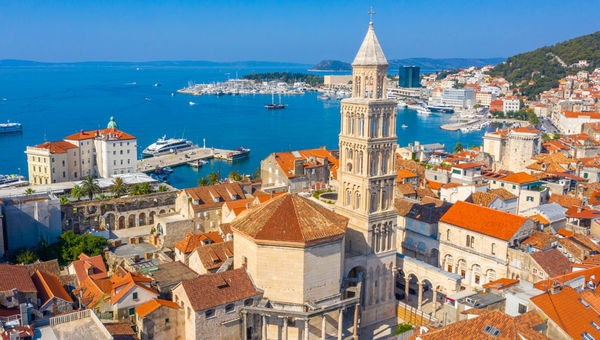
Split, Croatia
Advisor Expertise
Open-jaw itineraries can showcase travel advisors’ knowledge. “Anyone can reserve a flight and a hotel,” says Carter. “Designing a journey that incorporates United's long-haul network, regional carriers, luxury rail, private drivers, yachts, helicopters, and carefully-timed connections is where a travel advisor becomes a travel designer. Our team often says we aren't simply booking travel, we are directing the journey. Creativity is our greatest differentiator.”
Her example includes multiple flights. “One itinerary begins with United's nonstop service from Washington Dulles to Lisbon, continues north to a newly-opened luxury retreat outside Porto, then utilizes United's codeshare partner TAP Air Portugal nonstop to Marrakech, followed by a nonstop [flight] on SWISS, another United partner, into Zurich for a luxury wellness experience before returning nonstop on United to Washington. The long-haul flights remain efficient while the destinations in between become the story.”
Logistics are an important part of every open-jaw itinerary. “We evaluate every transition: distance, recovery time after long haul flights, seasonality, ground transportation, flight schedules,” says Carter. “And perhaps most importantly, how much movement feels enjoyable before it becomes exhausting. Our goal is always the shortest, most seamless route possible because once an itinerary begins to feel like work, we've missed the point.”
For Tahryn Nicastro, Owner and Travel Advisor, Shore to Sea Vacations in Howell, N.J., the biggest advantage of open-jaw travel is pairing experiences that complement each other while making the most of the time clients have. “I love designing trips that tell a story,” she says. “An open-jaw itinerary isn’t about squeezing in as many destinations as possible. I think every stop should add something different to the overall journey, whether that’s a change in scenery, culture, food or pacing. I’m looking at geography, transportation ease, flight schedules, travel times, and seasonality but I’m also thinking about how the trip feels. I typically don’t add a destination just because it’s nearby. I want each one to add to the client’s overall experience.”
Creating a good open-jaw itinerary involves much more than choosing two airports, stresses Prakash. “An advisor needs to understand the client’s travel style, [plus] flight schedules, train routes, driving times, ferry connections, hotel locations, seasonal conditions, and how much movement is realistic for that particular family or couple,” she says.
Translating the Client Experience
Carter states that her clients rarely actually request open-jaw itineraries. “Clients tell us how they want to feel and what they hope to experience,” she says. “It is our responsibility to recognize when an open-jaw itinerary will create a far better journey than a traditional roundtrip ticket.”
Although open-jaw travel is very popular with Prakash’s clients, she says that many do not know the term when they first contact her. “They usually begin by searching for a roundtrip flight because that is what they are accustomed to booking,” she says. “Once I start working with them and map out the itinerary—flying into one city and home from another—they quickly understand why it can make much more sense. It is especially useful in Europe, where a trip may include several cities, smaller towns, the countryside, mountains, or the coast.”
Nicastro stresses that one of the biggest benefits of an open-jaw itinerary is that clients keep moving forward instead of spending valuable vacation time returning to where they started. “Rather than losing a day retracing steps, they’re continuing their journey,” she says. “That often means fitting in another destination or simply having more time to enjoy the places they’re most excited to visit. I think that’s where a travel advisor’s expertise really comes into play. Most clients don’t know these routings are even possible. They tell me what they want to experience and my role is connecting those experiences into an itinerary that flows naturally without feeling overwhelming.”
Michelle Osborn, CTA, ACC, Owner of Outta Here Travels in Pampa, Texas doesn’t normally use the term open-jaw with her clients. “I just explain that they will be flying into one city and flying home from another because it makes the most sense for their itinerary,” she says. “I would recommend an open-jaw itinerary if a client is going on a European river cruise, such as one that begins in Basel and ends in Amsterdam; an Alaska cruise that begins near Anchorage and ends in Vancouver; or a tour through Italy that might begin in Rome and end in Venice. This avoids unnecessary backtracking and gives clients more time to enjoy the destinations along the route.”
Higher Revenues for Advisors
Open-jaw trips can create higher revenue itineraries, says Carter. “Instead of one destination, clients often experience three or four,” she says. “That naturally creates opportunities for luxury rail journeys, wellness retreats, private guides, yacht charters, culinary experiences and boutique hotels that may not fit into a traditional roundtrip itinerary.”
Kaspar agrees: “From a revenue standpoint, open-jaw itineraries often produce longer vacations, additional destinations, more hotels, tours and premium air opportunities.”
The destination will dictate how Prakash combines air, rail, cruise and ground transportation to create an itinerary. “I use high-speed trains when the connection is convenient and takes clients directly from one city center to another,” she says. “Madrid to Barcelona and Paris to London are good examples. I recommend rental cars for routes where the journey itself is part of the experience, such as driving from Dublin to Shannon, exploring Tuscany or Provence, or traveling through the Dolomites. For clients who do not want to drive, I may arrange private transfers instead. Ferries and boats are important in destinations such as Greece, Croatia, and coastal Italy. A short flight may be better when the distance is too great for a comfortable train or car journey.”
Off-the-Beaten-Path Travel
Prakash often recommends smaller places that provide a break from major cities depending on the clients’ interests when planning open-jaw itineraries. “These places often provide a more personal experience through family-owned hotels, local restaurants, outdoor activities, and a slower pace,” she says. “They can become the part of the trip clients remember most.”
She continues: “[Open-jaw travel] makes it easier to combine different types of experiences. I often recommend starting with a busy city and ending somewhere more relaxing, such as the beach, countryside, a lake, or the mountains. That contrast can make the trip much more memorable and prevent every stop from feeling too similar.”