AUCKLAND, New Zealand -- Air New Zealand CEO Christopher
Luxon said there's a simple reason why the carrier chooses to put a sharp focus
on innovation.
"If it is good for the customer, it will be good for us
commercially," he said in an interview at the annual Tourism New Zealand
Trenz conference here. "That's very much our mindset. We are just fixated
on improving all aspects of the customer journey."
Air New Zealand, which in February unveiled its latest
innovation -- a chatbot on its website that uses artificial intelligence to
answer and learn from customer queries -- has long been known for its
development of unique products and technologies.
In 2010, for example, the company released the economy
Skycouch, which Luxon calls the only economy lie-flat seat in the sky.
Skycouch flyers can transform their row of three economy
seats into the couch by extending flaps that tuck underneath the seats. The row
then becomes a couch long enough to enable children to sleep on it as well as
adults who curl their knees.
In the past two years alone, Air New Zealand has rolled out
a series of innovations that have won awards and in some cases blazed a trail
that other airlines are likely to follow.
Notable among them is the Airband, unveiled in November
2015. It's a wristband with an embedded chip that is worn by children traveling
alone. Luxon said the Airband was inspired by Disney's MagicBand.
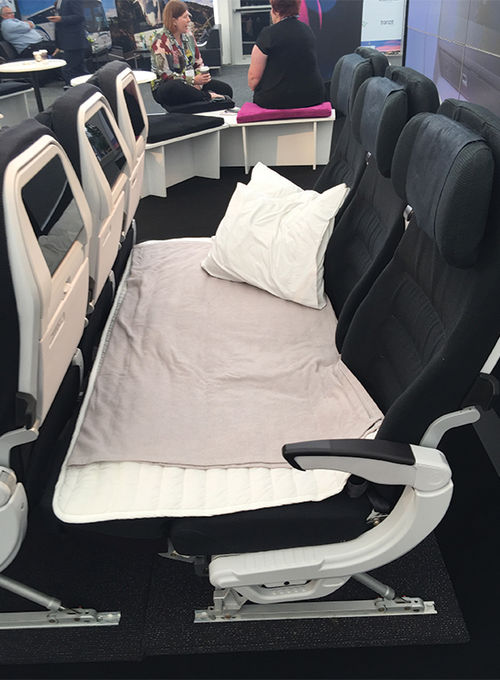
The Skycouch enables passengers to turn their three economy seats into a couch long enough for children to sleep on it.
At key stages during the course of the child's travels, the
chip is scanned, and parents are sent texts notifying them that their son or
daughter is still on track. The CAPA Centre for Aviation selected the Airband
as its innovation of the year for the Asia-Pacific region at its 2016 awards
ceremony.
Also in late 2015, Air New Zealand introduced self-service,
biometric bag drops at the Auckland airport. At the bag drop kiosks, passengers
scan their boarding pass and passport as their photo is taken by a biometric
camera. If the photo matches up with the documents, passengers are cleared to
place their bags on a conveyor belt for check-in. No ticket agent is necessary.
Other recent innovations put forward by the carrier include
business-class drink trays made with 3-D printing and a coffee service feature
on the Air New Zealand app.
The use of 3-D printing enables the airline to replace
broken trays faster and cheaper than it could using traditional manufacturing
methods. Users of the coffee feature store the type they like on their app.
Then when they enter an Air New Zealand lounge, the app automatically asks if
they'd like that type of coffee. When the answer is yes, the order is placed
with a barista. The app has thus far played a role in serving 2 million cups of
coffee, according to Air New Zealand.
Luxon said that in making decisions related to innovations,
Air New Zealand keeps a sharp focus on customers' needs. The Airband reduces a
parent's anxiety, for example. Biometric bag drops speed up the check-in
process. The Skycouch eases family travel.
"If you are going from London to New Zealand, that is a
24-hour flying experience, and so you have to understand a mother traveling
with young children," Luxon said.
Despite the success of more recent Air New Zealand
innovations, Luxon said the Skycouch remains his favorite.
As for the future, he said, Air New Zealand has many more
innovations planned, though he declined to say what they might be.
However, Roger Gray, the company's general manager of airports,
did offer a clue during a panel discussion at Trenz.
"We expect to see bots taking over a whole lot of
repetitive tasks that are currently filled by staff and driving efficiencies
for us," he said.