On the evening of Jan. 22, reports by airline pilots of a
drone in their approach path led the FAA to briefly stop arrivals into Newark
Liberty Airport.
The halt was the first such action due to drone operations at
a major U.S. airport. But experts say more are likely in the months and years
to come, especially since not enough preventive mechanisms are in place.
"It's a common problem we run into with any technology,"
said Ryan Wallace, an Embry-Riddle assistant professor of aeronautical science
who specializes in unmanned aircraft systems. "Response, legislation,
procedures, they all lag innovation. So we're behind the eight ball."
The FAA reauthorization act, signed into law by President
Trump last fall, gave the Department of Homeland Security and FBI the joint
authority to monitor and track drones without getting consent from the drone
operator. The DHS and the bureau were also granted the authority to disable,
take control of or disrupt a drone's operations without prior consent. Still,
airports are mostly in a holding pattern when it comes to managing drone
intrusions. Last July, the FAA sent a letter to airports suggesting that it
could withhold grant funding if they move forward independently with efforts to
implement drone detection and countermeasure systems.
"The use of such systems could place the safety and
efficiency of the [National Aviation System] at risk, which would not be
consistent with the airport sponsor's federal grant obligations," the FAA
letter stated.
In the letter, FAA director of airport safety and standards
John Dermody asserted that the deployment by airports of drone detection and
countermeasure systems could interfere with the performance-based navigation
equipment used by pilots and air traffic controllers.
But while airports have their hands tied, their concerns
about drone incursions into airspace are real.
Last May, a report by the U.S. Government Accountability
Office revealed that the FAA collected 6,117 reports of sightings of
potentially unsafe drone use between February 2014 and April 2018. More
specific to aviation safety, during a 13-day study around Daytona Beach Airport
last May, Wallace and his co-researchers detected 192 drone incursions into the
airport's airspace.
Wallace said the number would likely be higher at
large-market airports, which often have more people living near them.
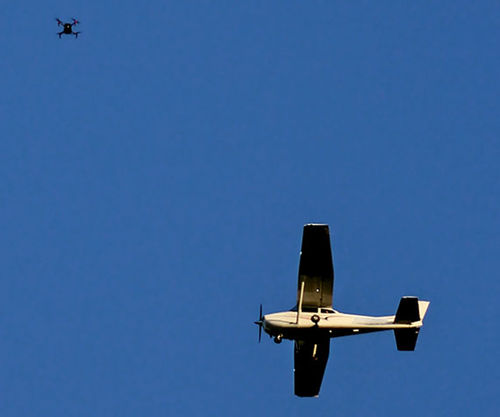
Photo Credit: A drone flies in close proximity to a Cessna over Oklahoma as part of a research project.
As recent events demonstrate, such incursions can quickly
cause chaos. The Newark stoppage was short enough that it only caused arrival
delays of approximately one hour. But between Dec. 19 and Dec. 21, drone
incursions into the airspace over London Gatwick led to repeated closures of
the airport and the disruption of travel for an estimated 140,000 people.
Chris Oswald, the senior vice president of safety and
regulatory affairs for the trade group Airports Council International-North
America (ACI-NA), said, "Taking away from the Gatwick story, the big thing
in my mind is the level of economic disruption that can be caused by what seems
to be a combination of actual hazard and uncertainty of the nature of the
threat."
Of course, concerns about drones go beyond the economic.
From a safety perspective, the most prevalent worry is the possibility of
collisions, especially in cases when drone operators get reckless or engage in
thrill-seeking.
For example, in a widely reported incident last February, a
drone operator filmed a Frontier aircraft from just above the plane's flight
path as it made its way into Las Vegas McCarran.
Commercial aircraft are more than likely to make it through
a drone collision unharmed. But that won't always be the case, Wallace said,
especially if the metal parts of a drone are ingested by one or more of an
aircraft's engines.
And airports must also be on the lookout for nefarious drone
incursions.
In in a 2015 Embry-Riddle study, Wallace and co-author Jon
Loffi of Oklahoma State University listed the kinds of mayhem drone operators
could cause at airports and other locations. Among the possibilities: Drones
could be used by criminals or terrorist groups for reconnaissance missions;
they could be intentionally steered into aircraft; and they could be deployed
to deliver explosives, or even biological weapons.
A primary solution to defend against such attacks could
include the deployment of drone detection and countermeasure technology at
airports.
To that end, from February 2016 through December 2017, the
FAA and other federal agencies worked with airports in New York, Atlantic City,
Dallas and Denver to observe such technologies. But the study showed that
airports had more sources of radio interference than the agency had
anticipated, leading to the FAA's determination the such technologies could
pose air traffic communication dangers.
For now, the agency is instead endorsing a regulatory regime
under which drones manufactured in the U.S. would be required to be equipped
with an identification and tracking system. The DOT began a formal rule-making
process last May to develop those regulations.
Oswald said such a requirement would have two important
effects. First, though flying a drone in restricted airspace around airports is
already illegal unless the operator has a waiver, the tracing systems would
serve as a deterrent to irresponsible drone operators who would know their
drone could be identified. Second, if a malicious operator chose to operate a
drone without an identification system, that drone would be readily suspicious
to law enforcement.
He added that the FAA continues to research drone detection
and countermeasure technologies, though such work has been put on hold during
the ongoing partial government shutdown.
In the meantime, Oswald said, the ACI-NA supports the FAA's
edict against the deployment by airports of detection and countermeasure
systems.
But Luke Fox, founder of the drone-detection system WhiteFox
Defense, said there are safe steps that airports could be allowed to take now
to reduce the drone threat. Countermeasures, such as remotely disabling or
taking control of a craft, do require the deployment of either a radio signal
or something more obtuse, such as a projectile, he said.
But drone detection can be accomplished using passive
technology. The WhiteFox system, Fox said, doesn't broadcast a radio signal.
Instead, it uses radio frequency analysis coupled with machine learning to
identify drone radio systems.
"It's safe," he said. "There is no study that
is required to demonstrate that."