Bonnie Lee, the CEO of the host agency Travel Quest,
often has advice for clients and friends who are headed for a flight out of
Delta’s Concourse G in her hometown airport of Minneapolis/St. Paul.
“I tell people, No. 1, get there real early,” she said.
“And the best thing about getting there real early is you can sit down and plan
to have a meal or a snack.”
That kind of counsel might not make a travel agent look
good at many airports around the country. After all, most people are in no
hurry to eat mediocre, overpriced food amid the generic architecture that has
long been the norm for airport concourses.
But travelers making their way through MSP won’t find the
usual assortment of chain grab-and-go pizza joints, fast-food Chinese
restaurants and undistinguished bars. Instead, their options include 14
restaurants, coffee shops, watering holes and markets, all tailored to the Twin
Cities locale.
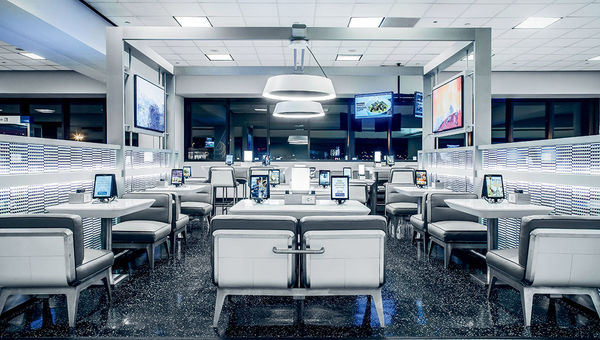
OTG's Gate Lounge at Newark Airport.
There’s Volante, for example, an Italian restaurant
overseen by chef Doug Flicker, creator of the innovative Piccolo restaurant in
Minneapolis.
There’s also the raw bar and French brasserie Mimosa,
created by St. Paul chef Russell Klein, a 2015 semifinalist for the James Beard
award. And for beverages, there’s Flybar, a sleek, 10-seat space serving craft
cocktails and local beers.
Rick Blatstein, the CEO and founder of OTG, which
oversees all the food and dining inside Minneapolis Concourse G, said, “We
don’t operate airport restaurants; we operate restaurants that happen to be in
the airport. Airports really need to represent a sense of place.”
Minneapolis is one of 10 airports in the U.S. and Canada
in which OTG has redone a portion of the food and dining experience. And it’s
not just the upgraded restaurants that stand out. There are also the modern,
eye-catching designs, conceived by the Rockwell Group architectural firm, a
creator of chic hotels, pop-up theaters and trendy nightclubs.
Perhaps even more transformative is OTG’s use of both
technology and space to increase revenue numbers while providing new options to
airport customers.
In its newer operations, including at Minneapolis,
Newark, New York’s LaGuardia and Toronto’s Pearson Airport, OTG has deployed
thousands of iPads, which serve as replacements for wait staff during the
ordering and payment portions of the meal. The use of the iPads enables the
company to spill restaurants into gate areas, where even harried travelers can
place orders without wondering if a flight is about to begin boarding.

Local Tavern in Philadelphia Airport.
Travelers waiting at those gates who don’t want to eat
are still free to sit in the iPad booths, where they can check flight
information, cruise the Web or play games at no charge.
At OTG’s biggest project to date, the ongoing $120
million revamp of United’s Terminal C at Newark, the plans call for the
deployment of 5,500 iPads. The project is currently 30% to 40% complete, United
spokeswoman Mary Clark said. Once finished, it will feature more than 55 food
and beverage outlets.
Its next transformation could come at Philadelphia
Airport, where Blatstein and OTG got their airport business start in the 1990s,
and where OTG now operates seven venues. The parties there are nearing a deal
on a redo of Terminal B that would include 15 dining concepts, said Jim
Tyrrell, the airport’s director of property management and business
development.
OTG has also put in a bid on an estimated $248 million
overhaul of the retail operations, including food and beverages, at Chicago
Midway.
Despite OTG’s use of iPads for some of the tasks that
waiters would typically undertake, Blatstein said that when the company enters
a terminal, staffing actually increases by 50% to 100%. What’s lost in the need
for workers per food order, he said, which is more than made up for by the
expansion of restaurant seating into the gate area as well the overall increase
in sales.

SkyAsianBistro, an OTG restaurant in Philadelphia Airport.
Indeed, said Liz Grzechowiak, the assistant director of
business development at Minneapolis, concession sales in Concourse G increased
from $18 million in 2012, the year OTG took over, to $28.5 million in 2015.
Still, she said that OTG’s upscale offerings aren’t
universally popular in the Twin Cities, where people tend to have down-home,
conservative tastes.
“It’s a kind of love-hate relationship,” she said.
Philadelphia’s Tyrrell, however, is downright bullish on
OTG and Blatstein.
“Every new concept he brings at the airport is better
than the last one,” Tyrrell said. “That’s not only in concept but in product
and customer service.”